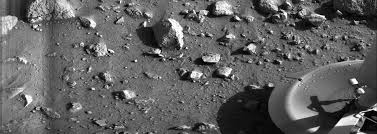
The first Viking image from the surface of Mars, its footpad at right.
*****
Although not much small and about the same weight as the great Mars rovers of the 21st Century, Curiosity and Perseverance, Viking in comparison looks stone-age primitive. Which makes it all the more a wonder what it did fifty years ago.
*
It’s July 20, 1976, seven years to the day since Apollo 11 landed on the Moon. It’s 16 days since the Bicentennial, which was he day Viking 1 was suppose to land on Mars. The lander is still attached to its mother ship in Mars orbit, but not for long.
On Earth at 2:15 a.m. EDT the Viking Control Center at the Jet Propulsion Laboratory in Pasadena, California, sends the “go” command. And 18.8 min. later it reaches the combined Viking 1 orbiter and lander in Martian orbit. Go for the attempt to land on Mars. There’s still time for controllers to change their minds, right up until a minute (plus the 19 min. communications lag time) before separation.
It’s been a hard road to reach this point. The spacecraft enters orbit around the Red Planet on June 19. After an orbital adjustment, Viking begins photographing the prime landing site on June 22. The photo reconnaissance was scheduled to last just 10 days, a startling short period, with cameras only able to resolve features the size of a football stadium — which is still much superior to the resolution of the 1971-2 Mariner 9 photos used in the preliminary site selection.
The landing site, sits at the mouth of an ancient river system that once emptied into a basin called Chryse. The first photos taken on June 23 show it to be rougher than anticipated, with knobby projections, gulleys and a myriad of impact craters. On June 27, NASA decides to delay the landing and inspect an alternative location northwest of the initial site, and so called “The Northwest Territory.” There would be no landing attempt on Independence Day. On July 7, the landing is again postponed as radar from Earth indicates the second site is also rough. Time is running out before the impending arrival of a twin Viking. Viking 2 had been trailing by 10,000 miles and now is closing in, due to enter orbit on August 7. The Viking network will need to prioritize it for the crucial orbital insertion. On July 8, Viking 1’s cameras are pointed at a third area 200 mi. to the west of the second one. It proves to be smooth, with slopes of only 3 degrees. On July 13, NASA decides to land there in one week. They’ve missed the Bicentennial, but find themselves landing on another anniversary — of the first moon landing.
At 4:51 a.m. EDT, the lander separates from the orbiter. Viking 1 was committed to landing on the western edge of Chryse Planitia — Plains of Gold — where it will prospect for signs of life. If life were found, the discovery would ignite a new era of Mars exploration.
About 3 hrs. after separation, the lander, secure in its saucer-shaped aeroshield, hits the upper atmosphere and begins slowing. The entire landing sequence will take just 10 min. AT an altitude of 3.7 mi., a parachute deploys and 7 sec. later the bottom aeroshield is jettisoned, followed in 8 sec. by the deployment of the three landing legs.
The lander now flying free is built around a triangular frame measuring 7 ft. by 10 ft. and standing just 1.5 ft. tall and only has 8.5 in. of ground clearance. Weighing 2,353 lbs., tt will be landing blind, with only radar to determine it’s altitude and no Neil Armstrong to spot obstacles. Sensors on the bottoms of the footpads will signal it’s reached the surface and switch off the engines.
In just 45 sec., the parachute decelerates the lander from 559 mph to 200 mph, and along with the upper aeroshield is jettisoned. The lander is .93 mi. above the surface. Banks of landing engines, designed not to disturb the surface directly under the lander, fire. Touchdown occurs just 40 sec. later. at a speed of 5.4 mph. Viking sends a signal, the equivalent of Neil Armstrong staying, “Tranquility Base here — the Eagle has landed.” And 19 min. later, cheers break out at Viking Control.
Just 25 sec. after landing, one of the lander’s two vidicon cameras, standing 5 ft. above the surface, begins scanning a near-range photo of the surface. The camera was aimed 4.5 ft. from the lander for a close-up of the surface. It is 4:13 p.m. local Mars time. The camera records a small strip at a time. The scan takes 5 min. to complete. The scans are transmitted through the 213 million miles from Mars to Earth. Mission Control, builds the images in strips from left to right.
Slowly an image of rocks of various sizes appears at Viking Control, culminated at the left end by part of the dish-shaped foot pad, clear enough to see rivets, a symbol of our presence on the Red Planet, the equivalent of Neil Armstrong’s boot print.
Viking begins taking a second photo 6 min. after landing. The second captures a panorama looking to the horizon varying 1.5 – 3 mi. away. The field of view is strewn with rocks, light and dark, up and down slopes, like cactus in a desert. Indeed, the left edge of the photo reveals dune-like swirls of Martian dust, just a hint of what full panoramas will reveal — a world to be explored.
*
To the public, Viking is no Apollo 11. An hour after the landing, I write in my journal that it had landed, “and the media covered it terribly. TV only cut in sporadically.”
If I’d checked the plans of the networks, I would have known to expect only “spot coverage.” CBS announced that it would break into regular programs at 8:10 a.m. for just three minutes of landing coverage. And it planned to break into programs for seven minutes at 8:47 a.m. to show the first photo from the surface. CBS said it only received eight or ten complaints about the lack of coverage.
That evening, I report, “I’ve seen the first two pictures relayed to Earth. It looks like a desert, different than the moon, although not terribly different.”
In that I was wrong. We’re still learning how different Mars is from the Moon.
*
Those whispers of wind-blown dust swirling around the rock carried the ghost of water, of a far different Mars long ago. Once upon a time, Mars was a blue planet . . .

