Missing. . . yet they’re all in this book.
*****
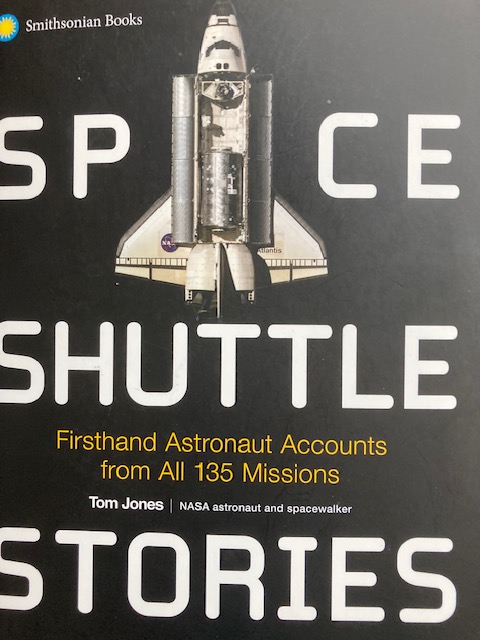
With the flight of Artemis II, I was reminded of the distance from the Space Shuttle we’ve come, how dated it seems. That feeling was reinforced with the 45th anniversary of the first Shuttle launch on April 12. Forty-five years. . . . The anniversary caused me to look back at the Shuttle program, which I covered for Countdown magazine. I revisited each flight through the pages of a book, Space Shuttle Stories, Firsthand Astronaut Accounts From All 135 Missions, edited by former astronaut Tom Jones (Smithsonian Books). The book devotes two pages to each flight, photos and brief reminiscences by a member — sometimes two — of the crew that flew the flight. Tom Jones? — he was an astronaut after “my time.” I covered Shuttle flights from 1983 through mid-1994.
There they were — the first missions I remember well, the ones before the Challenger accident and the ones of the return-to-flight in late 1988 and through 1989 and 1990. Space Shuttle Stories brought them all back to mind in quick vignettes touching on one or two aspects of each mission. I discovered stories I hadn’t known back in the time.
And then, starting in 1991, a shock: many of my Space Shuttles were missing. Flights had disappeared as if never flown. Not from the book, but erased from my memory. Here’s STS-39, the fortieth Shuttle flight, an unclassified Department of Defense flight to test “Star Wars” sensors, with a beautiful photograph of gas fanning out from the payload bay in an experiment on ionization. I check what we published in Countdown. There — we published the same photo. Except in black and white. I wrote the article reviewing the mission in day-by-day detail yet don’t remember it.
My memory lapses become much worse in 1992-94, with more holes into which Shuttle missions have fallen, unfamiliar until reminded by Space Shuttle Stories. For example, STS-52, the U.S. Microgravity Payload in October/November 1992 — it’s a blank to me. Some flights are just vaguely familiar, some I remember only by their crew patches and some have slipped entirely from mind. A few remain vivid: The first flight of Endeavour in 1992, with it’s three- person spacewalk to handle the retrieval of the Intelsat IV satellite, and of course the first flight to refurbish the Hubble Space telescope in late 1993.
Yet I couldn’t even tell you what the payload was for the last mission I covered in April 1994. You’d think I’d remember that. Here it is in the Tom Jones’s book: STS-59, the Space Radar Laboratory. And look at this — one of the Mission Specialists is none other than Thomas D. Jones. There he is in the the last mission review I wrote, the first flight of the Space Radar Laboratory. To be fair to my memory, the crew split into two shifts for round-the-clock operations, and he was on the nightshift. All the quotes I used came from the dayshift. Not that I remember covering anything of the mission.
Has my mind become Swiss cheese?
Maybe my failure to remember so many flights is not a symptom of a failing memory, but a sign of the success of the Shuttle program. As it was developed, the Shuttle was envisioned as providing routine access to low earth orbit, with as many as 60 flights per year. Of course it never approached that flight rate, yet it reached what in retrospect stands as an impressive flight rate between 1992 and 1997, seven or eight flights per year for a total 44 flights. For the remained of its flight span, 1998 to 2011, it would fly just another 46 mission.
We tend to forget what becomes routine. By that standard, the Shuttle achieved that benchmark in the middle years of the 1990s. For a brief spell of years, despite close calls, it seemed so. The spell was broken on the first day of February 2003.
*
The missions may be missing from my memory, but they are all here in “Space Shuttle Stories” edited by former astronaut. Yeah — he’s the guy I failed to remember flying the last mission I covered. By building small vignettes from each mission, he builds a total portrait of the entire program. He doesn’t let the story stand still long enough to be bogged down in endless details (a fault of mine!). I highly recommend it, the best vehicle to comprehend the total arc of the Space Shuttle program.

