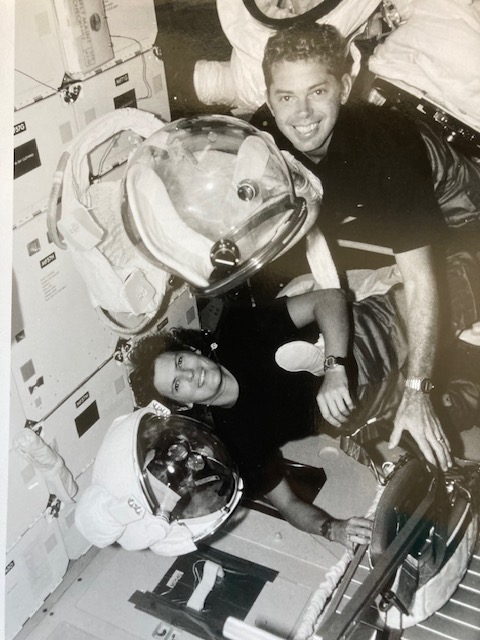
October 10, 1984: Kathy Sullivan and Dave Leestma with the helmets they will wear on a spacewalk
*****
Wake up time, for the 6th mission day of our flight aboard Challenger, Oct. 10, 1984, and we’re hit with a stirring rendition of “Navy Wings of Gold.”
“Good morning, Challenger. Let’s have everybody at attention,” Houston jokes.
“That will get it,” our commander, Bob “Crip” Crippen, a Navy veteran, calls back.
We’re the 13th Shuttle crew of Crippen, Jon McBride, Sally Ride, Kathy Sullivan, Dave Leestma, Marc Garneau and Paul Scully-Power. We’re the first Shuttle flight dedicated to Earth observation.
After a string of early problems, our mission has settled into a smooth groove. Overcoming antenna problems, data is flowing like clockwork to the ground. Scans from the Shuttle Imagining Radar (SIR-B) operated by Mission Specialist Kathy Sullivan is gathered on high-speed tape recorders and dumped to the ground through our Ku-band antenna. The dish antenna, it’s steering mechanism malfunctioning, must be pointed by steering the Shuttle itself. Flight Director John Cox reports that the Earth-viewing instruments are gathering 100 percent of expected returns. By the end of the day, the Large Format Camera in the U-shaped OSTA pallet in the payload bay will have taken more than 1,500 photographs.
One last big event remains before our return on Oct. 13 — a spacewalk by Sullivan and Dave Leestma to test satellite refueling techniques. Originally scheduled for Oct. 9, the EVA was moved to near the end of the mission so the spacewalkers can lock down the Ku-band antenna for landing.
Today, we prepare for the walk tomorrow. Kathy and Dave must pre-breath pure oxygen through their helmets to purge their bloodstreams of nitrogen which could cause “the bends.” They do so for several hours today.
Boring stuff? — floating there breathing oxygen. Sullivan tells Houston, “We’re just sitting here while we pre-breathe, looking at sunset over the western U.S. and watching SIR-B take some data.”
Not a bad way to pass the time!

