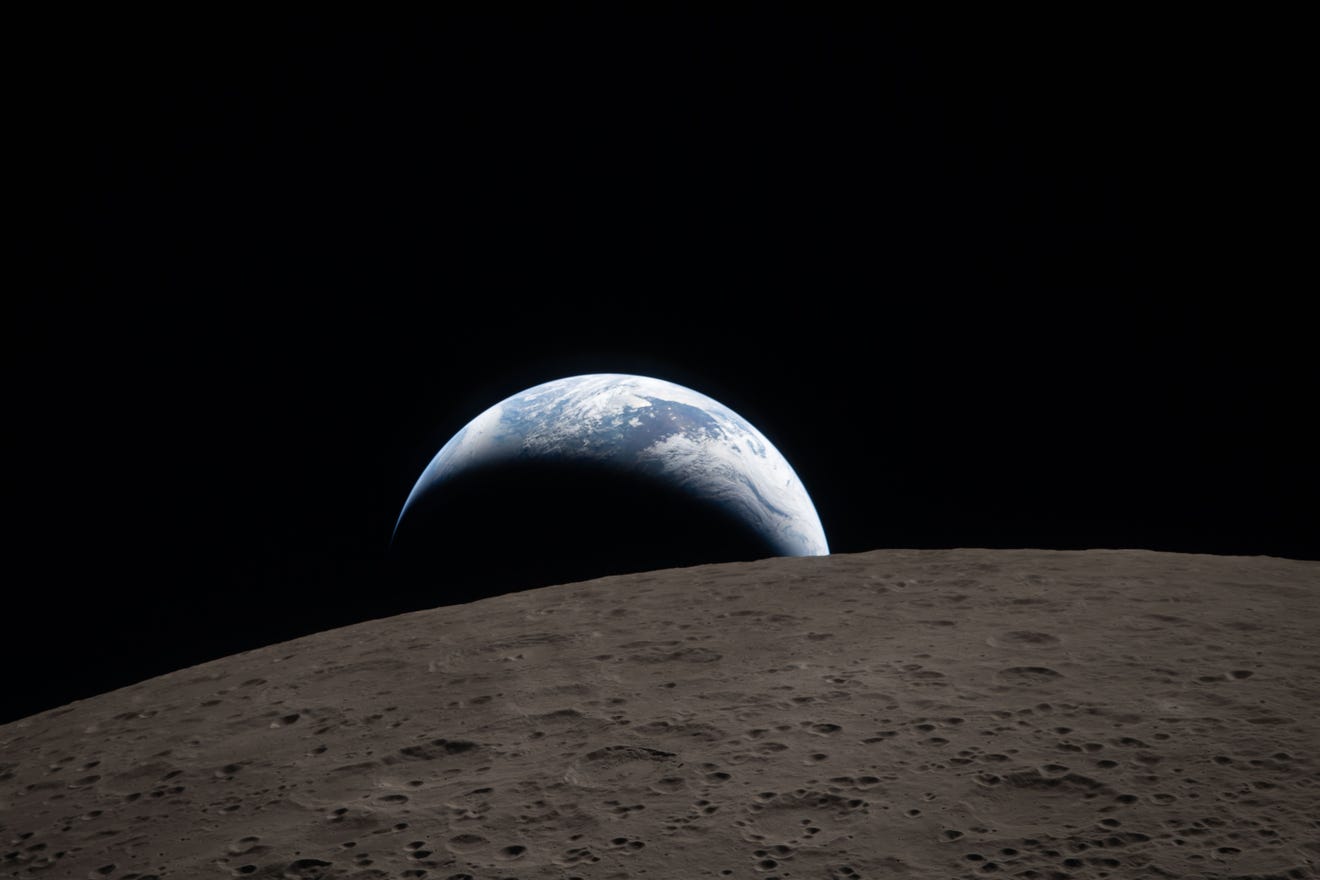
Earthrise from Artemis II.\\
*****
Nine minutes until splashdown. We have a visual of the spacecraft. Standing by for communications. Through the blackout. Six minutes until splashdown. Houston calls, “Com check,”
“Houston, Integrity, loud and clear.”
We see what in Apollo days was called the apex cover jettisoned. Two good drogue chutes. Followed by the three big main parachutes. Just like Apollo!
And at 8:07 p.m. EDT, splashdown, splashdown of Artemis II. Perfect! “Stable 1” with the apex up.
And so we are returning to the moon at last, an event that for most of my long life, I wondered if I’d live to see. I’m one of the few, the less than a fifth of the people alive, who remembers Apollo 11. And more, I’m one of the even fewer who remembers Alan Shepard’s Mercury flight in 1961, who grew up through Mercury and Gemini when the moon seemed a distant goal, seemed lost when the Apollo 1 fire occurred in January 1967, and saw the program reborn 18 months later in a swift progression of flights leading to the first landing. I remember them all, all the steps to the moon. That makes me a space relic.
And I remember what followed: Plans for nine more landings. And although budgets and flights were whittled away, the achievements stand vivid, especially the final three Apollos, the “J missions” of 1971 and ’72 that carried a rover, were equipped for three-day surface stays, each building on the previous, longer stays and moonwalks, longer distances traveled across the surface, each collecting more samples than the previous flight.
And then? With Apollo 17, with greatest of the surface explorations (orange soil!), with Cernan and Schmitt (and Evens up above), it ended. Like someone suddenly dying in the bloom of youth. That’s how it felt. And when Richard Nixon called Apollo 17 probably the last expedition to the moon in the 20th Century, Gene Cernan was damn upset.
I was upset and incredulous. Surely we would return to the moon by the end of the century. It all felt so unfinished. Indeed, I often sat with pen and paper visualizing if at least the final two Apollos — hardware already built! — had flown. If only the backup Skylab — already built! — had flown. If only we had built upon Apollo, even at a slow pace. With pen and paper — and unlike the Apple TV series, “For All Mankind,” without changing history and fudging the decline in NASA’s budget and fall off of public interest — could it be done? Compulsively, with pen and paper, year upon year even into the Shuttle era, I tried to visualize how we could have sustained a remnant of Apollo vision. And repeatedly, I crumbled the paper filled with F-1 engines, with timelines and crude outlines of a lost future. It was impossible to undo the end of Apollo. I could never figure out how to realistically get from 1972 to here. It was like trying to bring the dead back to life.
Until now. Suddenly what was lost has returned. Suddenly 54 years doesn’t seem such gap. We’re back.
And suddenly that lost part of me is restored. I feel like a relic no more.
 tlitiptree