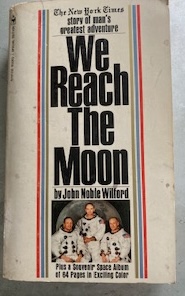
John Noble Wilford, Jr., age 92, born in Murray, Kentucky on October 4, 1933 — 24 years to the day before the launch of Sputnik 1 — died on December 8, 2025. No, he wasn’t an early astronaut. He was a journalist, a Pulitzer-prize-winning science reporter for The New York Times. His articles led the front-page coverage of Apollo 11. And were folded into an “instant book” about the space program, We Reach The Moon. The paperback was published just 76 hours after Apollo 11 splashed down.
Wilford said in acknowledgments at the front of We Reach The Moon that he was not a romantic or a dreamer but a journalist. “But who could cover the story of man’s first footsteps on another world, and cover it as more than a science story or another nuts-and-bolts technology story, without feeling in himself a flutter of all the romantic urges that have sent men across oceans, up mountains and out into he air and then the space beyond the air? I could not.”
The past is a foreign country — they speak a different language there, and not just the use of “man” to represent all humankind. To Reach The Moon freezes the fever, if you will, of the days of Apollo 11, the future flush with possibility.
In the book’s prologue, he wrote, “For the Apollo 11 crew, the successful 500,000 mile mission involving 88 separate steps was an incredible triumph of skill and courage. For the United States space team, from the other astronauts down to the technicians, it was the fulfillment of a decade of technological striving. For the world, it was the most dramatic demonstration of what man can do if he applies his mind and resources with a single-minded determination.”
Such a spirit of possibility.
“People everywhere, the important and the common, hailed the achievement. Perhaps never before had one event so captured the world’s imagination and spirit of adventure.”
Such a feeling of the unity of all humankind.
“Man’s going to the moon sprang from political and technological considerations and even deeper, from the very roots of the human spirit.”
In the epilogue of We Reach the Moon, Wilford concluded, “Man will never again look up at the moon and see it as the silvery symbol of all that impossible.
“Man may now see the moon as a new world to explore or even colonized, a new frontier for his restless, curious mind.”
Such a feeling of worlds within reach — and more.
“Man may now also see the moon and, knowing that he has been there, learn something about himself. He could gain a new sense of what is possible, a transfusion of confidence in himself. . . . Such a change in the human attitude may be the most significant result of the Apollo voyage to the moon
“Is that too much to ask?”
At the end of the first quarter of the 21st Century, such a positive vision and confidence in the future appears beyond asking. Maybe it shouldn’t be.
 tlitiptree