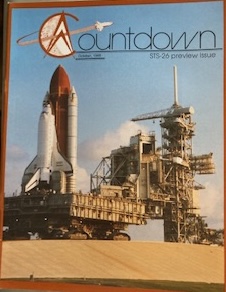
The cover of Countdown‘s return-to-flight issue, October 1988
*****
Part 4: Is the dream alive?
As the months passed after the Challenger accident, and the return to flight slipped from one year to more than two years, my mind on two tracks, recognizing the Shuttle was a flawed and costly system, yet still hoping a return to flight would restore the spirit of Shuttle exploration of space.
How did we keep a Space Shuttle magazine alive for the 32 months until the Shuttle flew again? For one thing, we never lacked for Shuttle news, with the redesigns and testing and finally preparations for the return to flight. And we broadened our coverage to other space projects.
As a reporter for Countdown magazine, I attended the launch of STS-26, the return to flight aboard Discovery. I drove from Ohio in my 1986 Dodge mini-Ram Van, with a sign on the back, “Follow Me To The Shuttle Launch”.
“Tues., Sept 27, 1988. 10:43 p.m. “I’ve arrived . . . Tomorrow the big adventure begins. We’re still trying to come up with a way to finagle 2 close-in launch passes.”
Ah, yes — NASA bureaucracy — or military security. The Air Force decided that the press site, the same one used since Apollo, three miles from the pads, was actually a bit within the blast zone. So they wanted to limit the number of people at the site. They weren’t closing the site, but NASA would determine who of a limited number of press could be there for the launch. The networks, of course. The big newspapers, of course. I guess they were considered expendable! The rest of us would be bused to some remote location with a distant view of the launch.
I thought it all was crazy, a symptom that NASA’s twisted “logic” had not changed with the Challenger launch decision. Maybe it was some crazy compromise they made with the Air Force so that the entire press site would not be closed during launch. I was in no mood for compromises.
“Wed., Sept 28, 1988. 11:36 p.m. I’m at the press site. For the next few minutes at least. Midnight is the deadline.” That’s when all but the Chosen Ones had to vacate the press site. “No luck getting a press-site pass, I had to leave.”
So I watched the launch the next morning from the remote site. I had no time to make a journal entry until the day after the Sept. 29 launch. “Discovery is in space. I’m in the deep blue. . . .Drove out to the middle of no where — a marsh strip by the Indian River. They locked us in by parking us car-to-car so no one could get out.
“So we want and waited. Little problems here and there made it seem that they weren’t going to launch. The upper winds were too light! They needed higher winds because that’s the way the computer navigation had been programmed — for fall winds whereas we were getting ‘spring winds!
“Then the suit fans failed on two of the crew suits. They seemed confused about the types of fuses. They had to ask the crew to describe them. They had to have new ones brought to the pad — a chilling resemblance to the Challenger hatch fiasco.
“But then the winds changed favorable” The count resumed, after delays of more than an hour and a half. “I moved into position.”
“. . . A nearby portable generator made hearing the Public Affairs countdown impossible. Those last seconds seemed to last so long that I was sure it had been delayed. My heart was pounding. I looked & looked. I tried counting the seconds to confirm more than 2 -3 minutes had elapsed — but I found I couldn’t count backwards!
“And then I managed to hear through the noise, ’11, 10.” It had been ticking down on time!”
Liftoff, at 11:37 a.m. EDT “The liftoff — from the distant view I had — was not impressive.”
I was spoiled from watching from 3 miles away. At least now I fully realized the dangers, as shown by my heart rate in the final moments before launch.
We made a large — for such a small magazine — advertising and direct mail push tied to the return to flight. Our returns fell short of our expectations and pre-Challenger performance, showing how the stature and standing of the Shuttle had fallen beyond rebound.
What to do, but keep on?
*
I had no time to attend launches, yet I wanted to attend the maiden launch of the replacement Shuttle, Endeavour. Why was that so important to me? Was I still trying to recapture my enthusiasm for the Shuttle program, a fresh start with a new Shuttle, the fleet complete once more?
May 7, 1992 “I waited there until a 10 a.m. press conference which I watched on NASA Select [as their TV feed was called] — they were going ahead with tanking.” And I drove to the press site. “It’s windy and cloudy. Looks like a fall day in Ohio! I bet they don’t go today.”
At the press center, “it was almost like old times for me.”
“. . . I moved outside for the final count. They said a ‘hole’ in the clouds might be coming, and posted the weather odds for a launch [which] kept going up.
” They had to wait 34 min. beyond the 7:06 [p.m.] target time for weather there 7 at the transAtlantic landing sites to clear.
“But they got the go & away it went. The flame looked more intense due to the murky light. There was still a cloud — a big dark cloud — hanging over the pad. The Shuttle disappeared into it 15 sec. after liftoff, emerging 3 sec. later — giving a good light show as the cloud swallowed the flame. And after that one cloud, it was visible perfectly in the clear — you could track out nearly 5 min. after the launch.
“The sound seemed more intense than I remember from ’83-’84 (’88 doesn’t count since I was so far away). It really drummed off my chest. And bled on for a long time like distant thunder.
“But in a way, it didn’t emotionally grab me — not the tension of the return-to-flight in ’88, or the excitement of my first launch 9 years ago.
“I didn’t feel the spirit of full return from Challenger that some NASA employees spoke of.”
Reading my journal, I now see that I often felt a post-launch letdown. Call it “The Empty Launch Pad Syndrome.”
And at this launch, for the first time, I did not take photographs. Freed from the viewfinder, I was pure observer, absorbing the experience. For the first time, I truly observed the intense light below the engine bells of the three main engines, like an arc welder’s light, and felt the mass and majesty of the Shuttle as it rolled on its back to establish the proper heading.
I can still see Endeavour hanging in the sky, engines pulsing and pushing.
*
In 1994, Countdown was sold and I moved on, ready for new challenges. I went on a long soul-searching vacation to England, Scotland and France. I was done with the Shuttle, wished to move on, I loved England — soon return for longer stands, studying literature and creative writing there. I was at the University of Lancaster in 2003 when the Columbia disaster occurred. I’d checked on the flight at least once on the internet. It reminded me of the Spacelab science missions I covered for Countdown. I’d told my writing group stories from my days at Countdown. They knew I was a space enthusiast. February 1, 2003: A fellow student in the program, a fellow American, Steve, called with the news.
Just like with Challenger, I opened my journal. “3:35 p.m. — The Columbia exploded/disintegrated at high altitude returning from its mission. I just got a call from Steve.
I’m going to go check it out. I don’t know if I’ll make this theatre review.” I was in a play and we were doing a review that evening.
“Nothing on radio/TV here.” I must have expected it to be like Challenger, even in England, breaking into the news. I headed to a nearby building with internet. “It’s on the internet news sites. Am at the computer lab. Apparently it broke apart at 207,000 ft. over Texas, 10 min. from landing. “A ‘big bang’ was heard by people on the ground.” That would have been the sonic boom.
I went to the theatre review, journal in hand. “6:09 p.m. A lull. Have got through it 2-3 times, the scenes.
“I’d been here and then back over to the computer room, oh, at 4.” We took an hour break before practicing our scenes some more. “No real news at 4:30. Nothing really known — it simply broke apart. Apparently on launch a piece of insulation came off — hit the left wing — but yesterday the flight director said that was no problem.
“NASA was supposed to have a press conference at 4:30, but it was postponed indefinitely.
“Flashbacks to Challenger. Wish I was in the US at this time.
“Very hard to concentrate on these [play] scenes.” My fellow actors, all English, were sympathetic, yet I could tell didn’t feel anything like what I was.”
“11:16 p.m. The review went fairly well . . . I had a couple beers with the group, then went to the computer. Caught a fat portion of a NASA press conference, familiar faces looking much older & visibly shaken — Ron Dittemore and Milt Heflin, flight directors.
“NASA is being much more open than after Challenger. They gave all the data they had — sensors going out in the left wing before the loss of contact.
“Sure sounds like the wing burned through, that those tiles were damaged more on launch than NASA believed.
“Then I switched to MSNBC TV coverage. Sure echoed Challenger — repeated replays of tracking camera coverage showing the meteor-like trail of the Shuttle. Then something broke off. And it disintegrated.
“It disintegrated at Mach 18 . . .” I note I’d gotten an email from my brother talking of the disaster.
“Whew! I’m tired as hell. . . . Flashbacks to Jan. 28, 1986.”
*
 tlitiptree