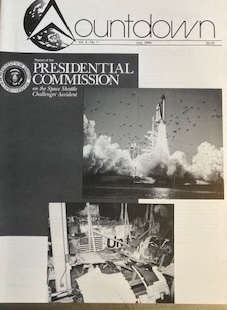
The cover of the July 1986 issue of Countdown, covering the investigation into the Challenger accident.
*****
Part 3: Tuesday, Jan. 28, 1986
That morning, cold and clear in Athens, Ohio, where the offices of Countdown magazine were located, I started work early, before dawn. Just like NASA, we struggled to keep up with the increased Shuttle flight rate. I listened to the launch chatter over a shortwave link as I worked, laying out a year-end special which, like NASA, was behind schedule. In addition, I was breaking in a new employee who arrived at 9 a.m. and worked upstairs on subscriptions. I’d yell updates on the launch to her. On Monday, I’d call to her as the fiasco over the stuck hatch handle played out, a stripped screw then a dead battery on a drill. We’d laugh at the latest. By the time they got all that sorted out, high winds led to a 24-hr. postponement. Now, I called her down to watch the launch on CNN, describing the sequence events. I stopped talking so we could watch Challenger rise. And a couple minutes after launch, CNN was about to cut away from it, when it all went wrong.
I didn’t write in my journal until 1:20 p.m. “The Space Shuttle Challenger exploded this morning — no survivors. Launch came at 11:29 [actually 11:28]. The Shuttle was throttling up it’s engines after passing through the area of maximum dynamic pressure (‘Max Q’) on the vehicle. The External Tank exploded blowing the Orbiter apart. The two Solid Rocket Boosters split off and continued flying. The explosion occurred without warning — with no call from or to the crew. Indeed, the PAO commentator continued talking his normal commentary, not realizing what had happened.
“It all over — no chance of survived for the crew.”
“I watched. Immediately knew something catastrophic had happened — yet my mind refused to believe my eyes. Yet I knew something horribly not normal had happened. I watched one of the Solid Rocket Boosters fly off — and hoped it was the Shuttle. The launch narrator continued talking normally and that bewildered me. I ripped at a fingernail until it bled as finally Mission Control realized what had happened.
“What we all expected would happen someday. Someday in the foggy future. It had happened — it was now. And it was already over. And soon
“And soon the TV networks . . . began the replays — the endless replays.”
I didn’t write in my journal again until January 31. As I remember it, I simply was too busy with the magazine work. The office phone started ringing before an hour had expired after the disaster, and keep ringing for days. The work was nonstop. Apparently that isn’t the full reason.
“Well, I really haven’t been in the mood to write. For the past days, for the most part, I’ve been by the TV most of the time, especially the day of the accident & the day after. It was just constant on TV. . . . And sadly not much more is known than when I wrote a couple hrs. after the disaster — it simply exploded. The slow motion replays do show flames licking up around the External Tank milliseconds before the big explosion.
“The event just keeps replaying in your mind.”
All along, “it’s been in the back of my mind that something like this could happen. That statistically, it was likely to happen as more & more flights occurred — and launch and landing, always very dangerous, were the most likely times. I’d thought about this story before it happened, yet reacted differently than I thought. I reacted initially with more bewilderment that I thought I would — I really wasn’t prepared for such a thing. It didn’t register for the first moments on my mind. . . . I thought time would slow down as as such a thing would happen, but it happened so fast, your eye could miss it with a blink. And the smoke of destruction mingled in with the smoke of launch until they looked deceptively the same. You wanted to believe it didn’t happen — and it was over so fast your mind & eyes let you do that.”
Throughout February, details of the disaster dribbled out. It wasn’t the one-in-a-million freak accident we thought at first. The flaws in the Shuttle system were being exposed. I only had time every few days to sketch my impressions in the journal. On the evening of February 25, I wrote, “Today was a disturbing day for the Space Shuttle program. The Presidential Commission investigating the accident held public hearings — questioned engineers from Morton Thiokol, makers of the booster rockets. The day before launch launch, they unanimously opposed sending Challenger up due to the cold weather which they believe could affect seals between segments of the Solid Boosters. They were overruled by management. NASA, in effect, put schedule before safety.
“I think NASA was pressured to do so — pressured by the economics of trying to run a space truck line.
“NASA may have squeezed until their priorities flip flopped, yet I feel let down by NASA — who prided themselves on ‘safety first.’ We, the people, put great trust in NASA . . .”
At the end of the month, I wrote, “Yesterday marked one month since the destruction of Challenger. It seems like much more than a month. It was a different ‘era’ before January 28. . . . I feel let down by NASA. Betrayed. . .
“The Shuttle will never be the same — that’s one thing for sure.”
In early April, still contemplating the effects of the disaster, even seeing hope out of it. “The accident really can change the direction of the space program. Perhaps some good can come out of it –a new appreciation for space exploration & setting a new agenda for space exploration.”
A flicker of optimism?
 tlitiptree