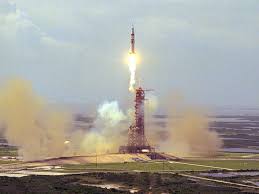
July 15, 1975: The final Saturn launch. My daily journal, still going, starts here.
******
Part 1: From Apollo, the Space Shuttle
I’ve kept a journal for 50 years. Seems impossible. Half a century. The daily entries not only bring back the past, they allow me to travel back and forth in time and fold events against each other. The space program forms a thread running through them, especially from 1983 until 1994, when I was editor of a Space Shuttle magazine. Yet long before that I was a space enthusiast, back before the Moon landing, back before Alan Shepard’s suborbital flight.
On July 15, 1975, one month before my 21st birthday, I watched the last Apollo launch on TV. Not to the moon, this was the joint mission with the Soviet Union. I marked the event by writing prototype for all the journal entries to come. My family’s big Zenith console was tuned to CBS and Walter Cronkite, as it’d been for every Apollo launch. You can’t lift off without Walter Cronkite.
It was Tuesday, July 15, 1975, and after watching the Apollo reach orbit, I precisely notes the time I began writing– 4:34 p.m. EDT. “I have just finished watching the launch of the last U.S. space shot for a long time.” I noted the flight of the Apollo-Soyuz marked the fifth launch of a Saturn IB, “so I knew what to expect. There was excitement — pressure to match the successful launch of the Russians this morning.”
“The rocket seemed to lift off very slowly (especially when compared to the rapid Soyuz launch this morning — the first broadcast live from the USSR. But the rocket gained speed and climbed into the clouds.
“There was a first — TV from inside the Apollo at launch.
“I was surprised how normal the astronauts seemed — it was great to be in the cabin with them.”
Great to be in the cabin with them. That line is the origin of the of the style I’ve tried to bring to all my space stories through the years, to put the reader — and myself — in the cockpit — as if we were part of the crew.
“Brand was closest [to the TV camera], and I could see him move his arms quite easily. At one point I was surprised to see him pick up the flight plan right during launch and read it.”
“During the S-4B second stage flight, Deke Slayton said, ‘This was worth waiting 15 years for.’ It’s ironic that one of the first astronauts is on this last flight. There’s a lot of nostalgia on this flight — the end of an era. It’s hard to realize . . .”
“Hopefully, we’ll have the Shuttle in a few years.” At the time, it was scheduled to fly in 1978. “Seems like a long time.” And it’d be a lot longer than that.
*
The Shuttle slipped in and out of the news, its first launch slipping from 1979 to 1980, and seemed to disappear. Finally it was back in the news in early 1981, set to launch on April 10. The TV networks geared up that morning. All that was missing was Walter Cronkite — he’d retired after Reagan’s inauguration in January. Dan Rather taking over launch duties. A computer timing problem scrubbed the launch for two days. I think subconsciously I blamed the computer failure on Dan Rather. He just didn’t have the feel for space exploration that Walter had.
April 12, 1981: “And it’s a fitting day to launch the first Shuttle. It’s the 20th anniversary of the first manned space flight, Vostok.” Past, present and future merged.
“With the computer problems over, now we can look to lighting ‘er up. What we’ll see then, no one knows.”
My next words: “7:30 a.m. — the launch was perfect — they’re up! It was quite a sight — rising fast through a cloud of steam on the pad — rolling around as it rose — just perfect. The cameras could follow it along through the separation of the Solid Boosters — you could see them fall away. It sure wasn’t like a ‘conventional’ launch . . . The winged Orbiter and Solid Boosters give reference points to show it pitching back as it leaped away.
” So far all is well — just like Apollo days.”
That’s what I wished for, something as grand as Apollo, something of opening up access to space to build space colonies as envisioned by Gerard K. O’Neill. I still have my hardback copy of his 1977 book, The High Frontier subtitled, Human Colonies in Space.
O’Neill set out a vision for how we would build islands in orbit from lunar material, habitats eventually as large as 4 miles in diameter and 20 miles in length. The work of these “colonies” would be to build solar power satellites to beam energy to Earth. And of course the vision began with the Space Shuttle reducing the cost of lifting payloads and opening up routine access to low earth orbit, leading to a heavy-lift cargo vehicle based on Shuttle components.
Columbia’s fourth and final test flight launched on June 27, 1982. The landing at Edwards Air Force Base, California, on July 4 made for a star-spangled celebration. The President of the United States, Ronald Reagan, was in the viewing stands. Rumors flew with the Shuttle that Reagan would announce his support for a space station as our next step.
It was a Sunday. “Got ready & watched the Shuttle come down at noon. Reagan gave a speech — but no new space policy, no call for a Space Station. NASA put on their best show for him — but they didn’t get anything for it.” And quite a show it was, a new Shuttle, fresh from the factory, mounted on the 747 carrier airplane was ready for its ferry flight to Florida. Reagan acted as air traffic controller, calling, “You are free to take off.” The new Shuttle was named Challenger. The Space Transportation System (STS), after just four flights, was declared operational.
Operational implied routine, and press coverage of the Shuttle steadily decreased. I had an idea for a magazine that would cover each flight. That idea became Countdown magazine. And kept trying to fit the Shuttle onto that Apollo-spirited template, writing about the flights in the same detail Walter Cronkite poured into his Apollo reporting.
 tlitiptree