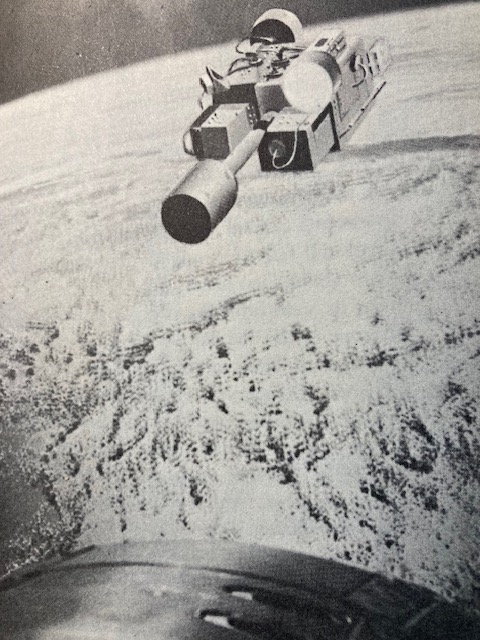
Sixty years ago: An artist’s rendering of the Radar Evaluation Pod floating in front of the nose of Gemini 5.
*****
What’s old often comes around again, such as cassette tapes. Maybe that will be case with Project Gemini, the “forgotten” program flown as a bridge between Mercury and Apollo. It certainly is the case with cassettes. And I recently bought a small boom box with an old-fashioned cassette player. In their day, They weren’t just for music. I have a small library of cassette tapes with copies of TV and radio coverage of the early manned space missions, copies made for me by a friend decades ago.
Now that I have the player, and with the 60th anniversary of Gemini 5 at hand, launched August 21, 1965, for the first time in memory I listened to the launch day tapes of the flight. “This is Gemini Control.” The voice was no longer that of the legendary John “Shorty” Powers of Mercury fame, but Paul Haney, yet the style was the same. Indeed, I was surprised at how similar coverage was to Mercury, despite Gemini’s tremendous advances over the earlier program and the gap of nearly two years between them. Air-to-ground communications were not provided live to the networks for the launch, but given later in replays. Just like Mercury. However, once Gemini 5, with astronauts Gordo Cooper and Pete Conrad, settled into a safe orbit, some “live” communications were provided.
Communications were dependent, of course, on the network of ground stations, and often the astronauts were talking to capcoms located at them rather than Houston, just like Mercury. It didn’t seem like much had changed from the day of Alan Shepard and John Glenn.
And the news broadcasts did not cease once Cooper and Conrad were safely in orbit, but continued for the early orbits. Every facet of the mission was delved into in detail. There’s Walter Cronkite giving a lesson in rendezvous to the nation.
Gemini 5 sought two major goals — to fly for a record 8 days, the duration of a moon mission, and, to perform the first rendezvous maneuvers in. As Cronkite explained, a small package called the Radar Evaluation Pod (REP) ejected from the rear of the Gemini on the second orbit. Cronkite gave every detail of the maneuvers that would follow, the Gemini would raise it’s orbit to fall behind the REP, then lower it to catch up and come back within feet of the 75-lb., box-shaped pod, testing its radar the whole time in something that in the Shuttle program would come to be called “prox ops”– proximity operations taking up the bulk of the first day.
The pod had been ejected, Cronkite reported, and the first maneuver to back away from it conducted. Radar was working fine, showing that Gemini 5 was moving away from the REP at 6.5 ft. per sec.
Communications chatter about the fuel cells, a new power system, seemed routine at this point on the second orbit. Gemini 5 was equipped with the cells instead of heavy storage batteries used in the past. Fuel cells combined oxygen and hydrogen, a process that generated an electrical current and also produced water as a byproduct. They made the long duration flights possible and would be used on Apollo.
Moving into a gap in communications coverage, about a half hour after the REP had been ejected, the crew noticed the oxygen pressure in the cells falling and falling fast to 200 psi, where as they were designed to operate in the range 850 psi, the pressure driving the oxygen and hydrogen out of the tanks into the cells. Cooper had never seen them operate at so low a pressure and made a command decision: Radar operations ceased, and they began powering down the spacecraft.
During a brief contact with the tracking station at Canton Island in the Pacific, Gemini Control caught up with the crew and concurred on the power down. And quickly the situation was passed on to the news networks.
Walter Cronkite maintained his cool, calm reporter’s voice, emphasized the crew was not in danger, but may have to return to Earth quite soon. He relayed the names of ships at sea that possibly could pick up the crew.
The air-to-ground conversations continued to be released, live at times, with most the scratchy chatter concerning fuel cells pressures and temperatures as they continued to fall. The networks broadcast every word and number, even if much was too technical to understand. Gemini appeared headed for an early landing, with enough battery backup power to last until an orbit six contingency landing zone in the Pacific.
Yet the rate of decrease in oxygen pressure slowed. It fell to about 50 psi on the crew gauge. But stabilized, and analysis showed that with time it should rise. By evening, Gemini 5 was go for 18 orbits.
Indeed, the fuel cells recovered enough to permit a full mission, although it was too late for the REP rendezvous. So came to pass, a name I well remember from 60 years ago: Phantom Agena. The crew rendezvoused with an imaginary computer-plotted Agena upper stage. Was this the world’s first space computer game?
I have it all on seven cassette tapes, a technology in it’s infancy when Gemini 5 flew. Music cassettes were not sold in the U.S. until the following year, and it wasn’t until the 1970s that I began recording my own mix tapes. Maybe I’ll play those next and maybe the music will bring back memories as clearly as Project Gemini, never forgotten by me..
 tlitiptree