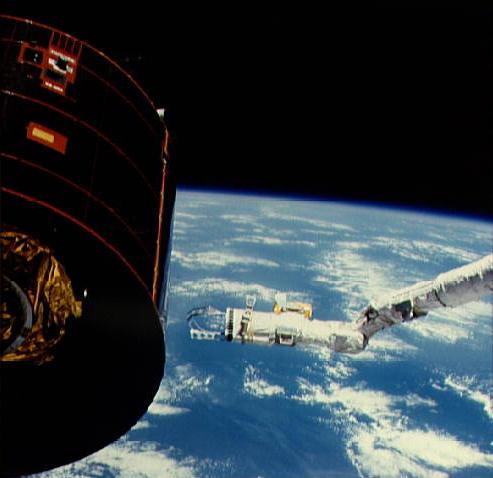
April 17, 1985: Under the control of Rhea Seddon, Discovery’s robot arm with its make-shift “flyswatter” extensions inches toward the Syncom/Leasat satellite.
*****
It’s April 17, 1985, the sixth flight day of our STS 51-D mission. At 4:30 a.m. (EDT), Commander Bo Bobko and Pilot Don Williams make the first maneuver back toward the sleeping Syncom/Leasat communications satellite we deployed early in th flight. Discovery should stop 35 ft. from the satellite in 3 hrs. 30 min. Everything must be timed precisely — down the moment we hope we bring the satellite back to life by tripping its activation lever. If we succeed, that will start the timer for a burn by the Syncom’s solid-fueled Perigee Kick Motor 45 min. after the timer starts. We must activate the timer at the correct time and location to send it towards its intended geostationary orbit 22,300 mi. above the Earth.
At 7:05 a.m., we’re 15,000 ft. below and behind the satellite, awaiting sunrise and our first glimpse of the Syncom. Don reports to Houston, “Coming into sunrise . . . And tally ho to the target.” It’s right in the center of the optical tracking sight. And the nozzle of the kick motor is pointed like a shotgun at us. A bit disconcerting!
Houston asks, “See the lever yet?” They’re anxious about the small hook-shaped activation lever extending about an inch from the side of the drum-shaped satellite. Everyone is hoping we are correct that upon deployment, it didn’t spring out like it should have. If it did flip solidly, then the problem must be buried in the electronics, and there’s nothing we can do to have the $80 million satellite.
We need to get closer to see the lever. That takes about 40 min. “We can clearly see the separation switch — but would like to hold off on any judgment.” And we keep quiet — the lever rotates into view every 36 sec., plainly visible in an orange rectangle. We close to within 200 ft. while remaining silent — the lever looks fully engaged. After 20 min., Mission Control can’t take our silence and asks, “We’re kind of curious. You reported tally ho on the lever. Can you give us some kind of of estimate on its position — whether it’s fully extended?
Jeff says, “It is definitely not in the launch position. Ah, it’s hard for us to tell if it’s fully extended, but it looks like it’s pretty near to the perpendicular. And I’m not sure that’s what you wanted to here.” We can see nearly all on the slot in which it rested until released. We’re trying to get a better look, and ask Houston, “My understanding from the drawings you sent up is that it should go past the vertical. Is that correct?”
“That’s affirmative — maybe 110 degrees.” The timer microswitch would only be tripped in the last couple degrees, they say.
“OK, obviously it’s not going to be possible to call two degrees. I assume our operations are go as planned, regardless of the position. Is that correct?”
“That’s correct.”
Maybe a good swat will trip the timer. We move it. On the flight deck Rhea works the hand controller for the robot arm from the aft right station overlooking the payload bay. She positions the end of the arm 2 ft. from the rotating surface covered with solar cells. At 9:12 a.m., the window to trip the lever opens. It will last just 6 min. At first Rhea hold steady, then moves the fly swatter in as the lever revolves into position. Two minutes into the window. A miss. The lever comes around again a half minute later. She moves in — brushes the lever, the cross pieces of the swatter break. Still time in the window for a swipe with the La Crosse stick. The lever comes around again. Bingo — the wire loop snags and breaks.
Had it worked? We can’t stay around to find out — immediately perform a separation maneuver, gaining distance from the kick motor we hope will fire. We tell Houston, “We estimate we got a hard physical contact on at least two occasions.”
“And we concur on that. That was a super job. . . .You did everything you possibly could.”
As we pull away, we can see that the Omni antenna is not deploying, nor is the satellite spinning up as it should. The lever was not the problem.
Time for some good news. Houston gives us the option of coming home tomorrow or resting up and coming home the following day.
“We’ll stay up,” Bo replies.
The Capcom answers, “Somehow I knew you might say that,”
 tlitiptree