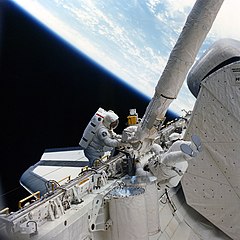
April 16, 1985: Astronauts Jeff Hoffman and Dave Griggs install make-shift “fly swatters” on the end the Discovery’s 50-ft.-long robot arm
*****
It’s 6:55 a.m. (EDT), April 16, 1985, the fifth Flight Day of our STS 51-D flight aboard Discovery. Jeff Hoffman and Dave Griggs are suited up and in the cylindrical airlock, about to make history, the first unscheduled spacewalk. While they wait, they run over the moves they will make. Jeff says, “I’ll be going out first. We’ll configure our tethers as normal . . . I’ll get the mini work station and all the adjustable wrist tethers I can. Dave will move to the forward PSA and pick up the PRDs.” PRDs are Payload Retention Devices, 15-ft.-long straps which can be synched around the end of the robot arm to hold two make-shift satellite “swatters.” “I’ll come back to the airlock and pick up the fly swatter and the La Crosse Stick” We fashioned them the day before out of items found in the cabin.
On Flight Day 4, the entire crew worked to prepare for the rescue of the Syncom/Leasat satellite that failed to activate following deployment of the second day of the mission. Mission Control used about 30 ft. of teleprinter paper to send up instructions for the unplanned rendezvous — something we hadn’t trained for — and salvage attempt. In the afternoon, we reviewed the rendezvous checklist with Bob Crippen in Mission Control, a Shuttle veteran of rendezvous missions. We shot a series of questions back and forth, and finally our commander, Bo Bobko, who will perform the rendezvous with pilot Don Williams, summed up the task. “I guess the over all plan, what was interesting me, normally we get up [to the satellite] at about [orbital] noon, and it seems we would have about 15 min. to get in and do it [trip the stuck lever on the satellite]. . . .Is that about the right timing I’m thinking of?”
Crippen replied, “Yeah, Bo. You’ll probably get in close to it, and we’re going to recommend that you . . . station keep, and you should be inside of 200 ft. by sunset.”
“It looks like we did get the swatter instructions.”
In the middeck, Rhea Seddon, Jeff and Dave got to work construction two devices to attach to the end of the robot arm. They are dubbed the fly swatter and La Crosse stick. The fly swatter was composed of 59-cent plastic book covers. Holes were cut in the covers to create a frame with three cross pieces. The hope is that the cross pieces will snag the hook-shaped lever sticking about an inch from the side of the satellite. The plastic should pull the lever and then break free. Three cross pieces — three tries. Rhea used a bone saw from the medical kit to cut two lengths of a metal “swizzle stick,” used to to toggle hard to reach switches. The swizzle sticks will be used as the stem for the fly swatter, and the La Crosse stick, which is formed from a loop of thin wire, which should pull the lever and then break.
The fly swatter and La Cross loop were affixed the swizzle sticks with duct tape, and sewn tight with needle and thread from a sewing kit. A veteran medical doctor, Rhea did the stitching, saying it reminded her of suturing a patient’s abdomen. As we worked, we nicknamed ourselves, “The SWAT team.” When finally finished, we showed the devices on TV to Mission Control. It looks good to them. At 7 p.m., when we should have been asleep, we were still running through the final details.
*
At about 7:30 a.m., on the nightside of orbit, Jeff exits the airlock. “My goodness, it’s dark outside,” he says. The duo quickly gathers the items we need from tool boxes and make our way to the robot arm. Rhea, the arm operator, has positioned it handing down over the right-hand side of the bay, half way back the length of the 60-ft. bay. Since none of this was planned, they have no task-specific tools, such as foot restraints to anchor themselves. They have to float free, holding on to the sill of the payload bay or the robot arm as they wrap the “PRD” straps around the cylindrical end of the robot arm. They attach the fly swatter first, and pause to exclaim, “Oh, there’s the moon! Oh, there’s the horizon! The sun is getting ready to come up.”
They put three loops around the can-shaped end effector, 8.5 ft. in diameter, of the robot arm. “Do you want us to put a fourth?”
Houston says, “I think it’s OK to press on with what you’ve got now, and if it doesn’t look stable enough we’ll put another PRD.”
They slide the stick of the fly swatter under the loops, and Jeff reports, “OK, the fly swatter is underneath the three straps. The apex is just even with the from of the end effector.”
Houston says, “That looks good, Jeff.”
“And I’ll go back and get the La Crosse stick.”
After they slide it in place, they check the positions — the fly swatter at the 3 o’clock position and the La Cross stick at 12 o’clock — and tighten down the straps. The actual installation of the devices took little more than an hour.
“Does that look good on your picture?”
Houston says, “That view out the end effector camera is exactly what we’d hoped we’d see. We’d like you to go ahead and berth the arm.” Houston wants to keep Jeff and Dave outside until after the arm is locked down to check clearances once they have daylight TV coverage. That gives the spacewalkers plenty of free time on the nightside with nothing to do but enjoy the sights and experience. “Looks like we’re coming up on sunset. Oh, look at all the ice crystals drifting around.”
Over Hawaii, Houston watches the berthing of the arm and declares, “We’re very happy with what we’ve seen — super work.”
We close the book on the spacewalk. As Jeff and Dave returned to the airlock concluding a spacewalk of 3 hr. 6 min., Rhea said, “Gentleman, take a bow.”
Tomorrow the main task will be up to her — easing the arm up and gently brushing the satellite with the swatters.
 tlitiptree