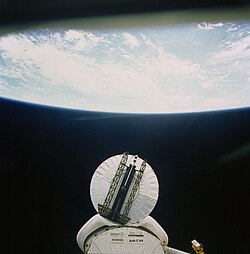
The 16th Shuttle flight: The Syncom/Leasat communications satellite rolls out of Discovery’s payload bay, the Omni antenna folded down at. the center.
*****
It’s April 12, 1985, launch day at last for our delayed STS-51-D mission aboard Discovery, the 16th Shuttle flight. It’s the 24th anniversary of Yuri Gagarin’s flight and the fourth anniversary of the Shuttle’s flight. An auspicious date to fly — that is, if the weather clears. The morning breaks with low clouds and light rain. As we board the Discovery at 6:30 a.m. (EDT), the rain has moved to the south but the skies remain solid overcast.
We’re Karol “Bo” Bobko, commander; Don Williams, pilot; with mission specialist Rhea Seddon, Dave Griggs, Jeff Hoffman and payload specialist Charlie Walker of McDonnell-Douglas. Later we were tasked with an additional person, the first Congressional observer in space, Senator Jake Garn (R-Utah).
We’re lucky to be chosen for the flight, as it is a combination of the “D” and “E” payloads (each Shuttle payload gains a letter designation). It could have been the crew of STS-51- E boarding the Shuttle.
We were originally supposed to have flown in 1984, two months after Discovery’s maiden flight. That is, until the launch pad abort that postponed that mission until August. Our flight was deleted. Then in August 1984, we were assigned to deploy the long-delayed second Tracking and Data Relay Satellite (TDRS).
Our finalized TDRS mission was to have launched aboard Challenger on another historic anniversary, February 20, the date John Glenn flew aboard Friendship 7 in 1962. Then tile replacement and a leaky fuel line delayed the launch date until March 7. But on the first day of that month, NASA grounded the TDRS satellite. A hardware flaw had been found in a device that encodes signals. Modifying the satellite would push its launch into 1986, and left us without a mission. Not for long. we quickly were chosen to fly the combined D and E mission, carrying a Canadian Telesat Anik-C communications satellite, and a bigger communications satellite, the third Syncom/Leasat. In a fast-paced, switch-a-roo, launch aboard Discovery was set for March 29. That is, until March 8, when a 2,500-lb work bucket broke loose as the Orbiter was being prepared in its hangar and punched two holes in the left-hand payload bad door. And that’s how we ended up entering Discovery on the overcast morning of April 12 aiming for an 8:04 a.m. launch. We had two small launch windows, due to the orbital geometry dictated by the deployment of the two satellites. We could launch between 8:04 a.m. and 8:18 a.m., or between 8:45 a.m. and 9 a.m. and no other time.
At 7:44 a.m., we entered the last planned 10 min. hold. Close and lock your visors — we’re finally going to make space. That is, until Launch Control says that a cargo ship has entered the danger zone where the twin Solid Rocket Boosters splash down, 125 mi. east of the Cape. And the weather is still dicey. We miss the first window, but the cargo ship has left the danger zone. We’re holding as the second window nears. Astronaut John Young in a weather plane is reporting rain on his windshield. We’re not permitted to launch through rain, which could damage the delicate heat tiles. We’re no-go as the we approach the time when we must resume the count or scrub the launch.
We’re still no go entering the last minute, thick overcast hanging over the Cape, a scrub seeming inevitable. Fifty-five seconds to go before a scrub, Launch Director Bob Sieck gives a go for launch. And just seconds before 9 a.m., our three Main Engines rumble to life below us. The Shuttle rocks and and the big SRBs light and we’re away. No stopping us now, all the months of delay shrinking behind our tail of flame. Quickly we’re knifing through overcast at 15,000 ft., break into the bright clear, holding on tight as those big solid rockets shake us for more than two minutes. And once we’ve kicked them away, purr into orbit.
NASA will state that no weather criteria were violated by the launch. Indeed, they tell the press that it showed the Shuttles “operational” capability. And it demonstrated launch flexibility to NASA Administrator James Beggs who was in Launch Control looking over the shoulders of the management team.
Jake Garn’s task on the mission is to serve as a subject for the study of space motion sickness. He begins it early — as soon as he moves about the cabin, he becomes sick and vomits, not for the last time. We adapt to weightlessness at various rates, yet get right down to work, configuring for on orbit operations that begin with our first satellite deployment, the Telesat Anik-C, resting in the payload bay in its clam-shell sunshield. It sits forward of the tub-like Syncom cradled on its side taking up the width of the bay. The Telesat, sitting upright, is small in comparison. We begin the long checklist to deployment set for the evening, 9.5 hrs. after launch. The spinning satellite rises straight and true from the payload bay at 6:38 p.m., even as we begin preparations for sleep. And 45 min. later its Payload Assist Module (PAM) upper stage fires perfectly, sending it on its way toward geostationary orbit high above the Earth.
*
We hope to repeat the success the next day with the Syncom/Leasat, spun out of the payload bay like a Frisbee. By 8:18 a.m., Jeff and Rhea begin the pre-deployment checks taking more than an hour-and-a -half.
At 9:58 a.m., as we cross the equator over Africa, the 15,000-lb. satellite, 14 ft. in diameter, rolls out the payload bay at a slow 2 rpm spin. Rhea watches it goes and reports, “It’s going, guys, and we’re taking pictures.”
“Outstanding,” Houston replies. “Two for two.”
Yet hold on. The stick-like Omni antenna at the top should swing out. Then 6 min. 35 sec. after deployment, the satellite should spin itself up to 33 rpm.
We’re not seeing any activity. Rhea tells Houston, “We are watching the Syncom. The Omni is still down.
“Any kind of of visual you can give us on the spin up?”
“The Omni is still down,” she replies. “. . . I’m afraid it doesn’t seem to be spinning up.”
We don’t have time to hang around, but must move to a safe distance, as the satellite’s solid motor is scheduled to kick it into higher orbit. That burn should take place 45 min. after deployment. We train a TV camera on the spot. And see nothing.
Later that evening, Houston tells us, “We’re still tossing around some ideas down here on the potential for a rendezvous . . .”
*
All the next day, ideas fly around Mission Control for a way to save the satellite. And we float our own ideas. Experts suspect that a small spring-loaded lever on the side of the satellite, which should have popped open as the satellite rolled out, activating the timer activating the satellite, had not fully sprung open. We could rendezvous with the satellite, perform a spacewalk, and anchored in foot restrains attached to the end of the robot arm, reach up and push the lever fully open by hand. That’s the initial idea. But wait a minute. What if the timer suddenly fires the satellite’s solid motor right near the spacewalking duo? Too Risky. We at least position the Shuttle to move in and inspect the Syncom.
Later in the day, Mission Control has some words for our commander, Bo Bobko. “We are not ruling out an EVA as a possibility. We may elect to come up with a procedure to attach something to the RMS.” That’d be some jury-rigged device made from items in the cabin, that, positioned at the satellite’s side by the RMS, could pull on the lever. That would be tried the day after the spacewalk.
And there we are as we eat dinner to conclude Flight Day 3, with the prospects of an unscheduled spacewalk, the first in history, and the rescue of a slumbering satellite. This “routine” satellite deployment mission has become very interesting.
 tlitiptree