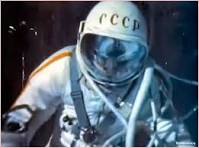
March 18, 1965: Alexei Leonov floats outside Voskhod 2 on history’s first spacewalk.
*****
Sixty years ago today the world was astounded by the latest Soviet triumph in what was then called manned spaceflight. At 10 a.m. Moscow time (2 a.m. on the East Coast of the U.S.),n March 18, 1965, The U.S.S.R. launched the spaceship, Voskhod (“Sunrise”) 2 with Pavel Belyayev and Alexei Leonov. Ninety minutes later, as they complete their first orbit, Leonov squeezes through the open hatch of a cylindrical airlock, pokes his helmet bearing the Cyrillic letters for USSR — CCCP — into the void of orbital space. He slowly pushes himself up through the narrow opening, freeing his hands to grip the outer rim of the hatch, bracing his eyes against the intense glare of the sun. And looks down on the Black Sea. He removes the lens cap from a movie camera, sends the cap floating away. First with one hand, then the other, he lets go and floats free, drifting away from the spaceship. Drifting on the end of a tether, legs stiff, turning, doing a somersault After l0 min., now over the Pacific Ocean, he floats back to the open hatch where he removes the movie camera and shoves it ahead of him into the airlock. Which he enters head first, 12 min. after he left. A television camera has shown the feat in fuzzy black and white to all to the world.
The magazine Aviation Week & Space Technology, proclaims the walk in space another major pioneering achievement by the Soviets. Opines that their “constant progress” indicates a technically sound program. That the flight opens up a new chapter in the history of spaceflight. That it is the first step toward the construction of large space stations. They predict the Voskhod will provide a tremendous capability for long-duration flights and missions involving rendezvous and docking between two such vehicles.
However, during the flight, Moscow ceases giving updates for a period starting on orbit 12. Had something gone wrong? Observers in the West speculate that a rendezvous mission had been planned with a Voskhod 3, canceled late in its countdown. Could there have been a communications failure? Problems with the retrorocket system? Problems with that system definitely must have occurred at some point.
Voskhod 2 lands the next day at 12:02 p.m. Moscow time on its 18th orbit after a flight of 26 hrs. Normally, to land at the primary landing site, Voskhod should have come down an orbit earlier, a sure sign that some problem had prevented retrofire on that orbit. Later, it would be revealed that a sensor in automatic orientation system failed, forcing Belyayev to make a manual retrofire one orbit late. They came down 500 miles northwest of the prime zone in a densely forested area near the city of Perm, deep with snow cover. Rescuers had to reach them on skis. It took two days before they could be helicoptered out.
The Voskhod was shrouded in mystery, as the Soviets released no photos, no details of the spacecraft. In the absence of hard facts, speculation in the West imparted vast capabilities to Voskhod:
That it was new generation of spacecraft leapfrogging the U.S. Gemini about to make its first manned flight. That it was widening the Soviet’s lead over the U.S. That the spacewalk was a step towards building space stations which could be used to launch missions to the moon. A Russian space official, Vasily Seleznev, was quoted, saying, “The target now before us is the moon, and we hope to reach it in no distant future.”
Who would have believed that Voskhod merely was a modified one-man Vostok. That it was incapable of rendezvous. That this would be the last Voskhod flight. Who would have believed that the Soviet Union would not launch another man into space for 25 months. And that when they flew again, the flight would end in tragedy.
 tlitiptree