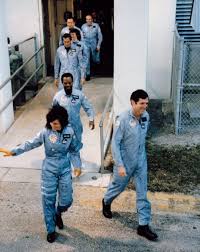
Thirty-nine years ago: The Challenger crew leaves for the pad, led by Dick Scobee, followed by Judy Resnik, Ron McNair, Mike Smith, Christa McAuliffe, Ellison Onizuka and Greg Jarvis.
*****
It’s January 27, 1985, the 18th anniversary of the fatal Apollo fire. Discovery, completing the 15th Shuttle mission, STS 51- C, with Ellison Onizuka as one of the mission specialists, faces the fires of reentry. The deorbit burn at 3:18 p.m. EST commits the Shuttle to a landing at the Kennedy Space Center. There she is, coming around the hack, lining up with Runway 15, back from the black of space and her black military mission, the first fully dedicated to the Department of Defense. Wheels down for a landing at 4:24 p.m.
*
It’s January 27, 1986, 4:38 a.m., launch day for the 25th Shuttle mission, including the first teacher in space, Christa McAuliffe. And with Ellison Onizuka, as he was a year before, as one of the mission specialists. Tanking of Challenger’s External Tank with liquid oxygen and liquid hydrogen was completed less than a half hour ago. The flight crew is about to begin the well-worn rituals of launch morning.
Accidents usually don’t have a single cause. What will transpire in the next 31 hours involves a series of miscues, wide fault lines that converge in a nexus of disaster. Temperatures this morning are just above freezing, and winds are brisk, rattling the tiny “white room” at the 195-ft. level where the crew access arm is snugged against the side of Challenger. Skies are clear, providing a deep blue backdrop for sunrise. As the sunshine spreads, the crew arrives to board the Shuttle. Mission Commander Dick Scobee tells the close-out technicians, “What a beautiful day to fly.” He and Pilot Mike Smith enter the Shuttle first, followed by Onizuka, who will take the righthand seat behind Smith, and Judy Resnik who will take the seat at Ellison’s side looking over the shoulders of the pilots. She will serve as flight engineer, assisting them. Then came the crew members seated below in the middeck, Greg Jarvis and Christa McAuliffe, and seated by the circular hatch, Ron McNair.
It’s just after 8:30 am. EST. As they shut and locked the hatch, the close-out crew is running ahead of schedule. Until they observe the “hatch latched and lock” indication on a panel at their shoulders. Two microswitches should verify the hatch is securely sealed. Only one does. One must proceed carefully here — if the hatch isn’t sealed, the crew, wearing just coveralls, will die as the cabin loses air. The close-out team uses a lighted mirror extended in a small pressurization port at the center of the hatch to observe the locking pins. They appear in place. But the call must be made by the Shuttle managers in the Launch Control Center. Who discuss. Who analyze the problem. And discuss some more . . . as winds begin the gust. Wind limits for a landing at the Shuttle Landing Facility, used in case of a Return-To-Launch-Site abort, are a headwind of 29 mph or a crosswind of 17 mph. Westerly winds have begun to gust above 17 mph.
It’s an hour later. Managers have come up with another scheme to verify the hatch is latched. They have the close-out crew use a T-shaped tool to open and close the latches as Ron McNair leans close to the hatch from the inside and observes the locking pins. At first he can’t see them. Then barely does, enough to verify they appear latched. Finally managers give the go to close out the white room. The next step involves removal of a ground-use handle used to open and close the hatch, a three-legged “milk stool” which bolts securely to the metal frame of the hatch. A long-shafted wrench is used to unscrew the three bolts. The first two come out quickly. The wrench spins freely on the third. The threads of the bolt, made of tough Iconel alloy, have stripped.
The technicians try angling the wrench against the bolt hoping to gain a grip against the stripped thread. Nothing works. So they call for a battery-operated drill and hacksaw to be brought to the pad. That takes 45 min. as the winds continue to gust stronger. Weakened by the cold, the battery quickly dies. More batteries are brought to the pad, taking a half hour to arrive — but the alloy of the bolt head is too tough to drill. We need to cut off the milk stool, the pad technicians radio to the Launch Control Center, but the cumbersome management decision process takes time. Finally the pad team is given the go, and quickly cut off the milk stool and finished preparing the hatch for launch.
By then the crosswinds are gushing 5 mph above limits. Still launch managers hold out hope the wind will dissipate. Aboard the Challenger, the crew suffers, backs aching pitched up like half folded jackknives on the hard, unforgiving launch seats. They out the “indefinite hold.”
At 12:28 p.m. EST, the hold becomes definite. The launch is scrubbed, the count recycled for a launch the next morning.
*
It’s January 28, 1985. After midnight, Houston time, Ellison Onizuka arrives home from STS 51-C, his first flight. Filled with the wonder of his first spaceflight, he is unable to sleep. Stays up all night.
He has exactly one year to live.
Two days later, at the Cape, the spent Solid Rocket Boosters, retrieved at sea, are being inspected. They are comprised of segments fitted together, held by “tang and clevis” fittings — think of them are interlocking fingers, the joints sealed by two rubber o-rings, a primary and a back. Those o-rings prevent the hot gases of combustion from breaching the joints. There has been problems with the seals on previous flights. They don’t work as expected. The forces of ignition, engineers have determined, cause the steel cases of each segment to compress, ballooning outward just enough that the primary o-ring does not seal for a millisecond. Hot gases have scorched the primary o-ring on some flights, even blown by it during ignition.
Roger Boisjoly, an engineer with Morton Thiokol, makers of the boosters, is observing as the segments are being pulled apart. He’s alarmed to see that grease packed between the primary and backup o-ring is blackened by the products of combustion and vaporized rubber from the o-rings. On both boosters, for a significant distance around their circumference, the primary o-rings have been burned and breeched. The worse case of hot-gas “blow by” they’ve seen.
Could the cold temperatures be the cause? Boisjoly thinks so.
*
It’s 2 a.m. on January 28, 1986. An ice inspection team is on its way to Launch Pad 39-B where Challenger sits. It’s the first time the pad will be used since the Apollo-Soyuz launch of 1975.
Hours ago, a series of meetings ended, the weary meetings that started after the scrub and went on into the night. Some of the meetings concern the freeze protection plan for the pad. Instead of the time-consuming task of draining the water systems, as was done the year before for STS 51-C, they let water trickle through and out drains to prevent freezing. But that is creating ice on the pad structures, waterfalls of icicles that could break off and strike the Shuttle. This is what the ice team is assessing in the early morning hours.
Another set of discussions in teleconferences between Morton Thiokol and NASA managers at various locations concerns the temperatures of the Solid Rocket Boosters. Based on the flight a year before, Thiokol engineers recommend waiting for warmer temperatures. Yet they don’t have actual test data to prove it’ll be too cold to launch. NASA demands proof. NASA manager Lawrence B Mulloy, at the Marshall Spaceflight Center in Huntsville, Alabama, tells them over the voice link, “My God, Thiokol, when do you want me to launch? Next April?”
Thiokol’s management steps in, overrules their engineers. Thiokol now recommends launching.
The ice team reports that ice is so extensive on the Fixed Service Structure that it poses a threat to launch.
It’s 6 a.m. The astronauts are awake after gaining an extra hour of sleep as launch teams work the issues caused by the ice on the pad. Launch time is slipped an hour. Onizuka sends a warm flight jacket ahead to the astrovan that will take them to the pad.
It’s 7 a.m., the coldest period, just after dawn. Temperatures are 24 degrees (F). The ice team has returned to the pad, trying to break up ice that has formed in the sound suppression toughs (which use water to deadening the strong acoustic shock of liftoff). They take temperatures readings which show that the aft segment and skirt of the righthand Solid Rocket Booster is just 8 degrees (F), due to the proximity of the super-cold propellant lines and the External Tank.
The ice team attempts to break up ice forming in the sound suppression troughs. A skin of ice keepings forming despite the thousands of gallons of antifreeze that have been added to the troughs.
It’s now 8:25 a.m., and the astronauts arrive at the 195-ft.-level crew access arm leading the the white room snugged against the hatch. Despite the cold, Scobee, looking at the clear skies, says, “This is a beautiful day to fly.”
Onizuka takes a ribbing from the close-out crew because his warm jacket carries the patch not of this flight but of his one a year ago. He must take the jacket off before crawling through the hatch.
Resnik and McAuliffe stamp them feet and slap their arms to keep warm. Just before she enters the Shuttle, Resnik tells the school teacher, “The next time I see you, we’ll be in space.”
It’s just before 9 a.m. and the hatch is swung shut. McNair verifies that the latches are shut and locked. Up on the flight deck, Onizuka jokes, “My nose is frozen.”
At the final planned hold period in the count. the launch managers dispatch the ice team for one last check. It’s 11:15 a.m, with launch sent for 11:38 a.m. Inside the cockpit, the astronauts speculate that the launch will be postponed. The sun has caused considerable melting, yet ice still clings to the west side of the tower. Still the go is given. Scobee calls to the crew over the intercom, “All right!”
Ice is not the only concern. At high altitude, a strong wind sheer, sharp cross currents of wind that will buffet the Shuttle, has been detected. It remains within flight limits.
It’s less than 2 min. to launch. Scobee tells the crew, “Welcome to space, guys.”
It’s 6 seconds to 11:38 a.m. Challenger’s three Main Engines ignite and build up thrust. Scobee tells the crew, “There they go, guys.”
Resnik shouts, “All right!”
The Shuttle rocks forward due to the thrust of Main Engines. When it springs back to vertical, the twin Solid Rocket Motors fire. Unknown to anyone, the aft field joint of the righthand solid rocket did not seal within the first 300 milliseconds, allowing hot exhaust gases –at 5,000 degrees (F) — to blast against the primary o-ring along the side facing the attachment to the big External Tank. Both o-rings are vaporized along an arc of the joint. Milliseconds later, the hold-down bolts are fired and release. Liftoff of Challenger, carrying the second Tracking and Data Relay Satellite. As the vehicle rises, black puffs of smoke, matching the vibrations along the length of the solid rockets, escape from the compromised joint. They go on for 2.5 sec., then miraculously stop. Somehow the burned particles of the solid propellant have sealed the joint.
Then, just before “Max-Q,” the zone of maximum air pressure on the Shuttle, Challenger slices into the wind sheer. In the cockpit, Smith comments, “Looks like we got a lot of wind here today.” Indeed, it’s the strongest wind sheer ever encountered by a Shuttle.
It’s 1.5 sec. later. Probably due to the force of the wind, the tenuous seal created by the burnt-propellant soot crumbles. A flame appears, like a blow torch striking the External Tank. In just 3 sec., the torch breeches the skin of the hydrogen tank, fuel disgorging in a blooming stream. And ignites in a fast fire (rather than an explosion). The aft attachment between the solid rocket and tank breaks. The rocket pivots around its upper attachment and crashes through the skin of the liquid oxygen tank of the External Tank. Challenger’s Main Engines are starved for fuel, and the Shuttle’s computers dutifully begin to shut them down. Mike Smith just has time to say, “Uh-ho,” before the power goes out. Challenger, no longer steered by its Main Engines, has begun tumbling. The last data bit of data from it is sent at 11:39:13.628 a.m. EST., about half a second after Smith’s exclamation over the intercom. Challenger breaks into pieces like a shattered egg.
The breakup occurs at an altitude of 46,000 ft., a velocity nearing mach 2, The crew module, trailing bundles of wires, remains intact. it soars out the cloud of propellant in its own final flight. Indications show that the crew was alert and aware for at least part of the time. Individual emergency air packs had been switched on. Likely it was Ellison Onizuka who reached forward to turn on Smith’s air pack, which could only be reached from behind. Changes in switch positions indicate that Smith attempted to call up backup power from a panel at his side. There was no backup anything, the only light provided by the windows, the only sound the atmosphere tearing at the capsule-shaped crew module as it rode a weightless arc to 60,000 ft.
And then plunged, meeting, after 2.5 min. of terror, the ocean surface.
 tlitiptree