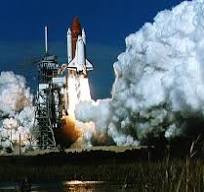
Forty years ago: Discovery is launched on the 15th Shuttle flight
*****
Two Januaries a year apart circle each other and meet, the nexus centered on astronaut Ellison Onizuka. The nexus also being cold weather. Onizuka, from Hawaii, hates the cold.
It’s January 23, 1985, the scheduled launch day for the 15th Shuttle Mission (STS 51-C). For three nights, subfreezing temperatures have smothered central Florida and the Kennedy Space Center where Discovery sits on the pad. “The freeze of the century” they are calling it. The same deep cold forced the second inauguration of Ronald Reagan inside. Fearing that ice forming on the External Tank or launch tower could break off at launch the damage Discovery, the launch was postponed a day. Pad crews race to drain water systems that could freeze and burst pipes.
The crew of T.K. “Ken” Mattingly, commanding his second shuttle flight. Loren Shriver, pilot; Jim Buchli, mission specialist along with Ellison Onizuka, and Gary Payton of the Air Force as payload specialist, stands down for 24 hours. After a cold start to the day, temperatures on the 24th were forecasted to rise quickly. The flight, the first exclusively for the Department of Defense and therefore payload, mission, and even launch time is kept secret. Originally the mission was to fly as the 10th Shuttle flight at the end of 1983. It’d been delayed due to problems with the Inertial Upper Stage (IUS), developed by the Air Force but also used by NASA to launch its Tracking and Data Relay Satellites. A seal in the second stage of the IUS failed during the launch of the first Tracking and Date Relay Satellite from STS-6 in January 1983. The IUS was one aspect of the flight the Air Force did not keep secret, anxious for good publicity. Meanwhile, the identity of the satellite was revealed in The Washington Post: An electronic eavesdropping Sigint (Signal Intelligence) spy satellite weighing about 5,000 lbs.
*
It’s one year later, January 23, 1986, at one time the launch target for the 25th Shuttle flight (STS 51-L). Now it’s crew arrival day, the launch slipping to the 24th and then the 25th. It’s also arrival day for Columbia on the back of its 747 carrier aircraft, coming back from a delayed landing at Edwards Air Force Base, California, capping a much delayed mission (61-C) Those delays have fallen like dominoes from the sky on the flight schedule and Challenger. All due to spare parts. Or the lack of them. Cannibalization of parts from one Shuttle to another has become routine. As soon as Columbia landed on January 18, parts needed for Challenger — such as propulsion system temperature sensor and General Purpose Computer — were removed and flown to Kennedy on a T-38 jet. Installation of the parts formed one reason the flight was slipped.
Columbia arrived first at the 15,000-ft.-long Shuttle Landing Facility runway, followed in late afternoon by the 51-L crew. Astronauts Dick Scobee, the mission’s commander, pilot Mike Smith and missions specialists Judy Resnik, Ron McNair, and Onizuka, arrive in T-38 jets and taxi to a position near the waiting press. Payload Specialist Greg Jarvis and Teacher-in-Space Christa McAuliffe have arrived on a NASA Gulfstream jet and join the others on the runway. The focus of the press — and public — is of course the teacher in space. McAuliffe enthusiastically says, “No teacher has ever been better prepared to teach a lesson.”
As the ceremonies conclude, the sun is setting on a perfect day.
*
It’s January 24, 1985. The morning shakes off the overnight cold, temperatures rising into the 60s. Still this will make for one of the colder launches in Shuttle History. The 51-C crew arrives at the pad at 11 a.m., usually timed 2.5 hrs. before launch. The sky is clear “Air Force blue,” much as Onizuka will see a morning a year hence. NASA’s PR machine comes to life just before liftoff at 2:50 p.m. And once orbit is achieved, falls silent. Afterwards, the public is only informed in short updates that all systems “are performing satisfactorily.”
It’s January 24, 1986. In a time-honored tradition, the crew is driven to the famous but ramshackle NASA beach house dating back to the days of the Mercury program. There they meet their families one last time before launch. After midnight, Fueling of Challenger’s orange External Tank begins, aiming for launch on Sunday, January 26.
*
It’s January 25, 1985. Aboard Discovery, the Sigint satellite on its IUS stage, taking up most of the payload bay, is raised at an angle on its tilt cradle. At about 7 a.m. EST, it is released, gliding above the Shuttle as Onizuka and the crew watch. About 45 min. later, the first solid motor of the IUS fired, starting the journey to geostationary orbit.
The next time the IUS would fly would be a year later aboard Challenger.
It’s January 25, 1986. A cold front is approaching Florida, threatening the launch the next morning. And Vice President George Bush is due to watch the launch. No one wants to see him sitting in the rain waiting for a launch that never occurs. This is a critical call. Air Force forecasters predicted that the leading edge of the cold front will reach the Cape by 5 a.m, followed by fog and increasing rain. They put the change of squeezing in a launch at 50/50. However, the skies should clear by late afternoon, with favorable conditions for launch the next day. In the evening, NASA management decides to postpone the launch until 9:37 a.m. EST on January 27.
*
It’s January 26, 1985. Discovery orbits in the silence of secrecy, conducting secondary experiments, and preparing. Silence was appropriate to the awe beyond words that Onizuka felt looking down at Earth, at his Hawaiian Islands, at the sunrises and sunsets set against the black void of space. Yes, a magnificence beyond words. And such a short, intense flight. Who wouldn’t want to return?
Dawn touches Cape Canaveral on January 26, 1986. The sun lifts into clear blue skies. Perfect weather for a Shuttle launch. Except, of course, too late — the launch had been pushed until tomorrow. The front that was forecasted to bring clouds and rain has stalled to the north, with an unanticipated secondary low forming behind it, blocking the build up of arctic air mass. The perfect weather holds through what would have been the launch window. Dick Scobee and Mike Smith make practice landings in the Shuttle Training Aircraft, until the front finally arrives, bringing rain in the afternoon. No words can express the frustration of the crew, of NASA itself at the lost launch opportunity. Already tendrils of cold are reaching the Cape. The forecasted temperature for the 9:38 a.m. launch has dropped 15 degrees to 40 degrees (F).
*
Far to the north, even worse cold is lurking, gaining strength, pushing against the gates of the stall front. For the second time in two years, a “freeze of the century” points like an arrow of ice at Florida, due to strike, but thankfully not until the evening after Challenger should be safely in orbit
That is, if January 27th, the 19th anniversary of the Apollo 1 fire, changes its fortunes for the Shuttle.
END of PART 1
 tlitiptree