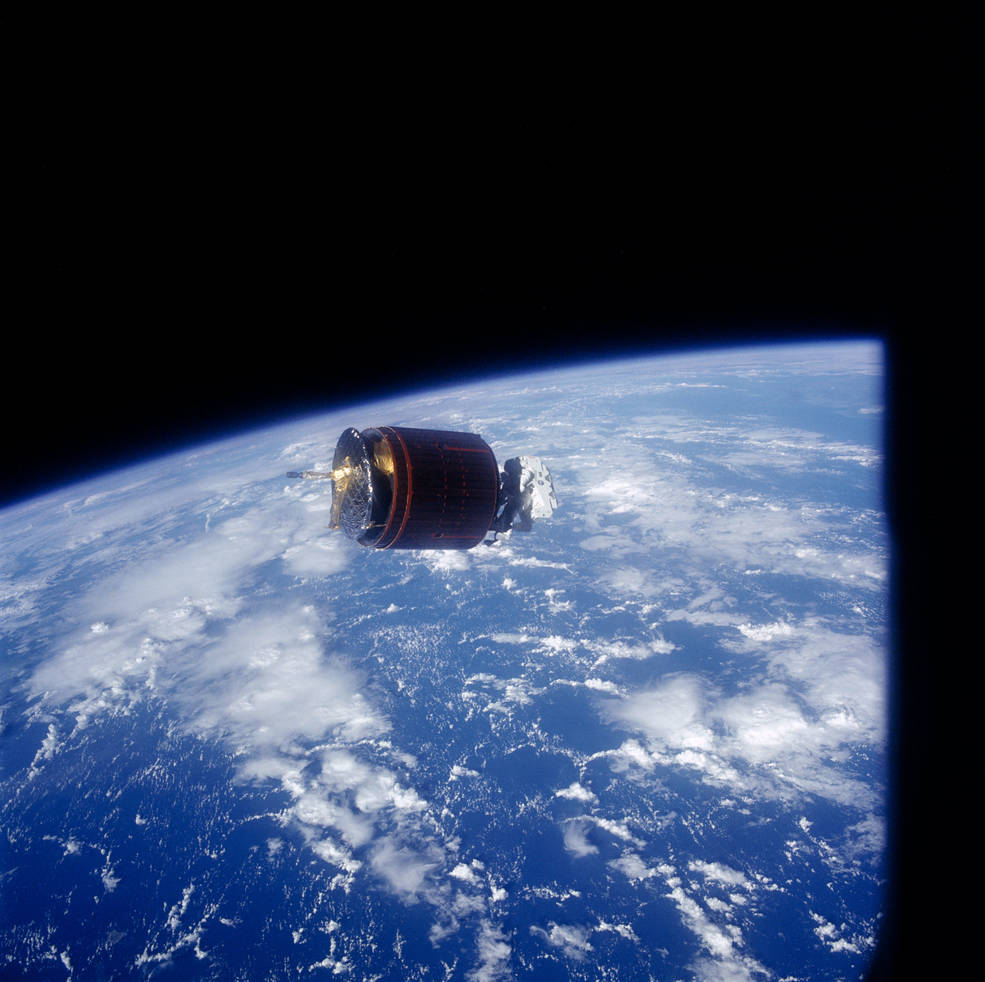
Nov. 12, 1984: Joe Allen, at right, latches onto the stranded Palapa communications satellite.
******
Early on Nov. 12, 1984, the fourth day of our STS-51A mission aboard Discovery, having successfully deployed two communications satellites of our own, we’re ready to begin to fill our payload bay again. Today we’ll attempt to retrieve the stranded Palapa communications satellite.
The closing chase begins at 4:34 (EST) with the first of four burns conducted by our commander, Rick Hauk, and pilot, Dave Walker. Down in the middeck, the spacewalk team of Joe Allen and Dale Gardner are suiting up, assisted by Anna Fisher.
By 7:56 a.m., after our third midcourse burn, we’re 7,000 ft. from Palapa, starting to slow our approach, closing rate now 13.5 ft. per sec. We’re nearly ready to depressurize the cylindrical airlock between the middeck and the payload bay.
By 8 a.m., we can see Palapa, 9 ft. long and 7 ft. in diameter, shining in the sun. Passing over Baja California, we inform Houston, “And you’ll be pleased to hear that Palapa is bright as can be.” We’re now 5,600 ft. from our quarry, closing at 9.7 ft. per sec. At 8:04 a.m., Anna tells Houston, “This is Discovery. We’re going to depressurize the airlock.”
Three minutes later, Rick takes over manual control from the station at the rear of the flight deck, windows overlooking the payload bay. We’re 3,500 ft. from Palapa, closing at 6.5 ft. per sec. In another three minutes, we’re 2,000 ft. away, continuing to brake. At 8:15 a.m., our closing rate is down to 3.5 ft. per sec. Joe Allen and Dale Gardner open the outer hatch. As it rotates above the payload bay, stabilized by its spin, Palapa splashing sunlight like a sea beacon.
And our spacewalkers exit. Even as we continue to close on Palapa, the duo begins checking out the Manned Maneuvering Unit (MMU). Joe will use the jet backpack to grab the satellite.
It’s now 8:38 a.m., and Dave tells the spacewalkers, “Go ahead and start the MMU check, including the docking device that attaches to the front of his suit. And quite a specialized device is it, designed to capture drum-shaped satellites that were not designed for retrieval, presenting a surface of solar cells capped with a circular sunshield at at the top and an spent rocket nozzle at the other end. The docking device consists of a 6-ft.-long “stinger” pole to be inserted in the engine, three spring loaded latches at the tip. A circular braking plate is located in front of the astronaut at the base of the stinger. Once the latches make a loose “soft dock,” the pole will be retracted until the base plate locked against the base of the satellite for a solid “hard dock.”
We’re now within 150 ft. of Palapa. Joe test flies the stinger to targets in the forward part of the payload bay, checking the balance of the combination. “It’s like I’m flying in the simulator,” he reports, working in the lights of the payload bay as we swing through the nightside of orbit. He’s working slightly ahead of the timeline. Now over Australia, we’re about 35 ft. from the satellite, hanging there over our payload bay.
He’ll wait until sunrise to make his move toward the satellite. As he waits, Joe says, “Boy, how can I miss. A few more feet and I could grab it by the omni.” That’s the omni antenna poking up like a stalk at the edge of folded main antenna at the top.
At 9:32 a.m., we call to him, “The sun is coming up, guy.” We’re approaching Mexico.
As the light quickly spreads, Joe says, “Oh, my gosh, look at it.” He heads out, like a knight with a jousting lance. He heads out into the bright sunshine. Which, shimmering off the satellite, blinds him. Still he drives straight and true for the center of the burned-out engine, slowly merging with the satellite, spearing it. He’ll manually toggle the three latches open. “And I’m starting to toggle — soft dock, soft dock. I’m going to spin with it.” The satellite is still in its stabilizing roll. “OK, I’m pulling right down with no gas at all.” He clamps down and the satellite, the braking ring clamps down solidly — and Allen begins turning with the spin of the satellite. He uses the MMU jets to halt the spin.” “Stop the clock,” he calls, “I’ve got it tied.” The satellite and its human rider are motionless. It’s 9:44 a.m. He’s nabbed the satellite in only about 10 min.
Now Anna Fisher, operating the RMS arm from a station on the rear right of the flight deck, takes center stage. Her first task, grapple a pin-like fixture on the side of the stinger device. The arm is cocked and standing by for capture.
“Keep it coming Anna,” the spacewalkers say.
She tells them, “I see the grapple fixture. I’ll give a call.” Then, as Allen continues to stabilize the satellite, she says, “Joe give me a little more right yaw.”
“OK — right yaw. Mark.”
At 9:49 a.m., she puts the arm in motion The spacewalkers call, “Take it in. You’ve got plenty of room.” It doesn’t take long — in just 2 min., she snares the grapple fixture. Joe calls, “Good work, Anna. Way to go!” Joe rests a few minutes attached to the satellite now in Fisher’s control.
Walker tells him, “We’re going to start moving the RMS, Joe.” The plan is to swing the satellite top down over the payload bay, where Dale Gardner in a set of foot restraints awaits it. He will clip off the protruding omni antenna and clamp an A-frame bar across the circular sunshield at the top of the satellite. A grapple pin is fixed to the center of the A-frame, needed so the robot arm can position the satellite on a cradle in the payload bay.
Just 31 min. after Joe nabbed the satellite, Dale calls, “The antenna is cut. We have a souvenir omni antenna.” He then prepares to attach the A-frame, lifts it to the satellite and fit it. Something is wrong. He can’t clamp it over the sunshield at the satellite’s top. Small protuberances, electronic boxes that were missed in designing the A-frame, are thwarting him. He looks for a way to cut or unbolt them. It can’t be done. It’s only a matter of a quarter inch. But that’s enough to ruin the plans.
We were out of communications range at this point. Coming into contact with Houston at 10:50 a.m., Rick Hauk informs them. “We’ve got a problem here. “We are proposing to go to the no A-frame procedure.” This backup plan, developed just three weeks before the flight, involves one astronaut holding the satellite in his hands, in effect, become a human A-frame.
“Go to plan B,” Houston says. Joe releases himself and the MMU from the stinger device, which is still grappled to and under the control of the RMS. “OK, I’m going to back off,” he says. “. . . I’m not interfering with the arm, am I?”
By 11:13 a.m., Joe is in the payload bay and performs a “quick doff” off the MMU. “I’m going over to help Dale.” He sets up foot restraints high on the sill of the open payload bay. Held by his feet, he looks like he’s working on an invisible stepladder. Anna calls, “OK, I’m going to bring it over.” She uses the arm to position the satellite, top down, so that Joe can loop a tether around the sunshield and use that to hold the satellite. Voices fly back and forth clipped with seriousness: “Hang on just a second — you’re doing just fine . . . A little bit more — stop. . . . Move it towards you. . . Be careful when you say you’ve got it, Joe.”
“She’s ready to release, Joe. . . OK, you’ve got it, Joe.”
“I’m going to move it ever so slowly,” he says.
“You’ve got to take it to your right,” we direct from the flight deck.
“I’m bending to the right.”
“Lean back,” Dale tells him. Joe slowly swings the satellite’s bottom toward Dale in the bottom of the bay. Dale reaches for the stinger device protruding from the end. “OK, Joe, I’m going to put it where I want it — you just hang one.” He removes the stinger. “Take it easy up there and relax, Joe. I’ve got the little old stinger in my little old hand.”
We ask Joe how he’s doing.
“Not very — ha. I’m doing OK — never you mind. The view is out of this world.”
By 11:55 a.m., our spacewalkers are settling into a nice work pace. “We’re in good shape,” Gardner says. In just a half hour, Dale has taken out the stowage adapter needed to clamp Palapa’s base to the floor of the payload bay. The adapter has nine latches to attach it to the satellite, and Dale begins torquing them down, much as you would change a car’s tire. “We want a good used car here,” he says. Three triangular arms on adapter then can clamp the satellite to a U-shaped pallet in the bay. By 12:55 p.m., our spacewalkers are ready to clamp down the satellite.
Have you got the satellite, Joe?” Dale asks.
“I’ve got it.”
“I’m going to come out of the foot restraints and cross over. . . . OK, bring it down, Joseph.” The duo wrestles the satellite down. “Very, very gently, Joseph.”
At 1:12 p.m., the spacewalkers exclaim, “All right, we’ve got it here! We’re home!” Palapa is secure.
Applause ripples through Mission control.
 tlitiptree