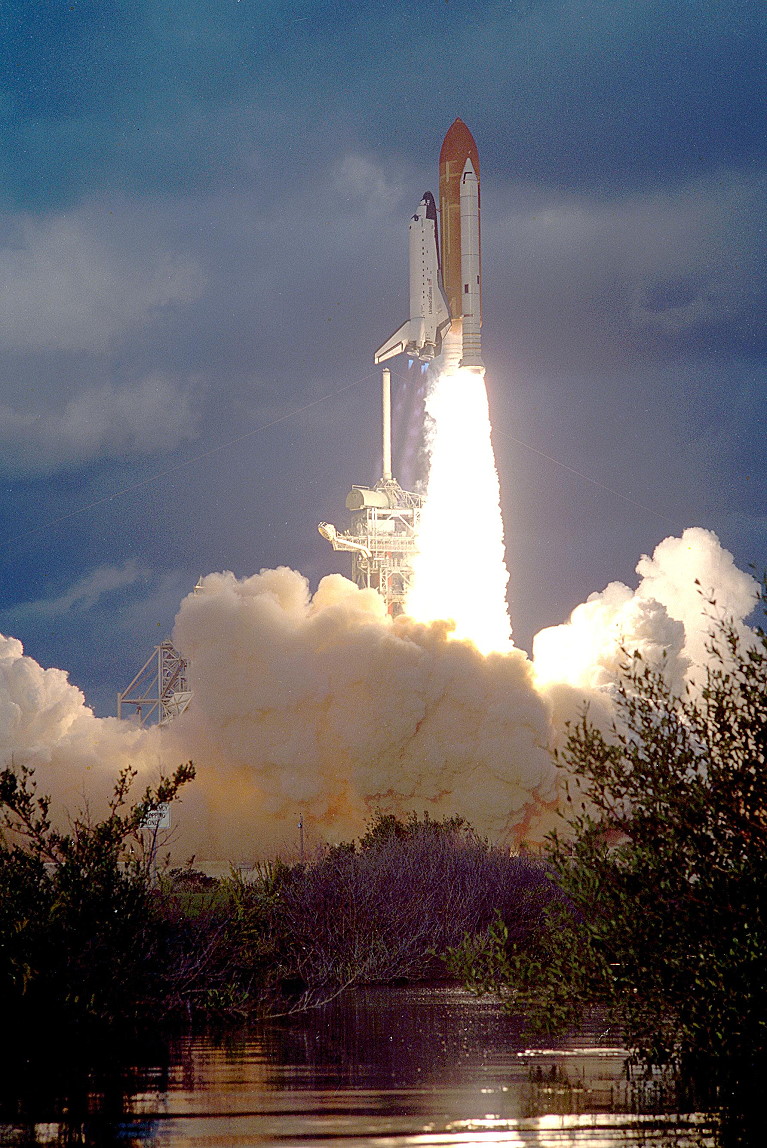
Nov. 8, 1984: The chase is on! Discovery launches on a flight two deploy two communications satellites and retrieve two others.
*****
Today, Nov. 8, 1984, is Dale Gardner’s birthday. And we aim to give him quite a birthday celebration — launch aboard Discovery. We are the crew of the the 14th Shuttle mission flight that includes him: Rick Hauk, commander; David Walker, pilot; Joe Allen, mission specialist, Anna Fisher, mission specialist. And of course our birthday boy. He and Joe Allen will conduct two spacewalks flying the Manned Maneuvering Unit — the jet backpacks flown twice before this year — in an effort to retrieve the two communications satellites stranded in low orbit in February after deployment from the 10th Shuttle flight. Oh, and along the way, we’ll also deploy two communications we’re carrying up.
Some say our flight, STS-51A, is the most ambitious mission since the Skylab repair in 1973; others call it more challenging than anything since the first moon landing. We will make 44 orbital maneuvers as we deploy our two communications satellites and retrieve the stranded Palapa and Westar satellites. Those two, not designed for retrieval, were given up for lost after their Payload Assist Module (PAM) upper stages failed due to defects in the nozzles. They are not equipped with pin-like grapple fixtures that our Remote Manipulator System (RMS), the 50-ft.-long robot arm that will be operated by Anna Fisher, can latch onto. So we will attempt to nab them using a lance-like probe attached to the front of the astronaut flying the MMU. He fly to the satellite, 35 ft. from the Shuttle, align his “stinger” with the engine nozzle and drive it in. Latches in the tip will spring open securing the hold.
At least that’s the plan, developed in just months. Risky? — you bet. Those MMUs, with limited fuel, are tricky devils to operate. Especially with the Shuttle and satellite in close proximity, a three-body problem. And a lot riding on those bodies. We’re trying once more to prove the flexibility and capability of the Shuttle system, crucial to expanding its role. Failure would be a blow to the entire Shuttle program.
Frankly, we’ll be lucky to retrieve one of the satellites.
*
It’s Dale Gardner’s 35th birthday. You’d think we’d let him sleep in, but he and all of our crew are woken at 3:25 a.m. EST., aiming to light his birthday candles with a 7:15 a.m launch. We were scheduled to launch yesterday, but unseen at 20,000 to 50,000 ft., winds were whipping around at 90 mph, creating wind shears that could tear the Shuttle apart. A half hour before launch , the upper level wind unabated, liftoff was postponed.
This morning, nearly a dozen weather balloons are sent aloft and show that the wind shear has eased. A cloud deck, scattered at 3,500 to 5,000 ft., is clearing. We’re strapped in and go for launch.
That is, until about to come out of the planned hold at T-minus 20 min. A key console in the launch center, the Main Integration Console, fails. The four controllers at the console along with the Test Conductor dash to backup computers at opposites ends of the launch control room and race to enter in 110 key commands manually. They make it!
. . . And we have engine start, feel Discovery sway and solid rockets’ bone-jarring ignition. We’re away — on time. The chase is on. It’ll cover 1,622,934 mi. to reach our first target, the Palapa on Nov. 12. By 11 a.m., we’re 17,000 mi. behind it.
Of course, along the way, we’ll deploy our two satellites, a Canadian Telesat H, that uses a PAM upper stage and a bigger Hughes Leasat/Syncom. On our second flight day, the Telesat will be the first to go, smoothly rising from the payload bay and heading for higher orbit. We’ll tell Mission Control, “We have an empty pallet in the cargo bay, and it looks like we’ll have room for a couple more satellites.”
 tlitiptree