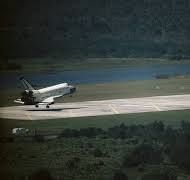
Oct. 13, 1984: Challenger, under the control of Bob Crippen, lands at the Kennedy Space Center to conclude Shuttle mission 13.
*****
Twice he was scheduled to make a landing at the Kennedy Space Center (KSC). Twice the missions he was commanding, STS-7 and STS-41C (mission 11) were diverted to California due to weather. Robert “Crip” Crippen gets his third shot at a Florida landing today, October 13, 1984.
We, a crew of seven, are flying Challenger nearing the end of the 13th Shuttle Flight.
Finally! This time the weather cooperates. At 11:30 a.m. (EDT) over Australia we make the deorbit burn. We’re headed toward the 3-mi.-long runway at Kennedy, half a world away. Our looping orbit with an inclination of 57 degrees to the equator — never flown before — has us reach the first touches of the atmosphere over the northern Pacific at 11:55 a.m. In the blaze of reentry we pass over Alaska, arc down over Canada, entering U.S. airspace over Minnesota. We skirt Chicago . . . Cincinnati . . . Knoxville . . . Atlanta. Then make a shallow turn out over the Atlantic near Jacksonville, turning back toward Kennedy, arriving at Titusville at 12:23 p.m.
Crip guides Challenger around the Heading Alignment Circle rolling out towards Runway 33. And at 12:26 p.m. plus 36 seconds, he sticks the landing. Wheels stop. Our flight of 8 days, 5 hrs., 24 min. and 25 sec. is complete.
“We had a super flight,” Kathy Sullivan, the first American woman to walk in space, proclaims. The number 13, starting out amid a series of problems, has journeyed from potential failure to success. But isn’t that the journey of every mission?
 tlitiptree