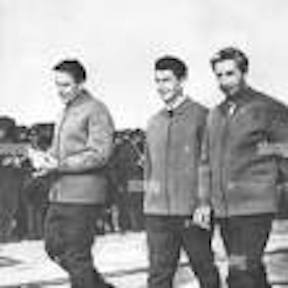
The Voskhod 1 crew (L to R) of Komarov, Yegorov and Feoktistov.
*****
Sixty years ago today, October 12, the Soviet Union shocked the world by launching Voskhod (meaning “Sunrise”). The era of single-seat space flights was over. Voskhod 1, seemingly an entirely new class of spacecraft carried three people: Vladimir Komarov, the pilot; Konstantin Feoktistov, an engineer and spacecraft designer, and Boris Yegorov, a medical doctor. In what would turn out to be his final official act, Nikita Khrushchev spoke to the crew during their third orbit. By the time he return, he’d been replaced by Brezhnev and Kosygin.
*
I am a spaceship of glass in the shape of a lens
riding on the wing of a feather back in time
sixty years, the old Sputnik syndrome rising
in shouts from Western “experts” who see:
— A new and more powerful booster.
— a larger, more advanced spacecraft
. . . why, it appears an “Apollo-class” vehicle!
leapfrogging NASA’s pitifully two-man Gemini.
Raise the alarm!
— a crew of three in shirtsleeves,
. . . so confident in their spaceship’s design
they don’t need spacesuits.
— so advanced the crew includes non-pilot cosmonauts
who perform advanced science in orbit.
–More flights sure to follow, perhaps a two-week mission,
–More flights sure to follow leading to space stations
used as a jumping-off platform for the Moon.
–As the British newspaper, The Guardian, writes,
“It now seems certain that the Russians will get to the Moon before the Americans.”
*
Of course it proved to be a ruse, a crew of three squeezed sideways in a capsule designed for one, a modified Vostok spacecraft. It did contain improved systems such a backup retro rocket and landing rockets fired just before touchdown to soften the jolt, yet was no giant leap forward. The crew didn’t wear spacesuits not because Voskhod was so advanced but because they couldn’t have squeezed into the capsule wearing bulky spacesuits. Dangerously, they had no escape means during the first seconds of flight. Yet it worked, and after flying 16 orbits in 24 hr.s, Vostok 1 landed successfully. Yes, a ruse that worked so well, why not try it again?
 tlitiptree