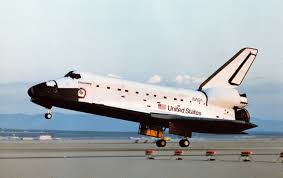
Sept. 5, 1984: Discovery touches down with a hydraulic leak in its righthand main landing gear.
*****
It’s our seventh flight day, September 5, 1984, with Discovery, free of that chuck of ice, we’ve reached the end of the orbiter’s maiden voyage. We’re doing much better than the maiden voyage of the Titanic. We’re Hank Hartsfield in the commander’s seat, Pilot Mike Coats to his left. Behind them Mission Specialist Steve Hawley serves as flight engineer, ready in case there is an emergency. Mission Specialist Judy “J.R.” Resnik is to his right. She’d been seated down on the middeck for launch and has traded places with Mission Specialist Mike Mullane for landing. Before flight, the two had determined their launch and landing spots by a coin toss. So Mullane along with Payload Specialist Charlie Walker is now down in the middeck, with a view of nothing but a row of lockers.
We’re on our 96th orbit, and down at Edwards Air Force Base, John Young flying the Shuttle Training Aircraft reports all is ready to support landing. Because we’re flying a new orbiter, just to make sure everything on the orbiter works, we’re targeted to land on the wide expanses of Edwards, a 7.5-mi.-long lakebed runway.
At a flight elapse time of 5 days, 23 hrs. 35 min., we’re given word. “Discovery, Houston, you are go for the deorbit burn.”
We’re over the Indian Ocean flying upside down and backwards, engines forward. This position gives us a good horizon reference. Our configuration is go. At 5:36 a.m., PDT, we ignite our twin Orbital Maneuvering System (OMS) engines. They burn for 2 min. 48 sec. We’re headed home.
Hank pitches Discovery around, nose forward and held 40 degrees high. In this position, the black tiles on the Shuttle’s belly will take the brunt of the heat pulse.
At an elapse time of 6 days, 2 min., we enter the communications blackout; now 32 min. until landing. The sun is just rising over the mountains east of Edwards. Everything goes as advertised through the flashing fires of reentry. Discovery bleeds off velocity in a series of S turns. In addition the computers command eleven test maneuvers. We’re still exploring the operational envelope of the Shuttle. Now 12 min. to landing, Mach 8.5. Swift as can be, we pass the coast of California, speed now Mach 4.5, altitude 100,000 ft., passing over Santa Barbara, range to Edwards 117 mi. Ground track still good. We pass south of Bakersfield, velocity down to Mach 3, range 73 mi. Mission Control calls, “Take air data.” This call tells us the data from our air probes is accurate and can be relied on.
We’re down to Mach 1.3, now 30 mi. from the runway threshold. There’s the sun rising over Leuhman Ridge. We pass below the speed of sound, heading for the sun before making a wide 270-degree alignment turn. Hank Hartsfield takes manual control entering the circle, the turn made at 30,000 ft. altitude. Coming out if it, he lines up with Runway 17 on the dry lakebed — about 90 sec. to landing and 8 mi. from the end of the runway. At 300 ft. altitude, Mike Coats lowers the landing gear. And Hank put’s her down right on the money 6:27 a.m. PDT, the main gear touching earth exactly on target, 2,500 ft. past the runway threshold, nose still held high. Hank slowly lowers it.
And just as the nose gear touches down, the righthand main landing gear strut sags low, causing Discovery to veer sharply to the right, catching Hank by surprise. He uses the Orbiter’s rudder to compensate and lets the ship to rollout a bit to the right of the runway’s centerline. After 1 min. 3 sec., we roll to a stop, completing a flight of 6 days, 57 min, 7 sec. The tense rollout consumed 10,285 ft. of runway.
Later we learn what caused Discovery to buck on the runway. The righthand strut had compressed 3 in. due to a hydraulic leak. That’s all it took to make the landing interesting. And demonstrate once again that nothing about the Shuttle is routine.
 tlitiptree