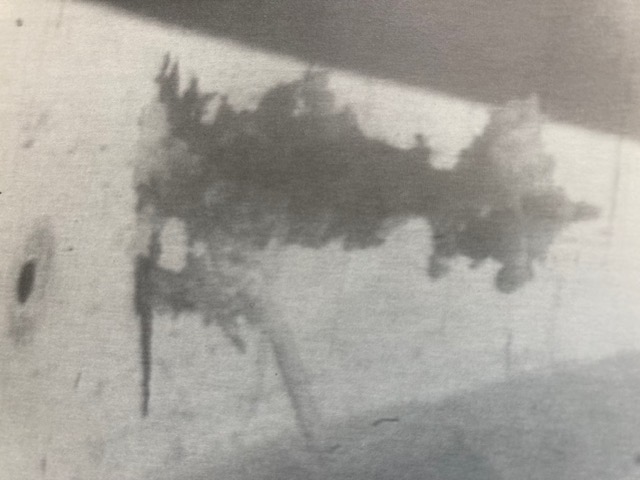
Forty years ago: Ice blocks the water dump ports of Discovery. On reentry, it could break off and damage the Shuttle.
*****
It’s September 4, 1984, the sixth day of our flight aboard Discovery on the 12th Shuttle flight. And the ice that formed like a gargoyle two days ago? It’s still there. Sill there, frozen around the supply water dump nozzles just above the leading edge of the left wing. Hopes that the sun would melt it or we could shake it loose are fading.
Yet yesterday, they told us it wasn’t a serious concern. Seriously? It could break off during our reentry and strike the lefthand OMS pod. That’s the hump-like pod aft of the cargo bay housing one set of our Orbital Maneuvering Systems (OMS) engines. Houston said the pods could withstand a strike as they had been strengthened with higher density tiles following the 11th Shuttle mission. That was done after a pod had been hit by ice during that mission.
Then later in the day, they came back and say, yes, it is a concern. Engineers at Rockwell, prime contractor for the Orbiter, reported that the Mission 11 damage was caused by a much smaller piece of ice, and the one hanging from Discovery could punch a hole in the pod. That’s not good. We began preparations for a spacewalk to clear the ice. At the same time, on the ground Sally Ride and Ron McNair conducted simulations to test if the ice can be knocked off with the Shuttle’s 50-ft.-long robot arm. The ice is located below the open payload bay doors where the arm operator cannot view it directly. And the TV views as the arm approaches the Shuttle’s side are poor. One miscue and that arm could rip the heat protection blankets around the water ports. Yet Ride and McNair were successful at knocking away the “ice” in several simulations.
That evening, we were told, “We just want to advise you guys that we will not be doing an EVA [spacewalk] tomorrow.” We’ll use the Remote Manipulator System (RMS) arm as a last resort.
Overnight the ice melted to about half its original size. We try another series of jet firings to shake it loose. No Joy. “We’ve still got the ice.”
It’s time to unlimber the RMS arm. We raise the payload bay door enough to give good clearance. Judy “J.R.” Resnik maneuvers the arm into the cocked position. Our commander, Hank Hartsfield, takes it on himself to make the final move to tap the ice. Moving in slowly. Very slowly. With the cylindrical end of the arm, he gently bumps the ice blob. And backs the arm away. And when he does, a large chunk of ice flies away into an orbit of its own.
“It worked like a charm,” Hank tells Houston.
“We got most of it,” J.R. observes. A small piece, maybe 5-in. long, remains. And throughout the morning, as we wrap up work on our experiments, it melts. We conduct more experiments, 20, than the 14 planned. We’re set for a landing in the morning.
The cause of the ice build-up? The dump ports both have heaters that should warm them to 300 degrees (F) and prevent icing. But the new insulation blankets used on Discovery in place of tiles may have blanketed the effectiveness of the heaters.
“I assume you don’t want a supply water dump this evening?”
` “That’s correct.”
 tlitiptree