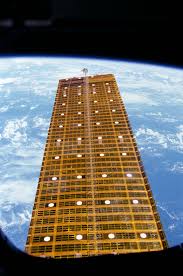
A test solar-power wing rises from Discovery’s payload bay during the 12th Shuttle flight, 40 years ago.
*****
So far, so good, even routine, as we the first crew of Discovery begins our fourth day of flight, September 2, 1984. We’re already three for three in deploying communications satellites, all now successfully reaching higher operational orbit. And yesterday, after the third went spinning on its way, something big occurred. Literally. We — or I should say Judy “J.R.” Resnik — began testing a 10-story-tall solar array. Called OAST-1 (for the Office of Aeronautics and Space Technology,” the solar wing consists of 84 panels folded accordion-style into a pack just 7 in. deep spanning the back of the payload bay in a support structure. Each panel is 15 in. high and 13 ft. wide. When fully deployed, the wing rises 102 ft. above the payload bay. Yesterday, under J.R.’s control, we raised the wing to a height of 73 ft. It rose at a rate of 1.5 in. per sec., taking 9 min. 19 sec. to reach 73 ft.
“It’s up and it’s big — stiff and steady,” she reported.
Our commander, Hank Hartsfield, told the ground, “The panels unfolded one at a time, except when some seemed to stick. Mast oscillated some until it got to 70 percent extension, and then it got just as firm as you’d expect — so nominal.”
Most of the 84 panels of the array do not carry actual solar cells. The main objectives focus on testing the structure itself. However three sets of different types of solar cells are mounted in the top panels of the array, producing 25 watts of power. If the entire array had been covered in solar cells, 12.5 kw of power would be produced, enough to power the Shuttle.
Retraction went smoothly. The panels slipped down, glimmering in the bright sunlight and flapping fanwise into their box. “It’s folding about as well as expected,” we reported. “Everything is well-behaved — few jiggles.”
J.R. extended the wing again, and as she did, we fired the Shuttle’s jets to observe how it reacted. It moved maybe 10 inches to the eye, and accelerometers mounted on the wing pinned the motion at just 3.5 in. Judy brought it down and then performed a third extension as we cross into the night side of the orbit over the South Atlantic. This test was to see how the wing reacted to the cold of dark space. We saw the wing bow in the middle like a sail catching a stiff wind. We performed more maneuvers, and Hank told Houston, “It’s as solid as a rock.”
J.R. observed, “We just saw a gorgeous sight with the sun coming up behind the array — it lit up like a Christmas tree.”
Today she’ll raise it to full height. Our morning routine is broken when an alarm sounds. It’s the temperature on the nozzle of the supply water dump port. The fuel cells produce water we periodically dump overboard. It’s a low temperature alarm. The water may be freezing as it exits the the port. We don’t want ice to build up there — on reentry, it could break off and damage the heat tiles.
With Houston evaluating the situation, we continue testing the solar wing. When J.R. has the wing up to 70 percent, we enter darkness. A laser takes measurements of the motion as the wing cools. We take measurement through several passes around the earth
Houston asks, “We’d like more information on the bowing observations . . . how much?”
Judy replies, “It seems that as it gets cold, it bows. When it warms up, it straightens out. But it’s difficult to quantify.”
She goes for full extension, and reports, “Houston, we’re in the process of extending. This time the panels aren’t sticking together . . . seems they just stick at the first extension.”
And there it is. We’re a schooner until full sail!
“Mast is extended to 100 percent. . . It took 3 min. 3 min. 41 sec. At 2 min., we had some plus-X wobbling of the mast.” We’ve completed the main tests of the wing, but we’ll conduct more operations with it tomorrow.
It’s now 6:45 p.m. (EDT), and during another water tank dump, Steve Hawley reports, “Temperature went down to 30 [degrees]. So it’s freezing up again.”
We train a TV camera on the port, located on the left side of the Orbiter just 10 in. above the leading edge of the wing. The view shows a big glob of ice like a gargoyle.
A second port below it expels waste water — from our toilet. Houston has us dump from this port, hoping to knock our gargoyle loose. Instead, a rope of ice forms.
We estimate the first chuck of ice is 18 in. long and the second is a foot in length. Houston says they could weight 8 – 20 lbs.
To prevent more ice from forming, we will no long dump waste water. That means we can’t use the toilet. Or, rather, all of us can’t. Houston tells us there’s room in the holding tank for one person to use the toilet for three days. Unspoken, they are saying the woman onboard can use it.
No way, J.R. says. She doesn’t want the impression of preference to a woman. She’s working hard to prove that women astronauts are astronauts pure and simple. There’s a lot of pressure on her and all the women astronauts to prove themselves equal. Take when she got her hair, floating wildly, caught in the gears of the large IMAX film camera that Hank was using during one of the satellite deploys. The camera jammed. Do not tell Houston the cause of the jam, she ordered our commander. It’d simply fuel the sexual stereotypes. So we simply said the camera jammed. And Mike Mullane got the camera working again.
No, she’ll use the plastic bags, 84 stored on the Shuttle just for such a contingency. Apollo bags, we call them, the same type carried on Apollo. It’s a mess and half. Hank jokes to the ground, “We decided those Apollo astronauts must have been real men.”
There’s still the problem of the ice. We must do something about it. If sunlight doesn’t melt it overnight, we may have to start preparing for an emergency spacewalk. That task would fall on Mike Mullane and Steve Hawley. And wouldn’t they love to make the first unscheduled spacewalk.
 tlitiptree