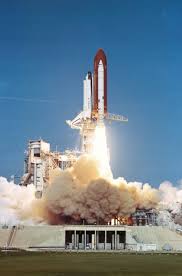
August 30, 1984: Discovery takes flight on its first mission and the 12th of the Shuttle program.
*****
Here we go yet again, another attempt to launch Discovery on its maiden flight, the 12th Shuttle mission. It’s August 30, 1984. Once again our crew runs through the pre-launch routine which gives a shot of adrenalin mixed with anxiety, even gallows humor. Only the prelaunch rituals seem may routine, the brief physical exam, the breakfast, the walkout — our third walkout. The Shuttle is not routine The launch is never routine. And we know it well. We know the metallic taste of fear. Yes, that word, the same one Gus Grissom used in front of reporters after his Mercury flight. They were incredulous that he’d utter it. Yes, he’d been afraid.
We’ve experienced the rush of launch-day emotions just 24 hrs. before. Yet at least we didn’t reach the point of suiting up. Just the day before the planned August 29 launch, a problem was discovered in new software for the Master Events Timer, a computer in the Shuttle’s aft section that sends signals for all major launch events such as separation of the Solid Rocket Boosters and External Tank. At this late moment, they’d discovered that the software, under worst-case scenarios, could be overloaded and fail to send a critical signal. Software engineers feverishly worked to write a “patch” to correct the problem. Only 12 hours from launch on the 29th, NASA decided to take an extra day to make sure the patch works.
We’re running new software designed for heavier launch weights. That’s because we’re carrying, due to the flight delays, a record three communications satellites. After our June launch abort, two flights had to be combined, meaning someone wasn’t going to fly. We sweated out the decision, would ours or another flight be cancelled? The axe fell on the STS-41 F crew of Bo Bobko, Don Williams, Rhea Seddon, Jeff Hoffman and David Griggs. They won’t fly until 1985.
Here we are again, suited and strapped in, our backs and butts aching as we lay jackknifed in those hard seats awaiting an 8:35 a.m. (EDT) liftoff. We’ve reached the planned T minus 9 min. hold. But we’ve been here twice before — during the scrubbed launches of June 25 and 26, the second ending in a frightening engine shutdown on the pad. And during the planned hold, our luck appears to go sour once again. The hold is extended due to a problem with the Ground Launch Sequencer. In only minutes, it appears the launch team will clear the problem, yet the hold continues due to a frustrating issue. Two light planes have flown into the restricted zone around the pad, one of them within the blast zone. An Air Force plane is sent to chase it away. We curse like hell. It seems forever, yet after just 6 min. 30 sec. of holding, the count resumes. What else will happen?
One minute to go. Our commander, Hank Hartsfield, the only veteran on the flight, reminds us, “Eyes on the instruments.”
In the final seconds, and, “Go for Main Engine Start.” Are we really going? It’s 8:42 a.m. (EDT). The Three Main Engines start — yet we’ve actually been here before, during the June abort. This time the engines complete their start sequence, Discovery swaying under the force — and we hit zero, and those big Solid Rocket Boosters light, and in a blink we’re underway. We’re actually going, shaking and rolling and rising. Every part of the Shuttle is flexing against every other part like a dog shaking off water. At 40 sec., throttle down to reduce the stress as we punch through the wall of the maximum air pressure (“Max Q”).
“Go at throttle up.”
Two minutes. “You see that?” Hartsfield and pilot Mike Coats see small bits of foam insulation from the External Tank fly by. The light-weight foam is no concern. Just as it won’t be a concern 19 years in the future during a launch of Columbia.
Something else has occurred that will also be accepted as routine, something we don’t know, no one knows until our Solid Rocket Boosters are disassembled after splashdown and inspected. Hot gas has leaked in two joints between segments of the boosters, one on each booster. The joints hadn’t sealed during the shock of ignition, and the hot gas had started to burn the rubber O-rings that provide a pressure seal. Worse, hot gas had gotten by the primary O-ring on the lefthand booster. Yet somehow the joint sealed itself. We sail on in our merry ignorance. Down on the ground, the public has stopped watching, has gone on to other things. They think these flights are routine, just as NASA has told them..
We hear a loud metallic ringing. Solid Rocket Booster separation. A flash of flame from the separation motors licks the windows. And we are thrown into . . . smooth silence. Why, we have no sensation that the Main Engines are alive with fire and thrust below us.
As we approach 50 mi., altitude, an arbitrary designation of where space begins used by the military, Hank calls out the altitude. Fifty miles and the rookies on the flight are now “real astronauts.” We let out a cheer that is lost in our wake as we press on towards orbit, counting through the steps signified by abort calls, velocity providing us safer options — punching past where we’d make a transatlantic landing in Africa should a engine fail. Then passing the “AOA” limit, where an engine failure would force us a single suborbital loop around the Earth due to a failure. And then the sweetest call of all: “Press to MECO.” That’s Main Engine Cut Off, meaning that should an engine fail, we have enough velocity to reach the safe harbor of a low orbit.
And after 8.5 min., we reach the end of the ladder of calls. Hank reports, “Houston, MECO. Right on the money.” And we let out another cheer.
Discovery now a space veteran, punches ahead, discarding the big External Tank, firing the twin Orbital Maneuvering System (OMS) engines to lift us into final orbit, 184 mi. altitude. Debris from manufacturing, such as screws and washers, floats from hidden places, a sure sign that Discovery is new.
We are Henry W. Harstfield, commander; Michael L Coats, pilot; Judith A. Resnik, Mission Specialist; Steven A. Hawley, Mission Specialist, Richard M. Mullane, Mission Specialist and Payload Specialist Charles D. Walker. An employee of McDonnell-Douglas, Walker soon is at work down in the middeck operation the company’s refrigerator-size Continuous Flow Electrophoresis System that makes precise separation of pharmaceutical material with high purity. The material, hormones on our flight, are suspended in a fluid stream that passes through an electric field. Walker will attempt to run the until, test flown on previous flights, continuously for 80 hrs.
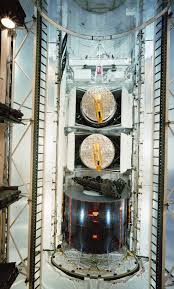
Steve Hawley and Mike Mullane are soon at work. They’re in charge of the satellite deployments, the first one coming up in just hours after launch, one of two Hughes 376 communications satellites familiar from previous flights. However, the last two, deployed by the tenth Shuttle flight in February 1984, suffered failures of their Payload Assist Module upper stages that stranded them in low orbit. The problem was traced to a a change in the manufacturing process for the nozzles that left a void between layers of heat-resistant carbon-carbon cloth. The first of our two such satellites, added from the canceled 41-F mission, is set for deployment 8 hrs. after launch. No rest for the launch weary! Each of the satellites sits on a spin table under its “Pac-Man” sunshade which must opens like a pair of jaws, the satellite spun up to 50 rpm giving it stability. And finally, at the precise time, spring ejected. First to go is SBS-4 for Satellite Business Systems. It rises straight and true as if climbing the tail of the Shuttle. “No anomalies,” we report. “Everything worked real good, nice and easy.”
From a safe distance, 45 min. after deployment, we watch the burn of the solid-fueled perigee kick motor 45 min. through our payload bay TV system. A tiny bright blob flashes at ignition and grows into a large “O” that floats against the curve of the earth’s horizon.
The kick motor has worked! And our mission, after all the delays, is off to a great start. In the next two days, we’ll deploy two more communications satellites. And begin something amazing. From a package just 7 in. deep, something will be extended from Discovery’s payload bay to a height of 102 ft.
So we hope! It’ll be quite a sight.
 tlitiptree