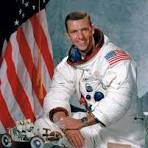
Joe Engle in his Apollo spacesuit.
*****
They flew in from the east, high to avoid the mountains before making a steep descent into the a dark-floored box canyon. To the north and south, the peaks already raised their shoulders above them, bright white in the unfiltered sun. As their tiny, fragile craft leaned forward, the landing site slide into twin triangular windows. Apollo 17 was about to make the final landing on the moon.
The Lunar Module Challenger descended swaying slightly side to side like a wind-blown leaf toward the floor of the valley of Taurus-Littrow. The two astronauts called out the landmarks. On the left, Eugene Cernan could see several large craters on the valley floor before flanks of South Massif, a loaf-like mountain with rounded shoulders. Unlike the depictions of sharp peaks in science fiction, the mountains of the moon were soft and gentle, polished by eons of bombardment by micrometeorites. On the right, the Lunar Module Pilot could see craters leading to the striated slopes of North Massif on the valley’s other side. The tan slopes of the mountains were peppered with bright craters. Ahead lazy, undulating hills led to more mountains.
Seven-thousand feet above the lunar surface, and coming down like an elevator, kicking up a thin, film of dust 100 feet. when descending below 100 feet altitude. At 19 hours 54 minutes, 59 seconds Greenwich Mean Time on December 11, 1972, mid-afternoon in the eastern U.S., Challenger touched the moon, and everything stopped, absorbed like the fleeing wave of dust into the lunar silence.
That Lunar Module Pilot could have/should have been Joe Engle. He possessed a distinguished flying history, making 16 flights in the X-15 and officially entering space on June 24, 1965, when he piloted the rocket plane to an altitude of 53 miles. He became an astronaut the next year. After serving on the support crew for Apollo 10, he advanced to the backup crew on Al Shepard’s Apollo 14. The back-up crew, which also included Gene Cernan as Commander and Ron Evans as Command Module Pilot, were poised to fly Apollo 17. And that’s the crew list Chief Astronaut Deke Slayton submitted — which was rejected by higher ups.
Joe Engle’s fate actually had been set after Apollo 13 when the final two Apollo flights then on the schedule, 18 and 19, were canceled. Geologist Harrison “Jack” Schmitt would have been the Lunar Module Pilot on Apollo 18. NASA wanted a geologist to fly — and Apollo 17 was the last chance. So it was Jack Schmitt not Joe Engle gazed out over the valley of Taurus-Littrow after landing.
The moon out of reach, Engle persevered, flying Enterprise in the 1977 Approach and Landing Tests, commanding the second flight of the Shuttle in 1981 aboard Columbia. And on his last mission, commanding the 20th Shuttle flight in 1985 aboard Discovery during which the crew repaired and released the Syncom F3 communications satellite.
Joe Henry Engle, the last surviving X-15 pilot, died at age 91 at home in Houston on July 10.
 tlitiptree