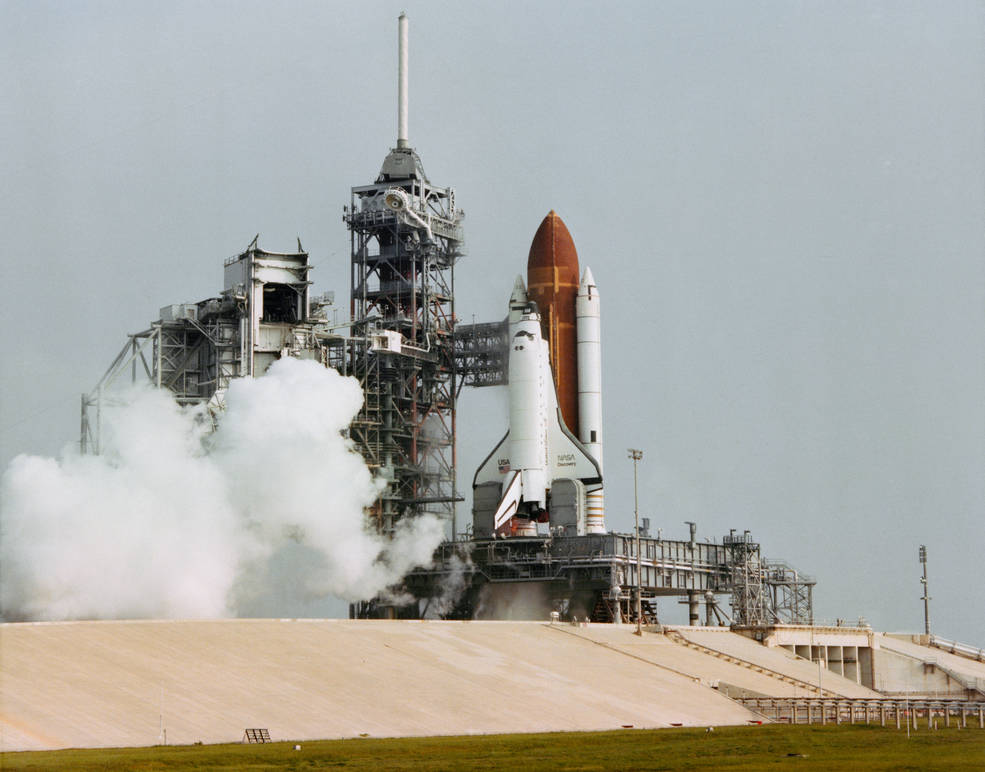
June 26, 1984: Steam clouds clear after Discovery’s first launch is aborted.
*****
High-speed turbo-pumps whir and wrack
seconds from main engine star,
fuel floods Discovery’s arteries
One last reminder from the commander’s seat:
Do like we’ve trained. Eyes on the instruments.
The three engines begin the start sequence,
igniting at millisecond intervals,
bottom left first, then bottom right.
The first engine reaches 20 percent thrust
as the second begins the start sequence.
The onboard computers detect
a fuel value isn’t opening fast enough
and commands a shutdown
less than two seconds into the start sequence
and four seconds before liftoff.
“We have a cutoff,” a controller calls.
STS – 41D, the first flight of Discovery
and the 12th of the Shuttle flight
commanded by Hank Hartsfield with Mike Coats in the pilot’s seat,
and Mission Specialists, Mike Mullane, Steve Hawley, and Judith “J.R.” Resnik
and non-astronaut Payload Specialist Charles Walker of McDonnell Douglas.
literally hangs in the balance.
*
Following the launch abort, Hank Hartsfield issued a statement:
“After the 31 second point int the launch count, I thought that were were on our way. At the seven second point we had the normal big kick when the engines ignite, and almost simultaneously we had the engine alarm. It was then that I knew that we were not going anywhere, and my major concern was that the solids [twin Solid Rocket Boosters] did not fire.
“The crew was very quiet both in the cockpit and middeck compartment with little or no conversation. We were all just listening to the communications loop, and the launch team kept us very much aware of what was never any great apprehension nor concern.
“One point I would like to make: The Shuttle system did exactly what it was designed to do, and I am very pleased that it did. If there are engine problems you want to know about them on the ground and not in the air. This is a real confidence builder.
“Of course we were very interested in the conversations concerning the fire. We were prepared to bail out if necessary, but the launch team had the situation under control and at no time did I feel that we were not protected.
“Finally, we were all disappointed, but the crew’s reaction was at all times purely professional and needless to say, we look forward to a successful mission later on.”
For the public, for the press, Hank Hartsfield says all the right things — the perfect “right stuff” words. Don’t believe it.
Two minutes before launch, Hartsfield, the only veteran on the flight (he piloted STS-4) shakes hands with Coats, seated to his right, and tells the crew, “Good luck, everybody. This is it. Do like we’ve trained. Eyes on instruments.”
At T – minus 10 sec., the go is issued to start the three main engines. The crew hears the turbo-pumps spin up. At T – 6.6 sec., the engines begin their staggered ignition, and the vibrations shoot through the Shuttle. Four seconds to launch. And the crew hears a loud metal screeching, like boxcars banging together in a derailment. The siren-like master alarm begins warbling. Hartsfield shuts it off. Launch controllers call, “Cutoff! We have an abort!”
Engine status lights glow red, showing two of the engines have shutdown. But the third light, engine number 1, does not show a shutdown. It’s a seat-of-the-pants moment, feeling no vibrations, the crew knows #1 engine isn’t firing. Still pilot Mike Coats punches the shutdown button repeatedly to make sure.
Launch Control doesn’t know that the engine never started. Eyes on instruments, their display indicate the engine is firing. (Actually, as it never ignited, it therefore never triggered a shutdown signal). A controller interrupts the com loop, “Break, break. Engine one not shutdown!”
Confusion, uncertainty. And a terrifying worry — what if those big Solid Rocket Boosters should ignite. They’d rip the Shuttle apart. You bet the crew was scared out of their pants. Hartsfield tells Launch Control, “We did not have engine start on engine one.”
Controllers begin reading off pressures and system status. Then issue another alarming report: Fire at the base of the Shuttle, on the left side — the side where the hatch is located. Hydrogen expelled through the engines has ignited. The clear flames licking up the side of Discovery are invisible. Hartsfield tells the crew to unbuckle and prepare for an emergency egress. Controllers switch on the pad’s fire protection system of rain birds, drenching the Shuttle.
Seated on the middeck near the hatch, Resnik clambered into position to open it, and calls to Hartsfield, “Henry do you want me to open the hatch?”
The crew discusses the situation for a few seconds, and Hartsfield decides: “Negative on opening the hatch, Judy.” They simply don’t know the situation; best to stay where they are.
The rain birds appear to extinguish the fire. After a few minutes the water spray is turned off. Then the fire is detected again. The rain birds again douse it. Yet it springs back to life a third time. Finally the water spray quenches the flames.
No one knows how far the invisible flames had licked up the side of the Shuttle. If the crew had opened the hatch, they may have been killed. Instead, in a record 38 min., the crew begins exiting the Shuttle. The last to emerge, Hartsfield wipes his face, rubs his eyes. Then walks to the elevator.
 tlitiptree