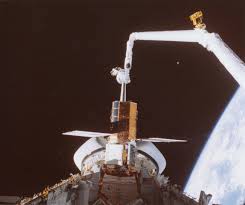
April 10, 1984: The Solar Max satellite sits berthed in Challenger’s payload bay, the Remote Manipulator System (RMS) arm moving over it.
*****
We’re relaxed and ready. We’re the crew of Shuttle Mission STS-41C, the 11th Shuttle flight, beginning our fifth day of flight, April 10, 1984. We’re Bob “Crip” Crippen, Richard “Dick” Scobee, Terry “T.J.” Hart, James “Ox” von Hoften and George “Pinky” Nelson. We’re back in business, after nearly losing our primary mission two days ago when the attempt to use the Manned Maneuvering Unit to capture the crippled Solar Max satellite failed. As we pulled away from the satellite, it was tumbling. And its two solar panels no longer faced the sun. In a few hours its batteries would be depleted.
As we slept that night, Challenger positioned 31 mi. behind Solar Max, controllers at the Goddard Space Flight Center, Maryland, struggled to stabilize the satellite. The only means they had to influence the tumbling spin of Solar Max consisted of its magnetic torquers which play against the Earth’s magnetic field. By 6 p.m. (EST) on April 8, the motion was clocked at 1.3 degrees per sec. in all three axes. True to the conservation of momentum, if one axis loses a bit of spin, another gains a bit. The key involved bleeding off total motion, called “momentum absorption.” One bit of luck — the batteries were holding out longer than expected. And by 8:30 p.m., the rotation rates of all three axes were coming down. They shut off the satellite’s transmitter to save power. As the motions halted, would the satellite end up in an orientation with the solar arrays pointed at the sun? At 11 p.m., the sun was just missing the arrays, rotation rates continuing to null out. Nearing midnight, the batteries were nearly out of power. Then good news — the solar panels were receiving at least 30 min. of sunlight. Turning off that transmitter made the difference between life and death for Solar Max.
On April 9, Houston told us that the satellite’s motion was nearly zero and the arrays were pointing at the sun. “The problem . . . is we cannot really determine the attitude of the Solar Max when you get in there as to where the grapple fixture is going to be.” If it’s on the other side, we’d have to expended our depleted supply of maneuvering fuel. “As a result,” they said, “We’d like to spin up the Solar Max to about one-half a degree per second and do the rotating grapple you guys have practiced so much.”
Rendezvous with the satellite was set for the following morning. Then we’ll do all the repair work in one spacewalk the day after that. Our mission will be extended a day. And that’s where we sit on the morning of April 10. Fuel remains the question mark. Only 20 percent remains in the forward RCS system of nose jets. About 15 percent will be needed to rendezvous. Yet the when the gauges say the tanks are empty, Houston estimates 1.5 percent fuel remains. We can run the gauges to zero rendezvousing and still have enough to back away normally.
At 6 a.m. (EST), we are 26 mi. behind and 6 mi. below Solar Max. At the rear of the flight deck, Crip is at the left station, flying the Shuttle. To his right, T.J. is at the controls of the RMS robot arm. AT 6:55 a.m., we’re 14 mi. from our target, and begin the terminal phase of rendezvous. At 7:32 a.m., we’re 42,150 ft. away, closing at 20 ft. per sec. Twelve minutes later over Hawaii, we’re 22,750 ft. away, on our orbital nightside. Nine minutes after that, we’re at 12,000 ft. range, closing at 16 ft. per sec. T.J. has the robot arm raised and ready. Sunrise a minute away. There she is, in the sun.
At 8 a.m., we’re 7,000 ft. from Solar Max, closing at 11 ft. per sec. Ten minutes later, our range is down to 2,000 ft., closing at 4.7 ft. per sec. At 8:17 a.m., we’re just 1,000 ft. away, closing rate slowed to 1.5 ft. per sec. By 8:28 a.m., we’re at 400 ft., inching ahead at 0.5 ft. per sec.
The Goddard Space Flight Center reports the satellite is ready for capture. It’s rotation is coning a bit like a spinning top. Crip is using jets that, while efficient in fuel usage, strike the satellite with their exhaust plumes. And that’s causing the wobble to increase.
At 8:45 a.m., over the Indian Ocean, we’re 100 ft. away, closing at 0.25 ft. per sec. The wobble continues to increase. We move in, nearly embracing the satellite in the payload bay. “It looks stable enough,” we judge.
Houston replies, “We know we’re in good hands and use nice soft gloves.”
The robot arm’s end effector, a stubby cylinder open at the end, is cocked at the satellite. Waiting . . . waiting as it the grapple pin rotates into position. There! — T.J. snakes in the arm. Got it! Snare wires inside the end effector tighten around the pin. We’ve got a good solid capture. On the first try!
And we lower the satellite onto the ring-shaped berthing table at the rear of the payload bay. She’s latched in and safe.
At noon, we receive a call from President Reagan. “And you and the rest of the crew demonstrated once again just how versatile the Space Shuttle is and what we can accomplish by having a team in space and on the ground.”
Tomorrow the focus shifts to Pinky Nelson and Ox van Hoften — the repair of Solar Max will be in their hands during that single long spacewalk. You might say the reputation of the Shuttle program will be in their hands.
 tlitiptree