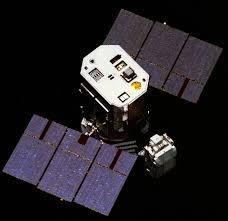
April 8, 1984: George “Pinky” Nelson, flying the Manned Maneuvering Unit (bottom right), closes in for a try to dock with the crippled Solar Maximum Mission satellite.
*****
Rendezvous, the first true rendezvous of the Shuttle program, begins with a height adjustment maneuver just after 5 a.m. (EST) on April 8. To make rendezvous with Solar may will take 4 hrs. filled with a series of burns. Think of them as climbing stairs, step step slowing and correcting our closing rates. It’s a delicate dance nudging us into co-orbit with the satellite. We reach that point, called the terminal phase finalization, at about 9 a.m. We are 1,000 ft. from the satellite. And our spacewalkers, “Ox” van Hoften and “Pinky” Nelson are in the airlock.
By 9:20 a.m., Pinky and Ox exit the airlock at the same time Crip is closing to within 440 ft. of the target. The pair floats to work stations at the side of the payload bay. The Goddard Space Flight Center reports that Max’s attitude control system has been deactivated. The capcom calls, “The Solar Max is ready for capture.”
At 9:36 a.m., in orbital night, we’re holding at 200 ft. from the satellite. The spacewalkers are checking out the suit-mountedTPAD docking device in the floodlit payload bay. During orbital night, Pinky floats to the MMU, housed in a support stand along the wall of the payload bay, and backs himself into its embrace. He releases, floats free in the floodlights, checking his systems. “This is a pretty good flying machine you have here . . . It’s lots of fun to fly,” he calls.
It’s 10:14 a.m. Up above, like a moon, Solar Max, already in sunlight, glints gold and silver, it’s two squarish solar panels look delicate, almost transparent. We’ve inched in to about 140 ft. from it. The payload bay is still in deep darkness. Pinky is holding steady in the middle of the payload bay, waiting for the sun. “How long until sunrise, Crip?”
Suddenly the shadows in the bay flee, the well of the bay flooded with sunlight. It’s time. Crip calls, “Well, I’ve done my part — go out and get that thing.” The retrieval should take 45 min.
Pinky steadies himself in the middle of the bay, rocks back, now looking straight up for his target, as if floating on the surface of a swimming pool. Zip — he begins to rise, steady and true, as if pulled on a string. Soon only his back is visible to one side of Max, shadowy compared to the bright satellite. “It sure is pretty,” we observe.
He still has a ways to go. Continues to shrink in size, appearing from the Shuttle like a toy astronaut. “Really, I’m kind of liking this,” he says. “Really looks like it’s rotating doesn’t it.”
He can now see all the details of the Solar Max. “Satellite looks in excellent shape.”
It’s 10:27 a.m. Pinky drifts to the right side of the satellite, from our perspective, and stops 15 ft. from it. With him as a gauge, the spin of the satellite really appears rapid. He waits for the trunnion pin to rotate in his direction and matches the rotation, orbiting the satellite.
It’s 10:33 a.m. He inches in, between the two solar arrays, until his form merges with the side of Solar Max. Just as he rotates from our view. He appears to have docked the barrel of the chest-level TPAD to the pin. Is he docked? No — no joy. And it looks like he jostled the satellite a bit. He tries again.
“OK, the jaws did not fire that time,” Pinky reports, meaning the jaw-like camps inside the TPAD did not close when triggered by contact. “The jaws did not fire. . . I had a good dock, too.”
Crip tells him, “OK, you can try again.”
He lines up and tries again. “Now I did it again and it didn’t fire again. I’ll back out and check them again.” He moves back a few feet, checks the TPAD. The satellite is wobbling worse than ever. “I’ve really got some rates going on the satellite there. One more try. I’ve got 1,500 psi of fuel.” He’d used half his fuel already.
He emerges on the left side of the satellite as it revolves, still appearing to make contact with it. No, we can see a gap between him and Solar Max. The jaws of the damn TPAD just won’t fire and all that jostling has really started the satellite wobbling. At 10:38 a.m., Crip tells him, “Pinky, you’ve started that rotation about to your left now. We really need to stop that to do a rotating grapple.” We’re thinking of a backup plan, grappling the revolving satellite directly with the RMS robot arm operated by T.J. Hart. “Walk out to the end of the array . . . Is there any way you think you can do it with your hands?” Crip wants him to stop that ugly rotation using the MMU’s jets. “If you can grab hold of it. You’d have to hold it with both hands.”
Pinky “walks” his hands to the end of one solar array, hangs on at its very end of the array as if on a playground merry-go-round. He commands the backpack into “attitude hold,” which should steady by him and the satellite. Another two minutes pass.
Crip calls, “How much have you got left?” Meaning how much nitrogen propellant.
” . . .1,200 on both sides.” He’s low on fuel.
Crip calls, “OK, come back in, Pink.”
Pinky backs away, asks, “What kind of rates are on the satellite?”
“Fairly high, but come back to us. Rotate around to your left, pitch down. I’ve got you in sight,” Crip says.
Despite the excessive wobble of the satellite, we’re not done. Crip tells Pinky, “Just as soon as you get stable out there [in the payload bay] and grab hold of something, Pinky, I’m going to go for the satellite.”
In 10 min. he’s safely back in the payload bay. Five minutes later, Houston says Solar Max now is wobbling in 1 degree of roll, 1 degree in pitch and 0.6 degrees in yaw. In other words, it’s in a slow tumble. Even so, were going to attempt a rotating grapple. We can’t give up. This backup method calls for T.J. to grapple the satellite as it rolls by the end effector of the RMS. It could have been used as the primary means to snare the satellite, but even at a slow steady rotation, ideally below 0.7 rpm, would risk damaging the RMS.
We no longer have enough fuel in the forward RCS system of nose jets to allow more MMU operations, as we’d have no margins to rescue Pinky should he be stranded while flying free. Crip says, “The thing’s got a pretty good rate right now, and I’m not confident that T.J.’s ever going to be able to grab it. . .
Still, we’ve gotta try. Crip says, “Let’s just sit here . . . and see if we can get into a position and try a rotating grapple.” It’s now 11:12 a.m. Crippen maneuvers the Shuttle 40 ft. from Solar Max, within reach of the 50-ft.-long robot arm. Four minutes later, T.J. makes a stab at the flower-like grapple fixture on the satellite’s side. And misses. We keep silent during this time. Ten minutes later, T.J. makes another attempt. “Close that time but no cigar.”
“Let’s try one more time.”
As we move out of communications range, the ground proposes moving away from the satellite overnight and trying again in the morning. Still, we try two more times, a total of four stabs at it. It’s impossible, simply impossible. And by 11:40 a.m., as we come back into contact with Houston, we’re backing away, preparing to perform a 0.23 ft. per sec. separation maneuver to move 8 mi. from the satellite.
The spacewalk ends after 2.5 hrs. of what was planned to be a 6 hr. retrieval and repair effort.
*
That afternoon, the Goddard Space Flight Center attempts to dampen out the motions using the satellite’s magnetic torquers that push against the earths magnetic field. But they need time to reload the computers, and Solar Max’s solar arrays are pointing away from the sun. At 2:45 p.m., they estimate only 5.5 hrs. of battery life left.
An hour later, they report, “We haven’t been able to do anything of any significance to stop the tumbling of the spacecraft right now.”
It looks like we’re going to lose our primary mission. But we’re not quitters. Not yet.
 tlitiptree