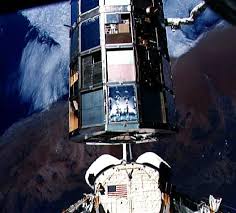
The day after its April 6, 1984, launch, Challenger drops off the bus-size Long Duration Exposure Facility before continuing to its primary objective, repair of the Solar Maximum Mission satellite.
*****
Even before we launch, we’re one for the record books. Only 51 workdays were required to turn Challenger around for this flight, thanks to the time saved because the previous mission in February landed at the Kennedy Space Center, eliminating the time lost ferrying the Shuttle from California. And we were the first mission prepared by a private contractor, the Lockheed Shuttle Processing Team, which now will manage all ground processing of the Shuttle. Obviously they didn’t miss a beat.
Those are the first of many firsts we, the crew of STS-41C (formerly STS-13), will make, flying the tenth Shuttle flight, and the fifth of Challenger, just a year after its maiden voyage. We will deploy the largest payload ever handled by the Remote Manipulator System (RMS) robot arm, the Long Duration Exposure Facility (LDEF). And we will attempt the first on-orbit repair of a satellite, the Solar Max Mission satellite launched in 1980. And our mission commander, Bob “Crip” Crippen will become the first person to fly three times aboard the Shuttle. He flew as pilot on the first Shuttle flight in April 1981 and commanded STS-7 in June 1983. We are Francis R. “Dick” Scobee, pilot; Mission Specialist Terry J. “T.J.” Hart, who will operate the RMS, Mission Specialist James D. “Ox” van Hoften, who will conduct the two repair spacewalks along with Mission Specialist George D. “Pinky” Nelson, who will fly the Manned Maneuvering Unit.
In another milestone, we will make the first “direct ascent” launch. Up until now, the Shuttle has entered orbit in a step fashion, using two burns of its Orbital Maneuvering System (OMS) engines to raise itself into a final orbit. We need to preserve the fuel for the OMS system for the rendezvous with the crippled Solar Max. We will burn the Shuttle’s Main Engines, used only on launch, a bit longer eliminating the need for the first OMS burn.
We’re in for a busy 6-day flight (spread over 7 flight days). Our first major mission event comes on the second flight day with the deployment of the LDEF. Think of it as a giant filing cabinet filled with small experiments, 57 in all. Many of the experiments are passive, requiring no power or data recording. These include test samples of materials as well as plant and seed samples to see the effects of an extended period exposed to the space environment. The LDEF will be retrieved by a future Shuttle. The LDEF, a 12-sided cylinder measuring 30 ft. long and 14 ft. in diameter, weighs 21,400 lbs. Moving it, the RMS will shatter its record for weight (mass) lifted, which had been the 8,000 lb. test article flown on STS-8. A simple system, LDEF contains no communications or attitude control systems. We will place it in a “gravity gradient” position — that is, with the long axis pointed aligned vertically to the Earth, a position that keeps it steady and stable.
Then the main event of the flight begins the next day — the first of two spacewalks. We’ll make several rendezvous maneuvers taking about 4 hrs. to reach Solar Max. We’ll be sitting 200-300 ft. from the satellite. A half hour later, our spacewalkers will exit the airlock.
The Solar Maximum Mission satellite, designed to study solar flares and magnetic fields, measures 13 ft. long and 7 ft. in diameter. It weighs 5,105 lbs. and holds seven instruments to study the sun in various wavelengths. After eight months of operation, the attitude control system failed, as did one of the instruments, the Coronagraph Polarimeter. Although launched before the Shuttle flew, with foresight designers equipped it with an RMS grapple fixture.
Pinky Nelson will don the Manned Maneuvering Unit (MMU) backpack tested on the previous flight. The Trunnion Pin Attachment Device (TPAD), also tested on the February flight, will be attached to his chest. He will fly to the satellite, which will be rotating at one degree per second for stability. He will circle the Solar Max, matching its rotation. Then close in and use the can-shaped TPAD to clamp onto the trunnion pin (a tubular attachment fitting) at the midsection of rectangular body of the satellite. He will use the MMU’s jets to stop the rotation and hold it steady. We’ll move up with the Shuttle and grapple the satellite with the RMS and lower it onto a servicing table at the back of the payload bay.
The satellite’s Modular Attitude Control System was designed to be replaceable. Only two screws have to be loosed to pull it out. We will replace it with an identical spare from the Landsat D program. The Chronograph Polarimeter definitely was not designed for replacement. On this first spacewalk, we’ll only have time to remove some thermal blankets. We’ll conduct a second spacewalk two days later, flight day five, to finish the job. We’ll have to remove 22 screws and unplug 11 electrical connectors. More wiring has to be cut. Then we’ll splice in a replacement unit, a very delicate job. Then we have to button everything up, replace the thermal blankets. Each spacewalk will require 5 – 6 hrs.
The next day, we’ll release Solar Max using the RMS. Repairing Solar Max will cost a third of that of launching a new satellite — and offer proof of the Shuttle’s expanding capabilities.
*
Rain that had plagued the area two days before had cleared out. The sky forms a blue bowl on launch morning, April 6, 1984. We’re counting smoothly toward a launch at 8:58 a.m. We only have a launch window of 7 min. 45 sec. We don’t need a single extra second of that window. All the final sequences converge on one moment — Main Engine Start. Feel the three engines rumble far below us. And six seconds later, the big Solid Rocket Boosters ignite and exactly on time we leap off the pad through thunderous waves of vibration. Soon that blue sky begins to turns black.
Two-and-a half minutes after launch, the rambunctious SRBs, they job done, are jettisoned. “We have separation,” Crip calls. A good sep.
Houston advises, “First stage performance low.”
“Roger, low first stage.” For some reason, either the SRBs or the Main Engines at the Shuttle’s tail, underperformed slightly. Luckily, our External Tank carries a margin of liquid hydrogen and liquid oxygen for just such a case. Will it be enough? We’ll soon find out — in about six minutes when we complete our ascent. We know the calls for the various abort modes will be a bit later than planned as we step towards orbit.
We pass negative return — beyond the range to return to the launch site in an emergency. Then we pass beyond range of the TAL — Trans-Atlantic Landing. Then come the “Press to MECO” — Main Engine Cutoff — calls, where we could limp into a low orbit on two engines . . . then a single engine. We keep flying. The Main Engines burn an extra 3 sec. — that’s enough to put us where we want to be. “OK, we have MECO.” And we separate off the back of the scorched External Tank. We nearly reached the low-quantity redline for liquid oxygen in the External Tank.
“Challenger, Houston, OMS 1 is not required.”
Hear that? We’re right where we planned to be and don’t need the usual first OMS burn. We’re presently in an orbit of 290 by 37 mi.
Houston gives us the go. “Challenger, Houston, nominal OMS 2.”
That burn comes 42 min. 55 sec. after launch and lasts 128 sec. We’ve been keeping an eye on the External Tank, out in front of us and below. When the engines light, we zoom away from it. “We’ve got a visual on the ET — way out in front of us and well below.”
We’re headed for the highest operational orbit so far in the Shuttle program.The burn raises the low point of our orbit to 157 mi.
Soon after we settle into that orbit, Pinky Nelson calls to Capcom John Blaha. “I tell you John, if you’re looking for something fun to do, you ought to try this sometime.”
“Roger, that, Pink, I’m looking forward to the flight.”
“John, it’s really exciting.”
When a new capcom, Jerry Ross, comes on duty, Pinky tells him, “OK, Jer, this is really exciting.”
Exciting! — it becomes kinda a joke. It’s all exciting. Well, not for everyone. The guy who is responsible for operation of the RMS is motion sick to the gills. Yet somehow T.J. Hart guts out the initial checks of the arm. That’s vital, because the next day, we deploy the LDEF from the RMS.
In the morning’s status report from Mission Control, sent up by teleprinter, until the section titled “Failure Summary,” a single word appears: “None.” Not even a trivial, minor fault. This is a first for the Shuttle program.
T.J. limbers up the RMS, raises it a few inches and lowers it back into the bay and latches it — crucial to show the big bus-size satellite will not hang up in the bay. If it did, we wouldn’t be able to close the payload bay doors. T.J. is feeling much better, is as steady as the RMS and satellite are. He raises the LDEF up and over the payload bay, conducts two-hours of maneuvering tests to explore how the arm responds to such a massive payload.
Release time — T.J. positions it, makes sure there are no motions (remember, it has no attitude control system). And gently lets go
“It was as steady as the Rock of Gibraltar and just about as big.”
We back away, and watch it against the cloudy blue Earth. And turn our attention to the main event, Solar Max. We are in a lower orbit than the satellite and trailing it. Objects in a lower orbit gain on those in higher orbits. We’re presently gaining 60 mi. on it on each orbit. Closing in as we sleep to set up tomorrow’s rendezvous and first spacewalk.
 tlitiptree