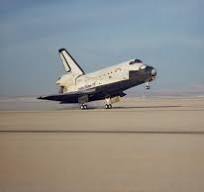
December 8, 1983: As onboard computers fail, Columbia touches down five orbits late.
*****
We’re ready to come home. It’s December 8, 1983, landing set for about 11 a.m. EST. Our science aboard the Spacelab is complete. We’ve achieved our goals and more. We’re the crew of Columbia/STS-9, the flight of Spacelab 1. We’re Mission Commander John Young and Pilot Brewster Shaw in the upper-cockpit. We’re our research crew of Owen Garriott, Robert Parker, Byron Lichtenberg and Ulf Merbold down in the middeck and the Spacelab module behind it in the open payload bay. We’ve made their last data runs and have buttoned everything up after a spectacular mission. Our scientific efforts have reaped 2 trillion bits of digital data, 72 investigations in five broad areas: Astronomy/solar physics, space plasma physics, atmospheric physics/earth observations, life sciences and materials processing.
We worked directly with Principle Investigators (PIs) in the Payload Operations Control Center (POCC) at the Marshall Space Flight Center, Alabama. Through the high-speed data we sent down via the Tracking and Data Relay Satellite, they could monitor and interact with many of their experiments directly. The PIs put in 200 re-planning requests during the mission. We were able to put most in work.
We’ve been in orbit since November 28. The first days were a trial dealing with equipment breakdowns as well as our own adaptation to space — or movements in Spacelab were jerky and uncoordinated. We’d lunge at handholds like novice swimmers. By mid-mission, we hit stride, our movements quick and fluid. With a flick of a foot we could anchor ourselves under a foot bar. Columbia and Spacelab used less power than anticipated, and so our 9-day flight gained a 10th day.
It’s now 9 days, 19 hrs. since launch. We’re about a half hour from closing the big clamshell payload bay doors and four hours from landing. We’re configuring systems for landing, and nose jets fire to move us into the proper orientation. When they kick, General Purpose Computer (GPC) #1 fails. We have five GPCs, four that act as primary, checking each other, one held back as reserve.
Moments later, we come into range of the Cape tracking station and John Young reports, “GPC 1 just failed all the redundant sets here, and we’re doing to the procedures right now.”
And in addition one of our Inertial Measurement Units (IMUs) used to determine our position in space, is showing errors.
Six minutes after GPC #1 failed, the jets fire again. And now GPC #2 fails. This really has us sweating. In theory, we can make a reentry with just one GPU operating, but to breath easy, we want much more margin. The whole system is now in question.
Houston calls, “We would like you to go back to free drift and then continue with the procedures on page 3-4.” Go into drifting flight — no jet’s firing, as it seems that’s related to the failures. The procedures are to bring up GPC #3 that had been isolated.
We’re working a lot of issues, and the first attempt at landing at Edwards Air Force Base on our 161 revolution of the Earth, has been postponed. We could come back on rev. 162. Quickly we are able to reload GPC #2 and bring it back up. It’ll now serve as the isolated backup. However, GPC #1 is hard failed.
Houston wants the programs from all the computers dumped to the ground so they can check them. It’ll take time.
We tell Houston, “We are pressing on with in house configuration for deorbit. Do you want us to continue with deorbit prep or not?”
“Negative, stand by, and I’ll give you the summary report.”
John Young tells them, “OK, I think we got a decent pass into Edwards today, if we can figure out what happened.”
“We’re considering that right now, John, on revs. 165 and 166.”
Landing on rev. 166 would put us down 50 min. before sunset after a delay in landing of five orbits. We don’t want to try to land with uncertainty about our computer system. Yet we don’t want to have to stay up overnight, increasing the odds of more failures. But fully understanding what’s going on with those computers, dumping their memories to the ground and testing, will take time. It’s a race.
Houston tells us that if we come back on rev. 165, we’ll make our deorbit burning at a mission time of 10 days, 5 hrs., 22 min. — which translates to 4:22 p.m. EST with a landing at 5:17 p.m. EST For the next orbit, it’d be 10 days 6 hrs. 55 min. This, the longest Shuttle flight, is getting longer. And there’s not a thing for most of us to do, but wait and maybe doze, if possible.
We gain some good news. Houston has determined that the IMU errors were caused because GPC #1 went down. “The IMU 1 is good.”
We — and the ground — continue to test GPC #1. Finally they report “no joy,” and declare the computer failed. It’s been about three hours since the problem with it occurred. They’re still looking at the data from GPC #2, which is now working, checking it against the other computers.
Houston calls to John Young. “John, we’re not sure at this time whether or not we’ll get the GPC 2 dump analyzed for rev. 165. If we don’t, we’re just interested in your opinion on going for the 166 versus waving off until tomorrow . . .”
“OK, I have no preference. I think I can get a couple or three hours sleep here if we go 166.” The decision is made to deorbit on rev. 166, with the landing occurring on rev. 167.
Finally at about 10 days 3 hrs., we begin our preparations toward landing. The deorbit burn will occur at 10 days 6 hrs. 52 min. into the flight, for a projected touchdown time of 10 days 7 hrs. 47 min, 6:47 p.m. EST. At about 10 days 4 hrs., we finally begin closing the payload bay doors.
We get word from Houston on GPC #2. “The results of the analysis of the GPC 2 hardware dump show the multiple locations in GPC 2 were altered. We think it was a transient hardware problem. We do not think it was related to thruster firings . . .”
Houston continues to compare memory dumps of the computer as we continue our deorbit preparations. Finally we get the good word: “And Columbia, Houston. You are go for the deorbit burn.”
And as we maneuver into position for the burn, they report “We have some good news. They have completed the analysis of GPC 2, 3 and 4. And the data from the memory dumps checked out A-OK.”
“OK, thank you.”
We’re over the Indian Ocean, just 15 min. from the deorbit burn. It was that close. Now we had full — or should I say as full as possible — confidence in our computer and guidance systems.
We travel northward over the equator, completing our final full orbit. We’re out of contact with Houston when the twin OMS engines fire for a bit more than 2 min. That’s enough to do it, we’re committed to a landing at Edwards Runway 17, no matter what happens with the computers. We’re on our own for most of the descent, not coming into communication range until we near the coast. The computers fly the Shuttle through a series of S-turns, a sheath of ionized air licking the windows. The computers fly one, two, three, four, five S-turns to bleed off speed like a ski racer. All go off on the mark, our descent on profile.
We’re at 165,000 ft. when we come into communications range. The capcom calls, “Configure AOS. Columbia, Houston configure AOS.” We set the system for Acquisition Of Signal, AOS. And they read us, and tell us, “Columbia, Houston, energy, ground track and nav. are go.”
We’re go as we cross the coast north of San Francisco, heading south. Everything appears perfect — three good APUs. Those are the three turbines powered by volatile hydrazine fuel that drive all our hydraulic systems.
We make a wide circle to lineup with the runway, John Young flying manually now. “Surface winds are calm,” the capcom calls.
And we drop to the runway — the heaviest Shuttle to land by 11,000 lbs. — our main gear touching, followed 18 sec. later by the nose gear. And when the nose gear hits, GPC #2 fails again. We don’t say anything.
John performs a braking test as we roll to a stop. “We have stopped!” he reports. Our flight of 10 days 7 hr., 47 min., 24 sec. is finally over.
“Roger that, Columbia, welcome home, beautiful landing.”
So we thought. A couple minutes after wheels stop, we report, “We’ve got a . . . thermal APU.” That’s a reading of high temperatures. The message appears to be an indication of innocent overheating. Actually, there’s an undetected fire between APUs #1 and #2, caused by leaking fuel. The fire began two minutes before landing undetected. And after landing, the heat caused the two APUs to fail. The third APU, however, was unaffected, as it is isolated away from the other two. That’s a design lesson learned after Apollo 13, when a fire and explosion in an oxygen tank caused the adjacent tank next to fail.
And the cause of the computer failures? Post-flight inspections discover microscopic debris is in their integrated circuits. Somehow the debris had escaped inspections.
The lessons keep coming. And we’ve brought home a Spacelab of them on this flight, transforming the Shuttle into a vehicle for science.
 tlitiptree