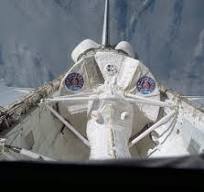
The Spacelab laboratory module flies aboard Columbia on STS-9, launched Nov. 28, 1983.
*****
Think the Shuttle is operational after eight flights? We’re the ultimate test flight, not only of the vehicle but of the wide range of science it can accomplish. We’re STS-9; flying aboard Columbia on the ninth Shuttle mission, set for launch today, November 28, 1983, We’re the first flight of the reusable Spacelab system, so we’re also known as Spacelab 1.
The Spacelab pressurized module is tucked in Columbia’s payload bay like a camper in the bed of a pickup truck. The laboratory connected to Columbia’s middeck living quarters by an 18.8-ft.-long tunnel, 3.3 ft. in diameter. The module itself is 23-ft. long, including end cones with a diameter of 13.1 ft. The inside of the cylindrical module is lined with 19-in.-wide experiment racks. Behind it, unpressurized in the open bay, a U-shaped pallet holds science instruments needing exposure to space. The pallet is 13.1-ft. wide and 10-ft. long. The module weighs 18,135 lbs. and the pallet and instruments check in at 7,449 lb.
With Spacelab, built by the European Space Agency (ESA), we are a flight of firsts: The largest crew ever flown, six astronauts and researchers, for the first flying non-astronaut Payload specialists, the longest Shuttle flight — schedule for nine days, flying the highest orbital inclination to the equator of any Shuttle, and home to the widest range of science ever attempted. We’re flying 72 experiments in five broad areas, a “multidisciplinary” flight to exercise the Spacelab system like we would test a new airplane. The experiments are divided evenly between those sponsored by NASA and those from ESA. Future Spacelabs will be dedicated to single disciplines, such as life sciences or astronomy. Our vast range of investigations range across astronomy and solar physics, space plasma physics, atmosphere and Earth observations, materials science and life sciences including the reaction of the human body to weightlessness. Yes, we’ll be jabbed for blood samples during the flight!
We are John W. Young, veteran commander, who becomes the first person to fly six times in space. A rookie, Brewster Shaw, who flew combat in Vietnam, takes the pilot’s seat. Owen K. Garriott, mission specialist, has more time in space in one flight than John has in five, having flowing the 59-day Skylab 3 mission. Robert A. R. Parker, a rookie mission specialist, holds a doctorate in astronomy and served on the ground as a Skylab program scientist. Then we have two payload specialists who aren’t career astronauts. Byron Lichtenberg has a doctorate in biomedical engineering and is a MIT researcher, and Ulf Merbold of West Germany, the first non-American to fly aboard the Shuttle, is a physicist with the Max Planck Institute for Metals Research at Stuttgart.
We were originally scheduled to fly a month ago on October 28, until a fault with a Solid Rocket Booster nozzle was discovered after the last flight launched in late August. Inspections show the ablator insulation lining the inside of an SRB nozzle, designed to slowly burn away (“ablate”) carrying away heat, started peeling off off in chunks. STS-8 made through the SRB shutdown before a burn through occurred, but the nozzle was 8 seconds away from a catastrophic failure. The cause? — a bad batch of ablator. And the insulation on our righthand SRB came from the same batch. Our Shuttle, Columbia, had to be rolled off the pad — the first time that’s happened — and the lower segment of the SRB replaced.
It goes to show that no launch is routine. Yet they can click along smoothly. Our liftoff comes on time at 11 a.m. (EST). In 7 sec., we’ve cleared the tower, followed by pitchover and the roll maneuver to place us on the proper heading, on the button with a flight azimuth of 35 degrees. That path takes us parallel to the East Coast of the U.S., arcing near Halifax, Nova Scotia, and out over the North Atlantic. The bone-rattling SRBs do their their job in just 2 min. 24 sec. and are cast aside. Our trajectory is right on profile.
Much smoother now going uphill on the three Main Engines. And at 8 min. 21 sec., MECO, Main Engine Cut-Off. Less than 20 sec. later, we discard the big External Tank. “Fine separation.”
We pass over Scotland, our orbit inclined (tilted) 57 degrees to the equator so that we pass over a large swatch of the Earth’s surface for Earth observations. Two burns of our Orbital Maneuvering System engines step us into a circular orbit of 155 mi. It’s only been 50 min. since launch.
Routine? Just listen to our commander, John Young, as excited as if it was his first flight. When he gets a moment, he tells the ground, “Man, it’s just super up here. Just beautiful.”
He can’t help himself. “That [launch] was really super, wasn’t it? Boy, it was a beautiful flying machine and just got up there like everybody said it would. . . .That is really some ride, I want to tell you — it hadn’t changed a bit. It’s the smoothest way to fly you ever saw.”
*
“Columbia, Houston. We have you on TDRS for 54 minutes.”
Hear that? — 54 min. of continuous communications through the Tracking and Data Relay Satellite above us in geostationary orbit. Fifty-four minutes, as opposed to the few minutes of communications that ground stations can provide. And that’s not all, with the high-data-rate we can transmit and receive, experiment data and commands can be exchanged between Spacelab and the “P.I.s” — Principal Experimenters — on the ground. Almost as if they’re flying up here with us.
“That TDRS is really working good today,” John Young tells the ground early on. Soon the focus shifts from the pilots to the science specialists. We’ll work around the clock in two shifts. The “Red Team,” with Young watching over the Shuttle systems, will see Bob Parker and Ulf Merbold working the Spacelab. The “Blue Team” with our pilot, Brewster Shaw keeping watch on the flight deck, gives the Spacelab work to Owen Garriott and Byron Lichtenberg.
Less than two hours after launch, our Mission and Payload Specialists work to open the hatch to their laboratory. And it takes them all to get there. The hatch is stuck closed, hung up on one latch. We take turns tugging on it. After a few minutes, like unlocking your finicky front door, we figure out the trick to it, and float into our work place for more than a week.
And four hours into the flight, two hours earlier than schedule, the science begins. Medical experiments dominate the first couple days, as we study the adaptation of the human body to weightlessness. So it’s quite a load of work right from the start as we take turns being both experimenter and experiment subject.
Here we are, doing the “hop and drop.” When a person on Earth hops, say from a chair, the brain, using cues from the balance mechanism of the inner ear, sends a reflex signal to the muscles of the leg. The leg’s reaction provides a physical sign of how the inner ear’s sense of balance is functioning. We fit ourselves in a rig of bungee chords that pull us down simulate a drop. Electrodes measure our leg responses.
We’re dealing with this snake next of bungee chords and electrode wires before we’ve really mastered the art of moving and working in zero gravity. And adapting to weightlessness, even if not causing motion sickness, tends to make us tired and sluggish.
Listen in as Byron Lichtenberg talks to the ground after doing the experiment on the first day:
Capcom: OK, can you tell me more about the 1-g drops, what’s particularly unpleasant?
Spacelab: The bungees seemed quite tight and every time that I dropped from it, looking at the rack, I got a little bit of dizziness and disorientation so that I didn’t feel too pleasant.
Capcom: OK, you did the right thing to stop.
And that’s just one of the experiments. Another, for example has us looking into a dome with rotating spots on it to test how the brain reacts to visual cues. Sometimes the eye interprets the spots as stationary and the observer as rotating. Disorienting, isn’t it? Yeah, space flight is fun!
In addition, we quickly run into mechanical problems, starting with something called “RAU 21” RAU stands for Remote Acquisition Unit, the device that gathers data from various experiments and routes them to the Spacelab computer. RAU 21, mounted on the U-shaped pallet, controls data from four experiments in the payload bay. It quickly begins sending fault messages. At first Mission Control thinks it was overloaded with data. They reduce the data flow, which works for awhile, but then the faults return. It’ll take time to figure out, the unit is failing when got hot.
Hey, things like that are why this is a scientific test flight, a test yet these are serious experiments that demand the most of us. We have one other first aboard that helps when our shifts are over and sleep time arrives. Columbia is equipped with three bunks along the wall of the middeck, allowing some privacy and isolation from the ongoing activity. So close the curtain and have a good sleep. You’ll need it in the days ahead.
 tlitiptree