******
This is us, the final crew to the Skylab space station, the first all rookie crew since Gemini in 1966. Call us Apollo leftovers, charged with squeezing every last ounce of juice out of Skylab.
We can hardly believe that after years in the program, three years of training for this flight, our day to fly has come today, November 16, 1973. We are Jerry Carr, commander; Ed Gibson, science pilot; Bill Pogue, pilot.
Not only will we continue the studies began by the first two Skylab crews, but we’re going off on a comet. Not literally as in the Jules Verne story, but with telescopes and cameras we’ll zero in on comet Kohoutek. The comet was only discovered in March by Czech astronomer Lubos Kohoutek of the Hamburg Observatory, West Germany.
Our flight’s departure date and duration have been adjusted so that will be able to observe its approach to sun in December. It will pass within 13.2 million mi. of our home star. The tail of the comet, as it nears the sun, is expected to extend 100 million mi. We’ve got two spacewalks planned to observe the comet, on Christmas Day — yes, it’ll be a work day in space just as it was for Apollo 8! — and on December 29.
We were set to fly on November 10. That is, until four days before the launch date when final inspection of our seven-year old Saturn IB booster were conducted. Technicians discovered hairline cracks in the tail fins, all eight fins. Two had one crack, six had two cracks, the largest 1.5 in. long. The fins had to be replaced on the pad, delaying the flight. Now we’re set for launch at 9:01 a.m. (EST).
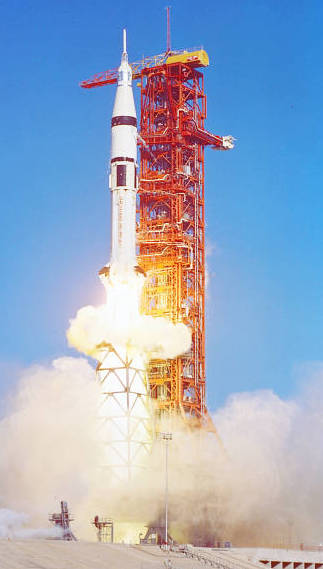
A knock on the door awakens us at 4:50 a.m. The routine launch day rituals rush by — shower, a brief physical (yes, we’re still breathing!) and the traditional breakfast of steak and eggs. Then, starting at 6:05 a.m., we suit up in our modified Apollo spacesuits and pre-breath oxygen to rid of blood system of nitrogen which could cause the bends. That 45-min. spell, all quiet except for the oxygen swishing through the suit, is a good time for a catnap — if you can! After, it’s time to go — for the walkout, last glances and waves to our NASA family. Quickly into the transfer van and to Pad 39-B where our two-stage Saturn, 224-ft. tall, awaits, perched on its “milk stool” pedestal.
As we make our way to the elevator, note the stillness surrounding the steaming rocket. Like all crews, we are struck by the lack of activity on launch day. Usually the pad is teeming with workers. Not today, as the booster is a loaded bomb.
And notice, as we wait to enter the Apollo, the creaking and groaning coming from the Saturn. It’s still being fueled. It’s coming alive.
Swing feet first through the hatch, helped by the support crew, and take a look below our three couches before you strap in. The space down there is packed tight with extra gear. Originally, we were to fly for 56 days. That has been expanded in order to capture the comet. At least 69 days, but the duration remains open-ended. We could stretch supplies to 84 days. We’re carrying 159 lbs. of food (to augment the supply already aboard the station), including 59 lbs. of concentrated food bars. Every third day, we’ll eat nothing but them, not appetizing but they contain a full day’s nutrients. We’re carrying a far ultraviolet camera, the backup to the one Apollo 16 used on the lunar surface, to photograph the comet. A coolant repair kit is also stuffed down there. Skylab’s primary coolant loop, located in the cylindrical Airlock Module, failed in August. The station has been running on the the secondary coolant loop since. We’ll replenish the coolant in the primary system. We’re also carrying a package of 12 new science demonstrations.
The weather is good; the countdown smooth. Twenty minutes to liftoff, the launch team wishes us “Good luck and God speed from all the king’s horses and all the king’s men.” That’s a reference about our formerly cracked “Humpty Dumpty” booster.
It seems unreal. We’re finally here. We’re finally going to do it. Ironically, we don’t have much to do but wait. Until . . .
In the last seconds, we feel the vibrations as engines swivel and pumps pulse. She’s ready to spring from the pad.
T – zero. The clock has started. She leaps from the pad, faster than the slow climb of a Saturn V. “Tower clear.”
Thrust is good on all eight H-1 engines of the first stage. The engines burn for about two minutes. It’s a rough ride, a rough ride all the way, bouncing against our straps. Yet we radio, “Good smooth ride.” Sure it is — especially at staging. “Holy cow!” We hear a metallic chorus of clanging as the stages separate. We’re tossed forward, slap against our straps, as if on springboard as the g forces release a moment. Then kick us back, the S-IVB second stage igniting it’s single J-2 engine. That engine rides smoother, much smoother, a magic carpet ride that ends 9 min. 37 sec. with “SECO!” — sustainer engine cutoff. And 25 min. later, we separate from the second stage and begin our 8-hr. chase of Skylab across five orbits. We’ll need to make five burns of our big Service Propulsion System (SPS) as we step our way to the station. Holy cow, indeed — that SPS engine gives a kick when it fires. Yippee. “Oh man, it really pushes you around!”
You could say we’re having fun, feeling fine as we close in on the station. We take off our spacesuits. Hey, we have time for a little snack. Take a look at the Earth. Everything looks scrambled until the boot of Italy snaps into place.
We sight the station 7 hr. 25 min. into the flight, our guiding star. That grows into the shape of our home. “OK, we see it. She looks pretty as a picture.” There she is, nearly 100 tons of her, 118-ft. long, the windmill Apollo Telescope Mount riding on top, the big solar wing freed by the first crew at the side.
We ease up to the Docking Module capping the narrow end of the station. Ease our docking probe into the cone-shaped drogue of the docking port. Indeed, we’re too gentle with her. The three capture latches don’t fire. We bounce out. Drive her in again. No joy. Houston reminds us we need to re-cock the capture latches. OK, let’s start over — do it right. With a good shove. Capture!
We’re docked, and it’s time to . . . rest. The previous crew had entered the station soon after arrival and moving about so much, suffered a strong bout of motion sickness. We hope by taking the first day easy, we’ll avoid that. We have a meal. And Bill, who’d already felt nauseous during the rendezvous is feeling far worse — the stewed tomatoes he ate come back up. At least he contains it in a vomit bag.
Just rest, Bill, rest.
Jesus, should we tell the ground about it?
You know those doctors — at the mention of vomit, they’ll try to rein us in.
We’ve got a lot of pressure on us to perform perfectly. And motion sickness hold implications for the future, for the Space Shuttle program. What if a Shuttle pilots suffer motion sickness during the demanding landing phase? Critics could use the prospect to kill the program. Yes, we feel the pressure to perform perfectly in all areas.
We could just toss the vomit bag into the trash and forget the whole thing.
OK, that’s what we’ll do.
And we tell the ground that Bill simply hadn’t eaten.
And that’s the end of that, right?
The next morning, Bill stays strapped in his seat in the Apollo as we enter Skylab and begin activating systems and unloading our command ship, a process that will take 3-4 days. Even when not sick, we feel miserable as adjusting to weightlessness causes a fluid shift that is very uncomfortable, causing congestion, headaches. It hits everyone differently For example, Ed — he takes to weightless as if born to it. Yet we’re all falling behind schedule, making mistakes, continually playing catch-up. We don’t have time to look out the window.
Space is not fun right now. And it becomes less fun. “Boss” Al Shepard gets on the comm loop. He knows about the vomit bag. Christ — we accidentally left the command module voice recorder on, automatically picking up our conversation. Later in the evening, the tape was “dumped” to the ground for review.
“We think you made a fairly serious error in judgment here in not letting us know the report of your condition. We’re on the ground to try to help you along, and we hope that you’ll let us know if you have any problems up there as soon as they happen.”
“OK, Al. I agree with you, it was a dumb decision,” Jerry replies
Yeah, he had us dead to rights. We’ve discredited ourselves. And we’re still, in these first days, sluggish as we adapt to space, inefficient, behind on activation, making mistakes, losing time trying to find items aboard the stations which were not stowed in the correct location. It’s a nightmare.
Who said space was fun?
 tlitiptree