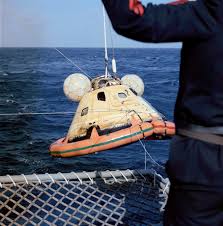
September 25, 1973: The Skylab 3 Command Module is hoisted aboard the USS New Orleans after a record flight 59 days.
*****
It’s 3 a.m. (EDT), July 25, l973, and in the bottom deck of the Skylab space station, down in the bowels where we hand like bats on a cave wall in our the sleeping berths, the sound of song resounds, Roger Miller singing, “Going back to Houston.” With the same energy and enthusiasm as during the entire mission, we reply, “Watch out, Houston, here we come.”
It’s our 60th and final flight day. It’ll be a truncated one, ending in about 15 hrs. with splashdown. We’re up and at it, on the move, which is routine for us. We’re the crew of Skylab 2: Al Bean, Jack Lousma and Owen Garriott.
We’ve been working at a high pace for weeks. We started a bit slow, suffering space motion sickness in the first few days following our launch on July 28. But by the middle of August we hit our stride. At that time, we tell Houston, “We’re looking forward to the last two-thirds of the mission. We hope we can get this flight plan down where we can really crank out the work.”
And that’s what we do. Indeed in late August when Houston offers to ease up on the schedule, our commander, Al Bean, says no, we want to drive as hard a work schedule as the ground can plan. And by God, we outpaced the planners, constantly asking for more. We findd we could cut down on meal periods, on our pre-sleep time, even on sleep itself. By the 39th day of the mission, according to measurements of our medical vitals, we had fully adapted. We discover we don’t need as much sleep as when on Earth.
The one thing we don’t cut back on is exercise. We exercise more than the first crew, recognizing it as key to minimizing re-adaptation to Earth after our record-duration flight.
Al repeatedly asks Houston for our mission to be extended. “We’re all awfully healthy up here, feeling awfully good. Everything’s working and we’re working and feeling good and going uphill instead of downhill.” Alas, Houston refused to extend our flight.
So our stay is complete. Less than eight hours after we wake, at 10:30 a.m., we’re suited up and in our Apollo command ship. The final hatch to the lab is closed.
Look at what we’ve achieved, exceeding every goal, despite 46 hrs. of unplanned repair work. On Flight day 40, we top the goal of 295 hrs. of solar observations with the Apollo Telescope Mount. A week later, we push beyond the 146 hrs. slated for operating the Earth Resources Experiment Package. And on Day 54, we exceed the 276 hrs. slotted for medical experiments. And all the ancillary experiments in various scientific and engineering disciplines — hell, we blow through the planned 146 hrs. on Day 35.
Fifty minutes after the hatches are closed, we undock. Due to the leaks that knocked out two of our four reaction jet quads, we do not perform a fly-around visual inspection of the station. So this is it — a quick good-bye as we drift away.
Just three days ago, on Sept. 22, we’ been there on outside of the station on our last spacewalk. We put an exclamation point with a perfect little stroll to change out the film in the Apollo Telescope Mount. The station humming along, despite the primary coolant loop being shut down due to a leak (the secondary taking over the load), we had no major repair work on this walk, finishing it in 2 hr. 41 min. And the next day begin packing up. And with our typical spirit, tell Houston, “Watch out today. We’re going to get this thing all put to bed.”
When all is added up, we made 305 hrs. of solar observations, compared to 206 hrs. planned preflight, returning 77,600 images of the sun’s corona in various wavelengths. We conducted 39 Earth surveys with the Earth Resources Experiment Package, whereas only 26 had been planned. The six instruments made nearly 16,000 photos and recorded data on nearly 18 miles of magnetic tape.
The reentry using just two jet quads has been rehearsed and proven in the simulators. It goes right by the books. Our reentry burn, a single firing of Apollo’s big engine, the Service Propulsion System, takes place at 5:38 p.m. (EDT). Just an 18-sec. burn is enough to start us for home.
We wear pressure cuffs on our legs, inflated to prevent blood from pooling in our legs as we feel gravity for the first time. The descent goes like the mission had — perfectly. We splashdown at 6:20 p.m. (EDT) 224 southwest of San Diego, and 6 mi. from the recovery carrier, the USS New Orleans. Our flight of 59 days, 11 hr., 9 min. and 4 sec. covering 24.4 million miles is over.
In less that an hour, our Apollo, with us inside, is fished from the sea and plopped on deck. When we exit and take a few steps, we definitely are wobbly. But some had predicted we wouldn’t be able to walk at all. Helped to chairs, we wave, smile and salute. All that exercise paid off — we’re in better shape than the first crew who flew half as long.
Yes, we are overachievers. Yet perhaps we failed in one goal, that of establishing a normal routine in orbit, one that could be sustained for indefinitely long durations. Our flight, as long as it was, still was short enough that we could maintain a non-stop work pace. You can’t live a normal life like that on Earth — or in space. Did our appetite for work give NASA planners the illusion that you can?
 tlitiptree