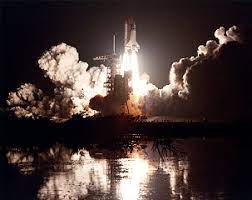
Aug. 30, 1983: Challenger provides a false dawn as it makes the first night launch of the Shuttle program.
*****
This is what they call perfect weather? That’s what the NASA meteorologists promised — I say promised — for us. Perfect weather for the first night launch of the Space Shuttle. We wake at 10 p.m. EDT on Aug. 29, 1983, to rain and thunderstorms, lightning all around the launch area. Liftoff is set for 2:15 a.m., (Aug. 30), with a launch window of just 34 min.
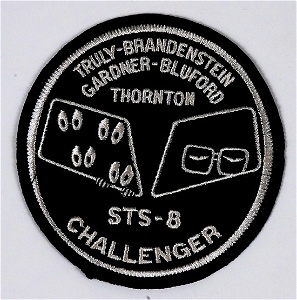
It sure doesn’t look like we’re going anywhere tonight. We’re the crew of STS-8, the third flight of Challenger. Listed in our launch positions, we’re Dick Truly in the commander’s seat, Dan Brandenstein in the righthand pilot’s seat, Mission Specialist Guy Bluford, seated directly behind serving as flight engineer, and by him, Mission Specialist Dale Gardner. Seated down in the middeck where is can’t see anything will be Dr. Bill Thornton, slated to continue the investigation into space motion sickness begun by Dr. Norm Thagard on STS-7. We’re a distinctive crew. At age 54, Dr. Bill will become the oldest American to fly in space. And Guy Bluford will enter history as the first African-American to fly. He was an Air Force F-4 fighter pilot and flew 144 combat missions in Vietnam in 1966. “In the Air Force, I was always in a situation where I was the only Black.”
“I was raised thinking I could do anything I wanted to,” and hopes to pass that spirit on to Black youth, that they can achieve anything they want.
We call ourselves, “One steely-eyed veteran and four wide-eyed rookies.” Our commander had flown as pilot on STS-2 (and wears wire-rimmed glasses) and the rest of us are rookies. We even had the motto made into an informal crew patch.
We go through all the launch preparation, rain still falling as we walk to the transfer van. Like anyone stepping into the rain, our pilot, Dan Brandenstein, lifts his palm to gauge the intensity of the rain. It’s raining like cats and dogs, and we’re not confident at all that we’re going to go tonight. Still we go through all the launch preparations, boarding Challenger at about midnight. Even though the worst of the storms have passed by 12:30 a.m., the weather remains a “no go” across the board.
Our night launch and night landing set for Labor Day, Sept. 5, have been dictated by the deployment time of our primary payload, India’s Insat 1-B, on flight day 2. A combination weather and communications satellite, it will be ejected much like the commercial satellites launched from STS-5 and STS-7. Insat was not always our major payload. We were slotted to launch the second Tracking and Data Relay Satellite (TDRS). That is, until an upper-stage failure nearly stranded the first TDRS, deployed by STS-6, in low orbit. The satellite managed to limp into its proper geostationary orbit using its small thrusters, the final burn taking place on June 29. The upper stage problem– which involved a donut shaped seal that cushions the second-stage nozzle against the casing — has yet to be corrected, so that left a big cargo hole in our payload bay. Which we have filled with the Payload Flight Test Article (PFTA), moved up in the schedule from the 11th Shuttle flight. It looks a bit like a giant dumbbell, and indeed, it functions are one to test the muscle of the Remote Manipulator System (RMS) robot arm. Weighted at one end with lead, measuring 15 ft. by 16 ft., it has a mass of 8,500 lbs. That’s more than twice the mass of the SPAS satellite lifted on STS-7 It is equipped with four grapple fixtures to text how the arm reacts to large masses. Set to be tested on two flight days, it will never be released, only moved about to see how the arm reacts.
Even without our TDRS payload, we still perform a vital role in the that program. We will extensively test communications, including high-data-rates, through the relay satellite. These tests are vital for the next Shuttle flight, STS-9/Spacelab-1, which will depend on TDRS to relay science data from the Spacelab module anchored in Columbia’s payload bay.
Entering the planned 10-min. hold at T-minus 9 min., no one is optimistic we’ll actually launch. Flying the Shuttle Training Aircraft over the Cape, Bob Crippen reports, on his first pass, that conditions were not good. Launch Control is extending the hold. On his second pass, Crippen says conditions are improving, the rain moving off to the south And on his third, he can see the pad, sees no rain, winds diminishing. After holding an extra 17 min., we are go, go for a launch at 2:32 a.m.
At T-minus 31 sec., Challenger’s computers take over control of the countdown. Coming up on Main Engine start at T-minus 6.6 sec., and . . .
Dale Gardner looks back through the overhead window as the engines start, and the light from the solid rocket darn near blinds him. Even with eyes forward, when the Main Engines ignite, we see the light reflected off the launch tower. And when the Solid Rockets ignite, that light becomes much, much brighter.
“Tower clear,” Capcom Bryan O’Conner calls.
As we rise, it looks like we’re driving through a bright fog bank, except there’s an orange core to it.
“Challenger, Houston, you’re go at throttle up.
“Roger, Houston. We’re looking at the moon, directly at it.
The foggy glow becomes brighter and brighter, a bluish light as we climb on the SRBs. Then it diminishes somewhat just before the Solids are jettisoned. When those solids separate, the light blooms into a very intense flash.
“Boy, Bryan, you should have seen it from here. It was blue light almost all the way up.”
“Wow, I bet it was.”
During the rest of the climb to orbit on the Main Engines, we see flashes of light, probably reflections off External Tank. Dale glances back through the overhead windows again, can see the edge of the Main Engine plume. He expects to see a nice sharp edge to it, and is surprised at the bright orange glow from the main engines bouncing around , brighter than he expects. It appears to pulsate, almost as if one engine was running unstable. Are the engine’s OK? Several times he asks Dan, who has the displays on engine status, if to check. Yes, they’re running nominally. We now are getting our MECO (Main Engine Cutoff) calls, first, able to reach our MECO point if one engine goes out. Then later, we reach the point where we can make orbit even if two engines go out.
“Challenger, Houston, press to MECO.”
“Press to MECO,” our steely-eyed commander replies, “We’ll see you on Labor Day.”
The launch is going so perfectly that we have time to comment, “OK, Houston, onboard . . . everything is looking good. We can see the stars real brightly, and we are seeing little flashes of light which I guess re reflections off the bottom of the tank.”
MECO coming up at a predicted time of 8 min. 42 sec. into the flight. The engines throttle back in anticipation of the event.
“OK, we’re throttling, Houston, and still looking good, we’re still seeing the reflections of the tank.”
“MECO, Houston.”
After engine shutdown, for a few seconds everything goes black, the few seconds before the big External Tank is jettisoned. When that tank separates, we’re surrounded by bright light, like a bonfire, like we’re in the center of a ball of flame. What an experience!
Prior to launch we’d set the light level on our cockpit displays low enough to maintain night vision. That was the most worthless exercise we did. Night vision? We were in a glowing ball of light all the way up, wiping out any night vision. We sure as hell hadn’t simulated that in training.
Crossing Africa, we see our first sunrise, water-color bands of color rapidly spreading and rising and then the blinding light of the sun washes it all away. We don’t have time to gawk anyway. We’re already unstrapping from our seats, thrashing around awkwardly at first, yet getting down to work.
We’re very busy, with two burns of the twin Orbital Maneuvering System (OMS) coming up quickly after launch to settle us in a circular orbit at 184 mi. altitude. And then we have to open the big payload bay doors, exposing vital radiators. Even as we’re doing that, we’re called upon to make a first in the program, the first Shuttle communications through the Tracking and Data Relay Satellite.
The capcom calls, “And Challenger, Houston, in 30 sec. we’ll be handing over to TDRS, and if that’s not successful, we’ll pick you up at Goldstone at 1 plus 29 [1 hr. 29 min. into the flight].”
“Roger, Houston, and we’re getting ready to [open] the doors.”
“Roger, Challenger, Houston, with you on TDRS. Challenger, Houston, with you on TDRS [pronounced “Tee-driss”].”
“Houston, Challenger, loud and clear. How do you read the CDR [Commander]?”
“Roger, loud and clear, also.”
This only the beginning of days of testing the communications system. Indeed, a day was added to the mission for the task. This is only the beginning for TDRS system, which the Shuttle will rely on for continuous high-speed communications into the next century.
This is only the beginning.
 tlitiptree