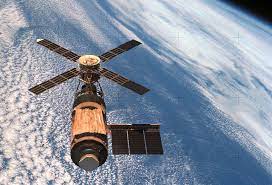
Skylab sports a new sunshield, one that would stabilize temperatures inside the station at 75 degrees (F). The second crew erected the sail-like shade on August 6, 1973.
*****
Are you ready? It’s August 6, 1973, and we’re suiting up to take a little stroll outside our home, the huge Skylab complex orbiting 270 mi. above Earth. We’re Jack Lousma and Owen Garriott suited up in the narrow cylinder of the Airlock Module poking at the top of the main body of the station. Our commander, Al Bean is consigned to watching from the command module of our Apollo ferry ship.
Was it only four days ago? Was it only four days ago, when we saw the propellant leak from a second RCS thruster “quad” of the Apollo? Would the remaining two quads fail? You know it’s serious when the man himself, Chris Kraft, NASA’s original flight director and now director of the Johnson Space Center gets on the radio to talk to your mission commander. “Al, this is Chris Kraft. As far as the RCS system is concerned, we really need to determine at this particular moment whether we have a generic problem or two unique problems with these quads. . . . Now, just to be prudent, we have begun preparation of the vehicle on an accelerated basis so that we would have a rescue vehicle available to us should that become necessary.”
NASA began around-the-clock preparations of the Apollo/Saturn designated for the third Skylab mission. In the plan, Vance Brand and Don Lind would fly it to fetch us home. Their Apollo could be moved to the pad as early as August 13 for a September 5 launch. A firm decision would need to be made by August 21.
Kraft added, “In concluding, I’d like to say, we’re proceeding as if we’ll have a nominal mission.”
Al replied, “You just said the right words. We were hoping you’d say that.”
We could now proceed with the delayed spacewalk, which is supposed to last 3.5-4.5 hrs. The main purpose originally centered on install fresh film cassettes in that towering Apollo Telescope Mount (ATM) holding five solar telescopes. We now have a priority item to achieve before that: We must augment the parasol sunshade deployed by the first crew which is deteriorating. We will use the alternative “twin-pole” shield developed by the Marshall Spaceflight Center and also brought up by the first crew. Essentially it’s deployed like a sail along two booms that form a V spreading like a travois from the truss of the ATM. The sail will be deployed over the parasol, which will remain in place, pulled tight to the hull of the Workshop.
We suddenly have yet an additional task — checking for signs of leaks in our vital cooling system. Two coolant loops carry heat from electronics, batteries and the cabin air to radiators located on the exterior of the Multiple Docking Adapter, the cylindrical module to which the Apollo is docked. Houston estimates that the primary loop will run dry of coolant in 16 days, and the secondary one will last 60 days, long enough for our mission but not the third one. We’re told, “You ought to see some yellow and brown vapor deposits.”
Ready to depressurize and open the hatch? We’re not rushing anything today and exit a half hour late, at 1:32 p.m. EDT. We must construct two 55-ft.-long poles from 5-ft.-long sections. That’s 11 sections to each pole. All the parts are held in two pallets we take out the airlock, along with a bag containing the folded sail itself. Owen works at the open hatch, while we move out onto the ATM truss where we clamp a set of foot restraints. And also a plate that will hold one end of the long poles which will spread like a V hugging the sides of the Workshop hull. It takes an hour just to get everything outside. Just don’t rush — we don’t want to loose any pieces.
Owen must assemble the poles and swing them over to us. We’re about 40 ft. away. Each 5-ft. section is bayonet-mounted to the next: insert the ends, twist 20 degrees until they lock, pull a rubber boot over the joint and move to the next. Simple? His his thick gloves, Owen has trouble releasing the sections from the the pallet. Just take it slow. We’re doing fine out here. Indeed, what a view, 270 mi. to the Earth below. Look at that — the coast of California as clear as can be. Can’t help but exclaim over it.
OK, here comes the first pole. Be careful — it’s threaded with a rope, each pole is, that connect to a pulley and will serve as a halyard to unfurl the sail. All these lines, hard to keep them straight. Go slow. Lock the end of the pole in the baseplate.
. . . Here comes the second one. Is the line tangled? It keeps twisting around the pole. No rush, here. As slow and sweet as can be. We’re not working up a sweat, no, sir.
OK, now let’s unbag the sail and hook it to the halyards. Wow, sunshield, paper-thin aluminized Mylar treated with a thermal coating, is billowing all over like an angry octopus. We remind ourselves, take it slow. Time to run up our sail. Wait, wait — the sail was packed accordion-style, very tight. And the pleats are sticking together. We have to separate them by hand, one by one.
We’re 3 hrs. into the spacewalk already. When we come into contact with Houston, Al assures them, “Everything is going good up here. They’re working at a slow, steady pace. Nobody is tired. I have a feeling the last half is going to go faster.”
A half hour later, we hoist the sail, pulling on the two ropes. Beautiful. We’re sailors now! Move to one edge of the sail and secure a line to keep it taut. Swim to the other end and do the same. Tie her down. Nice and sweet. It’s all complete 4 hrs. into the spacewalk.
And keep working, doing the inspections. Check the Apollo RCS quads. Some pitting here and there, maybe from micrometeoroids, but no signs of the leaks. And inspect around the Multiple Docking Adapter for signs of the coolant leak. Can’t see any discoloration, although the station skin is certainly discolored from expose to the sun, sections of gold color have bronzed.
OK, it’s time to climb the ATM and install the film. Owen has been looking forward to this — a change to lean over the end of the telescope mount and look down like high diver at the Earth. A slight sensation that you could fall all those miles! OK, several other tasks to perform, such as pinning open a stuck door to one of the telescopes. And mounting plates to detect micrometeoroid impacts.
We do it all, time not a factor. Indeed, clock it — 8:01 p.m. EDT when we end the walk — 6 hrs. 29 min., a new record for a spacewalk, beating by far the mark set by the first Skylab crew of 3hr. 23 min. when they unjammed the big solar wing.
And we have good news: Houston has refined their look at the data on the coolant loops. Only the primary system is leaking and still should last for another 18-25 days. The secondary loop, although it may show some very minor leakage, is sound and should last through our mission and the third and final flight.
More good news to come. The engineers analyzing the problem with the Apollo thrusters make their conclusions. The failures were independent. One came from a leaking value. The other resulted from a loose fitting. The other two RCS quads proved to be in good shape.
And they believed that the Apollo could fly home with on two quads safely. Brand and Lind test that out in the simulator and show it would work. In effect, they work themselves out of a job flying the rescue.
And so on August 7, we will make our first solar observations with the ATM and our full slate of scientific work will be underway. We look forward to seven weeks ahead of scientific discovery.
 tlitiptree