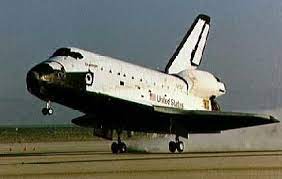
June 24, 1983: Waved off from landing in Florida, Challenger touches down at Edwards Air Force Base, California.
*****
We’re near the end of a mission of firsts — from the first U.S. woman in space and the first five-person crew to the first deployment and retrieval of a satellite. It’s June 24, 1983. Now entering our final flight day, we are slated to make one more — the first Shuttle landing at the Kennedy Space Center (KSC). We are the crew of STS-7/Challenger: Robert Crippen, Rick Hauck, Sally Ride, John Fabian and Dr. Norm Thagard.
Even before the day is underway, we know the chances are slim that we will make this last first. As often in such decisions, a combination of factors, not just one, comes into play. Certainly the weather is a major player. Early the previous morning, after breakfast, as we pass over Gulf of Mexico and Cape, Houston tells us, “Take a look out your side as you go over the gulf there, and you’ll see some weather patterns that we don’t think are going to clear for the next two or three days, and it’s really looking bad over the Cape.”
A low pressure area, tossing out clouds and thunderstorms, is stalled over the Gulf of Mexico. Yet later, the weather folks say the weather should slowly improve. Indeed, if we “wave off” 24 hrs. and try for KSC on June 25, chances are even better the weather will acceptable.
We begin testing Challenger’s systems, start APU 3 to check it out. That’s Auxiliary Power Unit, one of three turbines that power our hydraulic systems.
“OK, here we go.” We spin it up, and watch it perform nominally, but only for 40 sec.
“OK, Houston, we got an APU underspeed as soon as we started surface movement. . . . We got an immediate underspeed, and it just shut itself down.”
Something is wrong with the APU. Perhaps a partial clog in fuel system. Later in the day, we fire up all three APUs. And after a stutter, APU 3 works fine. As if the clog has cleared.
That evening, Mission Control sounds happy: “Challenger, Houston’s with you at Botswana for 7 min. with some good news.”
Crip replies, “OK, we’re always ready for good news.”
“Right Crip. Just to tell you that your APU 3 looks real good with the data we got during the Hawaii pass, and the weather forecast at the Cape has improved a little bit so we’re pressing ahead with nominal end-of-mission planning right now.”
There is one caveat. APU 3 remains suspect, by flight rules, it is declared failed, even though working. And flight rules dictate that we will not wave off for 24 hrs. with a failed APU. We’re coming down — if not at KSC, then at Edwards Air Force Base, California.
*
Landing day
At about 2:25 a.m. EDT, Capcom tells us, “Challenger, Houston. Be advised you’re no-go for payload bay door closing. We’ve got some clouds, low clouds forming there at the Cape. We’ll be keeping an eye on it. We’re hoping it’s going to blow off.”
We have two opportunities into KSC on successive orbits. Minutes later and only 15 min. before the deorbit burn, we are waved off the first opportunity.
“We are going to wav off this first rev; we’ve got some low clouds that just started forming on us down there and fog. And it’s for sure going to be a no-go for the first opportunity. We’re hoping maybe the winds will continue to pick up and blow that stuff out of there. So we’re, right now, looking for a one-rev. late landing.”
We quietly wait, and joke about having time to eat a few peanuts. Nothing much to do but wait. “Got a beautiful moonrise showing up here; looks like we’re just about full.”
Over U.S., Houston tells us, “The weather at KSC is getting worse instead of getting better, so it looks like we’re no-go for KSC, so you guys can sit back and relax a little bit. We will be going into Edwards on the following orbit KSC had a red carpet out there for you . . .
Crip replies, “Yes, well, we’d have liked to have gone in there very much, but if the weather’s bad, that’s not the right thing to do, and we understand.” The deorbit burn will occur at 6 days 1 hr. 23 min. into the flight beginning a one-hour glide to Edwards.
“Challenger, Houston. You’re go for the burn.”
“Roger, that. Go for the burn.”
Are about 15 min. from burn, pass out of contact. At Botswana, we report, “OK, we’re all set. Next thing is the APU start.”
As we pass out of communications range for 25 min., Rick, who flips the APU switches, tells Houston, “APU 1 is started.” APUs 2 and 3 start. We keep APU 3 in low speed, as backup. We can drive the hydraulics fine with two of the units. We’re heading out over the Indian Ocean. Tail forward and canted up, we fire the twin Orbital Maneuvering engines at 8:59 a.m. EDT. They burn for 2.5 min. And the burn is on the dot. We’re on our way home.
Coming into contact with Guam, we report, “We had a good burn on time.” After the brief contact through Guam. Houston calls, “We’ll see you after blackout, about Mach 12.”
At 9:26 a.m., we reach what is called Entry Interface, the point where we encounter the first tenuous tendrils of atmosphere. And look for the neon glow around the Shuttle to build. Two minutes later, we enter communications blackout. We’re on our own.
At 6 days 2 hrs. 8 min., standing by for contact after blackout. At 9:43 a.m. EDT, we hear Buckhorn calling.
“Challenger, Houston, configure AOS.” Acquisition of Signal.
“Houston, Challenger, loud and clear. Nice and smooth all the way down.”
“Real good, Crip.”
Moments later, Houston tells us, “Your energy, your ground track, your nav. are nominal.” Think of the return as a ballet to precisely to trade distance against speed/altitude. That’s what’s meant by energy management. As we descend, the Shuttle automatically makes five wide S turns to shed energy.
We approach the coastline between Ventura and Oxnard, going Mach 4, range 100 mi. Crip echoes what he said on the first Shuttle flight as it crossed the coast. “I’ll say once more, what a way to come to California.”
Crip takes manual control briefly at 77,000 ft., Mach 2.1, range 51 mi., flexing his skills. Then he goes back in auto control until we are closer in. He will fly the final approach on manual.
At 34,000 as we begin turning on the HAC, the Heading Alignment Circle, a wide left turn to line us with Runway 15. We’re 18 mi. to touchdown. We turn onto final, on glide slope and turning toward the centerline, altitude 14,000 ft.
“Your energy looks good. Surface wind 180 at 10.” Winds directly out of the south.
Crip keeps her on glide slope, on centerline. Gear down and locked. We glide in . . . and roll down the centerline.
And wheels stop at 6:57 a.m., California time, after a flight of 6 days, 2 hr., 23 min., 59 sec. Crip lets out a wild, “Yahoo.”
Capcom Bryan O’Connor calls, “The good news is the beer is very, very cold. The bad news is that’s it’s 3,000 mi. away.”
Crip replies, “That’s what I was afraid of.”
It’ll be awhile before they can open that beer at KSC. The next flight is slated to launch and land in darkness, and so we want it to land in the wide spaces of Edwards. And the flight after will carry the first Spacelab module up and back down. As heavy as it is, we want to land it at Edwards.
Even with the beer, we’ve got much to celebrate. Not just the records set, but the experiment and test data returned. We’ve met 56 of 58 planned test objectives. And still we’ve still much to learn about operating the Shuttle.
Landing wasn’t entirely normal, although we couldn’t tell in the moment. At touchdown, the brake on the right inboard wheel of the main landing gear failed. Two of its four rotors shattered.
The other brakes took up the load. Our perfection in landing is deceiving.
 tlitiptree