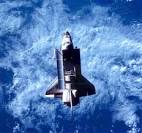
Forty years ago: Challenger as seen from the SPAS platform which it deployed and later retrieved after a day of tests.
*****
This is June 22, 1983, flight day 5 of our STS-7 mission, and it’s a big one. We’re going to conduct “prox ops” — that’s proximity operations with the German Shuttle Pallet Satellite (SPAS). We — Bob Crippen, Rick Hauck, Sally Ride, John Fabian and Dr. Norm Thagard — will attempt for the first time in the Shuttle program to conduct certain close-range phases of rendezvous by the Shuttle, gaining experience that will help in the first full rendezvous of the program. That’ll come in 1984 when STS-11 attempts to repair the Solar Maximum satellite which failed in orbit.
We will release the SPAS, using the Remote Manipulator System (RMS) robot arm, move away 1,000 ft., conduct radar tests, move back in and grapple the satellite. We’ll hold it there while we have lunch. Then release it, move off 200 ft., conduct tests to see how stable it is when struck by the plumes of our control jets, and then use another technique to move in for the final capture. That’s the short of a long day. These operations will take 10 hr. or more.
For the first half of operations, our CDR, Bob Crippen, will anchor the starboard station at the rear of the flight deck, controlling the Shuttle from there. John Fabian will be stationed to his right operating the RMS. Pilot Rick Hauck will be in the his seat at the forward cockpit, monitoring Shuttle Systems. Sally Ride will be in the commander’s seat, controlling the SPAS. After lunch, we’ll switch positions, with Sally Ride performing the RMS to grapple SPAS, so that everyone gains experience. There even may be a role for the fifth member of our crew, Dr. Norm Thagard, added to the flight to study space adaptation.
*
Just after midnight Eastern Daylight Time, we commence checking out the SPAS and the RMS arm. Two hours later. over the Dakar tracking station, we tell capcom T.J. Hart, “We have completed the SPAS checkout. The performance is nominal.” We’re given a go to grapple the SPAS, an inexpensive reusable experiment platform built on a truss that spans the 15-ft. width of the payload bay. Kinda resembles a big box kite, you might say, but one carrying a load of instruments and systems canisters, as well as cameras that can relay TV to the Shuttle.
In about 15 min., as we come in contact over Indian Ocean, Sally reports, “We’re in the process of uncradling the arm right now.”
We discuss with Houston a series of error messages sent by SPAS that indicate a momentary loss of lock with the Shuttle, but Mission Control determines are just a transient breaks. Sally reports, “Meanwhile, John’s over here maneuvering the arm to the grapple position, and we’re still holding up on our attitude maneuver so we can get this drift check. . .”
A few minutes later, we receive word. “Challenger, Houston. . . . You are go for unberth.”
Crip calls, “Outstanding! Does that mean we’re go for departure on the R-bar?” R bar is engineering talk for “radius vector,” meaning we’ll pull away along the orbital line of travel.
Houston is still looking at some temperature readings on the SPAS, heating up in the sun, as it did the day before, when overheating affected its data systems. “. . . You are go to unberth at least, and it’s looking good for release. We’ll see you at Dakar in about 5 min.”
Over Dakar, they say that they hope that once we’ve lifted the SPAS out of the payload bay, the heating problems will disappear. They don’t want the SPAS to get above 110 degrees (C).
“OK, T.J., the SPAS is coming out,” we report just before going out of communications range. It’s 3:45 a.m. EDT., and everything is going smoothly.
In contact with Indian Ocean 3 min. later, we report, “OK, we’re standing by, ready for release on your call.
“And Challenger, you’re go for release.”
“Outstanding.”
We move out of comm range again just as we’re about to release. John releases tension of the snare wires in the cylindrical end effect, the “hand,” if you will, of the 50-ft.-long RMS. This releases hold of the grapple pin on the SPAS. He swings the arm back. He then grapples SPAS again. The satellite remains steady during these exercises.
Seven minutes later when we come into contact through Yarragadee, Australia at about 4 a.m. EDT, we report, we report, “OK, T.J., we’re with you, and John performed a beautiful release and recapture in auto.”
“Wonderful! Wonderful!”
And John tells Houston, “For the RMS folks, you can tell them that the tip-off rates are negligible, underline negligible.”
“That’s outstanding, John.”
The SPAS temperature is creeping up. Houston says, “We’re still watching that temp but you can anticipate a go for the R-bar sep. at AOS Buckhorn, and that’ll be about 4 min. prior to the nominal sep. initiate time. ” That’s in less than a half an hour.
And we can report, “It looks like the SPAS color TV camera is working.” That camera should provide the world with dramatic images of Challenger in free flight.
T.J. Hart is replaced as capcom by Jon McBride. In contact over the U.S. now, we tell him, “We have detached and we’re waiting for about 10 min. to start the R-bar sep. . . .And we’re stable.”
“We copy that, and we’re looking at our data.” It’s gonna be close, SPAS temperature is 102 degrees (C).
McBride calls, “And Challenger, you’ve got a go for the R-bar separation.”
Over Merritt Island just before 5 a.m. EDT, we send TV of SPAS from our payload bay cameras, in orbital darkness.
“Got a good lock with the rendezvous radar at 90 ft.”
Jon says, “Beautiful.”
Into sunlight, we work the TV cameras. We’re about 100 ft. below the SPAS, moving down and a way on the R bar separation. We beginning sending views of the Challenger as seen by SPAS. Sally and John have worked out how to position the arm so that it forms a “7” proudly displaying our flight number.
Now 2 hr. 40 min. since beginning prox ops, we are 200 below SPAS, and begin moving further down . . .
About to pass out over the Atlantic, we tell Houston, “We’re out 300 ft., looking stable. It looks very good.”
When we come in range of the Dakar station, we’re out 500 ft., recording TV views from the SPAS. At 5:11 a.m., we’re about 525 ft. below the SPAS and 275 ft. in front of it.
*
By 5:31 a.m., we can report, “We are stable at 1,000 ft. and on the V-bar, and it looks real nice. The SPAS is performing like a champ and the attitude control system is holding up real well, no problems at all, and gee, it just really looks super up here.”
“We sure do want to pass on our best wishes to those folks from MBB [the German firm Messerschmitt-Bowkow-Blohm] who built this spacecraft. It’s a real beauty.” And Crip adds, “Also, the one we’re flying in is a real beauty, too. The Orbiter’s really handling like a champ, as John Young would say.”
“We copy that. And Crip, would have any any objections to rotating the SPAS about 45 degrees for a little cooling.”
“No problem.”
“OK. We’d like to see a minus 45-degree rotation about the Y axis.”
That heating is still a problem, temperatures still inching up. If it gets too high, we’ll have to terminate our prox ops. Sally commands the SPAS to rotate. And we conduct the first tests of our rendezvous radar test. Then report the SPAS is at 103 degrees (C). The temperature seems to have stabilized.
We’re wrong about that. Half an orbit later, over Hawaii, the SPAS temperature has increased to 105 degrees (C). Houston tells us power it down during our lunch period, a one-hour meal period ahead during orbit 65 after we’ve re-grappled it. We continue with more radar tests. Later on this orbit, the SPAS temperature creeps up to 107 degrees (C).
*
We begin closing the distance to SPAS. At 7:44 a.m. EDT., in contact with Hawaii, we report. “OK, we’re about 700 ft. out, closing.” We’re making a V-bar approach, moving backwards toward SPAS. In darkness. All we see out the payload bay windows is the bay lights.
Coming into contact over the U.S, Rick reports, “Hello there, Jon, we’re about 4 min. to sunrise, it looks like, and we’re into 350 ft. and looks like its going good.” We send more TV of Challenger, tail pointed toward Earth, as seen from SPAS.
Out of communication range, John eases the arm’s end effector to grapple SPAS. Crip holds the Shuttle steady as a rock as the arm closes in. Thanks to Crip, it’s a piece of cake, John says.
We do a capture and release, setting up another grapple test. In this one, Sally sets the SPAS in a slow rotation. John will attempt to snare it on the fly, so to speak. Or I should say — surprise — our doctor, Norm Thagard, will perform the test. After all, he’s a qualified RMS operator. He times his moves and catches the satellite perfectly.
In communications at Botswana, Crip reports, “OK, and rotating capture is complete, both Dr. Fabian has a couple grapples to his name and Dr. Thagard has a grapple. And we’re getting ready to go through the power down now.” That’s the power down on SPAS to ease the heating. The SPAS temp. is now up to 108 degrees (C).
“Once you power down, we’re going to stay power off for an extra revs, so that’ll give us two-and-a-hours for your meal time.”
Over Yarragadee, we report “We’re just getting ready to go down and grab a little lunch, and we think we’ve got everything set up like you guys wanted it.” Now 5 hrs. 6 min. into prox ops.
*
Change of shift at Mission Control. Guy Gardner is now capcom.
We transmit video of grapple. Crip gives running commentary: “It’s a very comfortable approach the way we planned the lighting. . . . And you can see the rate starts to kill and somewhere right in here, where I say to Jon Fabian that you got it, and time he starts closing in. . . OK, he is doing that now, he’s driving the RMS in.”
John pick up the commentary: “Crip provided a real stable platform, and I took it in about halfway here and then shifted over to vernier control so that the final maneuver into the payload would be a little smoother that we can get with the coarse control. And then continued on into toward the grapple fixture itself, and the payload was in fact very stable and as we approached the grapple fixture with the end effector. . . . Then we continue to close in the last couple of feet, with Crip looking out the overhead window to assist in all the ranging as we get closer. . . .It’s a very smooth operation coming in. The RMS is very easily controllable, and the trigger and grabbed it . . . and snugs up against the end effector.”
Crip tells Houston, “Got five very happy people. We’re looking forward to his afternoon’s little excursion with the SPAS, and we’re happy that the folks down there have worked on this little problem with the temperature to allow us to do that.”
We ask what the temperature should go down to.
Guy says, “Well, I don’t now about prediction but we’ve got a pool going down here on it.”
“We might have one going up here, too.”
“Our official guess is it’ll start up at about 100 degrees.”
“Great.”
*
Lunch is over. Houston suggests beginning activation again at 6 hr. 30 into the day’s prox ops activities. We’ve used about 700 lbs. of thruster propellant during first period, versus 981 lbs. predicted use.
We release the satellite on orbit 67 — the SPAS temperature down to 73 degrees (C) — and back away. It’s about 10 a.m. EDT. We back away, and at 100 ft. distance fire our thrusters at the SPAS to see how it reacts. When we hit it with our forward jets, it rocks and sways, no surprise. We then jets in the aft that fire upward, which shouldn’t disturb it as much. We receive a surprise as the plumes give it a ride, swinging back and forth like a bar magnet.
Over Botswana at 7 hr. 55 into the days’ prox ops, nearly 11 a.m. EDT, we report, “OK, and Dr. Hauck has done a superb job getting us through all the plume data. That is complete, and we’re sitting out here station keeping now at 200 ft.”
We conduct more radar tests.
Over Guam, at 8 hr. 28 min. into the prox ops, we report, “We’re sitting here for the appropriate time to maneuver the SPAS initial approach attitude . . .”
We talk of the plume tests, giving out compliments “to the engineer that put the SPAS together that could take the kind of hits that it took.” On orbit 68 we show video of aft jets disturbing SPAS. “You’ll see it rotate about its Y axis almost 90 degrees.”
*
By about 12:45 p.m. EST, our re-rendezvous is underway. All continues to click along perfectly and 40 min. later, we report, “Sally and Rick got a good capture on the inertial approach, and we’re now getting set up to do the single joint tracking capture. We’re almost there.” One final grapple, this time limiting the arm to a single joint, as if your arm was in a cast. A moment later, we report, “Dr. Ride just completed the single joint tracking capture.”
And that’s it for the long day. We put SPAS to bed in the payload bay.
“Challenger, Houston. . . . I’d like to sign off here and let you guys get busy getting ready for bed. Like to thank you for a great day of prox ops and some good experiment data . . .”
Crip replies, “I’ve been told that some crews in the past have announced that we deliver, while from flight 7, we pick up and deliver.” And we’ve expanded the Shuttle’s operational envelope, opening the way toward true rendezvous missions leading all the way to the era of space stations.
 tlitiptree