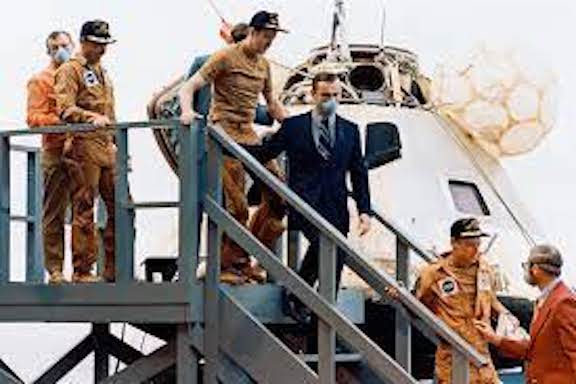
Fifty years ago: The first Skylab crew, led by Pete Conrad (at right on the steps), move from their Apollo capsule onto the deck of the USS Ticonderoga. Conrad is followed by a wobbly Joe Kerwin and P.J. Weitz.
*****
Strike up the band — June 22, 1973 — it’s time to come home. We’re the crew of the first Skylab crew, designated Skylab II. We’re the fix-it gang, the record-setting team of Pete Conrad, Joe Kerwin and P.J. Weitz.
Down in the sleeping quarters of the huge Orbital Workshop, we’re awake at 8:30 p.m. EST, (June 21) with splashdown in the Pacific slightly more than 13 hrs. away, and we have much to do to make that moment work. It’s not a morning to linger over breakfast, especially as yesterday we swabbed down the ship including cleaning the wardroom.
We’ve already said good-bye to the routine of 16-hour days that we settled into after we freed that stuck solar wing on June 7 (flight day 14), giving us plenty of power for a full load of experiment work.
Pete soon begins work on activating the Apollo spacecraft, that combination of Command and Service Modules with it’s big engine that will carry us home. Joe works in the Multiple Docking Adapter at the controls for the Apollo Telescope Mount. He’s setting it up to run in automatic mode commanded from the ground during the five weeks between our flight and the launch of the second Skylab mission. P.J. dashes — or I should say, floats — between the two, helping where needed.
Yesterday, We stowed most of the items we’re returning, the samples and film/data cassettes, but have a few that had to wait until now, the frozen blood and urine samples, as well as refrigerated biological cultures. It’s like packing for any trip. Indeed, it’s like we’re leaving home.
*
We’ve really hit stride in the past couple weeks. By the start of June 11, our 18th flight day, we’d already taken 11,224 photographs of the sun with the multiple instruments of the Apollo Telescope Mount (ATM). And we’d gathered 5,533 images of the Earth with the Earth Resources Experiment Package (EREP).
On June 15, while P.J. is at the controls for the ATM, a massive solar flair erupts on the sun, starting out as a bright pinprick. The ATM instruments detect it before we see it, and alarm sounds to alerts us to the flare. We photograph it as it builds and whips its electron storm into space. What a way to start our final week, on what originally had been scheduled as an off day, a break in the constant work. On this day, we also spend 4 hrs. through checks of our Apollo’s systems. And the next day we stage a five-hour, full-scale rehearsal of our return to Earth. We want to make sure we’re not rusty after nearly a month in orbit.
On June 18, we receive a call from Capcom Hank Hartsfield 3:20 a.m. EDT, as we’re just starting our daily routine by weighing ourselves in a special rig that works by a pendulum-like measurement of momentum. “In about two minutes . . . you’ll become the new world’s champs for the longest spaceflight.”
“OK, thanks for the note,” we reply. We’ve exceeded the 23 days, 18 hr., 22 min. set by the ill-fated Russian crew of Soyuz 11 in 1971. The Skylab space station is on its 500th orbit since launch on May 14.
That day, we wrap up much of our scientific work, taking our last photographs with the ATM. By flight’s end, we’ve worked 87 experiments aboard the station.
The next day, June 19, Pete and P.J. conduct a spacewalk to retrieve the ATM film cassettes containing all those valuable solar images, 30,247 in all.
The pair exit the Skylab’s airlock at 6:55 a.m. EDT. P.J. goes first, and Pete hands out the retrieval equipment.
“OK, here I come,” Pete calls before pulling himself out the Gemini-style hatch.
“Don’t fall; that’s a long way,” P.J. jokes.
“Boy, that looks a long way down to the Earth.” And yet Pete is about to experience an even grander perspective. He’s the one who swims up the tower of the telescope mount, pulling himself along twin handrails. P.J. extends a pole on which the film cassettes are attached and lowered. While up there, Pete uses a lens brush to clear some particles from one instrument. And he effects yet another repair. One of multiple power relays from the solar arrays of the ATM had failed. A relay is stuck, Houston believes. And instructs Pete to hammer — yes, hammer! — on the relay housing.
P.J. observes, “Boy, is he hitting it. Holy cow.”
Pete asks, “Did anything happen?”
“OK, it worked,” Houston says. “Thank you very much, gentlemen. You’ve done it again.”
And we’ve done it quickly. We only need 96 min. to conduct of the three hours allocated for the spacewalk. Yes, we’ve refined living and working in orbit to an efficient routine. But now it’s time to come home.
*
In our final hours aboard Skylab, we have yet one last problem to deal with. Unbelievable. Temperatures are rising in a refrigeration loop. While we continue our departure preparations Houston turns the the station 45 degrees so the sun will warm a frozen valve at the radiator panel at the Workshop’s base. The sun does its job, and the station is returned to its normal orientation to the sun and Earth.
Shortly before 4:30 a.m., we’re told to hold off undocking until the station had stabilized in its normal position. Pete tells Houston, “We haven’t done anything by the flight plan yet, so we’ll go by ear again.”
We wait nearly a half hour until given a go, and undock at 4:55 a.m. Pete calls “Bye-bye Skylab.”
*
What’s it like to live in space? Maybe that’s the most important part of our experience. As Pete would say long after when people inquire of his space experiences, he doesn’t think of going to the moon. His mind jumps to those weeks aboard Skylab.
What’s it like? Moving about in that big station is easy. The station was equipped with a “fireman’s pole” down the middle of the Workshop’s upper level to help us move about. We find we don’t need it and take it down. With a bit of experience, moving about becomes second nature. That makes working easy.
And we enjoy earthly comforts not seen in space before: We each had our own sleep compartments, small as they were, with a privacy curtain and ventilation controls.
And the bathroom. The space toilet actually worked quite well. No complaints!
And the wardroom with its three-leaf table equipped with food warmers. The cuisine may not have made the grade in a four-star restaurant, but it was a vast improvement over the freeze-dried Apollo stuff.
Hey, we could even take a shower. Our shower consisted of a plastic cylindrical curtain. We squirted water on ourselves and washed. Then suctioned the water away with hose like a vacuum cleaner. The only problem? — the whole process was time consuming. Too time consuming. Follow on crews elected for sponge baths with wet towels.
Like any homeowner, we spent a considerable time on cleaning and maintenance. The big air filter at the Workshop dome had to be vacuumed cleaned regularly. Indeed, anything loose and lost eventually would find it’s well to the filter screen. If you lose something — look for it there.
The best part of our house was the big circular window in the wardroom. With a diameter of 18 in., its the largest window on any spacecraft to this time. Nothing spells home like looking out the window at your backyard. And the entire earth was our backyard.
Despite the disruptions to our schedule and the workload, we did have time to relax. The window was the place you’d find us. That is, when we weren’t at the races. The circle of lockers just below the workshop dome forms a perfect track. Once you gained momentum, centrifugal force would provide a touch of artificial gravity, allowing you to run the ring doing flips and somersaults. There’s nothing like it — before or since.
And for real exercise, we had the bicycle ergometer down in the lower level. Leave it to Pete Conrad — he became the first person to bicycle around the world. He pedaled that thing for an entire orbit. We’d soon find out that we all should have exercised that much . . .
*
After undocking we do a fly around of our former home, photographing it. After 45 min., we blip our Reaction Control System thrusters to separate from Skylab. And 25 min. later, at 6:05 a.m., fire the big Service Module engine for 10 sec. to drop us into a lower orbit. After two more orbits taking nearly 3 hrs., at 9:10 a.m. EDT we fire the big engine again for just 7 sec. That’s all it now takes bring us down, destination the Pacific ocean 834 mi. southwest of San Diego.
Five minutes later, we jettison Apollo’s Service Module, and with the Command Module’s blunt end forward, take the fires of reentry. Not used to gravity for four weeks, we grit through the forces of deceleration, the snap of the parachutes deploying.
As we descend on our three main chutes through 2,000 ft. altitude, the recovery helicopter calls, “Skylab, Skylab, how are you doing?”
Pete replies, “We’re in super-shape. Super-shape.”
Once we feel gravity and try to stand, we’ll find out what kind of true shape we’re in.
At 9:50 a.m. EDT, we splash after a flight of 28 days 0 hrs., 49 min., 48 sec. We’ve come down just 6.5 mi. from the recovery carrier, the USS Ticonderoga. Unlike Apollo, we will not be helicoptered to the ship. So that we don’t have to move about much, we ride in our Apollo until it is lifted on deck at 10:28 a.m.
We climb out minutes later at 10:34 a.m. And the effects of the long flight are evident, as we’re escorted 22 yards into a special Skylab medical trailer, walking unsteadily. Indeed, Joe has to be helped along. Even before leaving the spacecraft, he was feeling dizzy, his blood pressure low as blood tends to pool in his lower legs and feet. We wore special pressure cuffs around our legs for just this contingency. And 25 min. after splashdown, he’d inflated his to force blood from his lower extremities.
Joe continues to feel dizzy and lightheaded, to the extent that he can’t complete the post-landing physicals in the trailer. Pete, however, ambles along in better condition than expected. P.J. experiences some dizziness, yet quickly recovers.
You can call these the first medical findings from the flight. Pete had exercised the most and Joe the least during the flight. The correlation seems evident between exercise and maintaining your condition. Starting with the next flight, crews will exercise more.
We’ve certainly brought back our share of results, despite all the emergency repair tasks intruding on the flight. We completed 82 hrs. of ATM solar viewing, 80 percent of the plan. We finished 11 full-range runs of the Earth resources package of the 14 planned preflight. We conducted 56 hrs. of other experiments, compared to the 64 hrs. in the original plan. We completed all 16 planned medical experiments.
We flew Skylab from near-disaster to shining success, setting the table up for even greater returns and rewards. Next up — launch of Skylab III on July 28 on a mission of 59 days. The welcome matt is out and waiting for them.
 tlitiptree