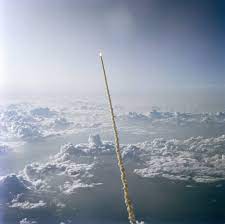
June 18, 1983: Challenger rides a thin column of solid exhaust above the clouds.
*****
It’s June 18, 1983, launch day for STS-7, and we wake at 3:13 a.m. EDT. We are the crew of this, the second flight of Challenger. The Orbiter has been turned around and readied for launch in a record 63 work days since it’s maiden flight in April. Although we are the seventh Shuttle flight, we will make a number of firsts, most prominently, 20 years after the flight of Valentina Tereshkova, the first woman in space, our crew includes America’s first, Sally Ride. Our crew, by its size, marks another record. We are the first five-person crew ever launched, thanks to Dr. Norman Thagard. A medical doctor as well as astronaut, he was added to the crew in December after some of the STS-5 crew suffered bouts of space adaptation syndrome, commonly called space sickness. Dr. Norm will gather data on our adaptation to weightlessness, making tests of the vestibular and visual responses. Our commander, Bob “Crip” Crippen, also is making history as the first person to fly twice on the Shuttle. He flew as pilot on the first Shuttle flight. He is scheduled to perform yet another first at the end of the six-day flight, landing the Shuttle at the Kennedy Space Center for the first time.
And here’s another first. We’re the first of the Thirty-Five New Guys, the TFNGs, selected in 1978, to fly. Now, TFNG could stand for a variant that replaces “Thirty Five” with another appellation for us new guys, more of a curse, The ________ing New Guys. But we’ll keep it clean!
Our primary objective mirrors STS-5, the deployment of two commercial communications satellites to be boosted to geostationary orbit by solid-fueled Payload Assist Modules (PAMs). Our busy launch day will culminate in deployment of the Canadian Anik C-2 satellite, a brother (the name means brother) of Anik C-3 launched by STS-5. On day two, we will release a nearly identical drum-shaped satellite, both built by Hughes Aircraft, for Indonesia, Palapa B-1.
Another first will occur on Flight Day 5 when we release a German truss-shaped free-flier, the Shuttle Pallet Satellite (SPAS) – 01. Built and owned by Messerschmitt-Bolkow-Blohm, it weighs 5,022 lbs. We will not only deploy the free-flying platform with the Remote Manipulator System (RMS) robot arm, but after about 7 hrs. use the RMS to retrieve the reusable satellite. In between, we were fly “prox ops” with it, proximity operations. We move the shuttle off from it and come in, performing the final stages of a rendezvous. We will do this twice, making an approach along the “V bar,” that’s the engineering symbol, a V with a dash over it, for velocity vector, the orbital path. We will back off again and make another approach, called inertial, as it uses gravity to do most of the work. The SPAS is equipped with various cameras that will photograph the Shuttle in free flight as well as carrying its own array of experiments.
All this and more is crammed into a flight of just six days.
The OAST-2 payload, sponsored Office of Space Science and Applications, is located on truss-like pallet spans the payload bay. Performing materials processing experiments, it carries two furnaces for studying crystal growth and the mixing of alloys in weightlessness that normally tend to separate. A third experiment will explore the containerless processing of glass melts.
In the middeck of the crew cabin, we’ll be the third flight to carry the McDonnell-Douglas Continuous Flow Electrophoresis System This refrigerator-size unit separates medical substances by their electrical properties and may lead to purer forms of drugs. Also located in the middeck, in a locker, the Monodisperse Latex Reactor is making its fourth and final flight. It produces nearly perfect latex beads that may have medical and industrial applications.
*
Launch of the STS-7
Launch time is set for 7:33 a.m. EDT, with very short launch windows. We can launch between 7:33 a.m and 7:38 a.m EDT. Or if we miss that opportunity, a small window is open between 8:24 a.m. and 8:26 a.m. EDT. That’s it for the day due to the constrains to deploy our communications satellites at the proper time.
We’re awakened at 3:13 a.m., four-and-a-half hours before launch. Events move fast. At about 4:40 a.m., we leave for Launch Pad 39-A. Forty minutes later, we’re entering Challenger’s cabin, taking our positions. As commander, Bob Crippen takes the left-hand cockpit seat up on the flight deck. Rick Hauck sits to his right. Centered behind them, Sally Ride will serve as flight engineer, keeping an eye on systems and keeping ready with contingency checklists should a problem occur. John Fabian is tucked in the corner to her right. And poor Dr. Thagard is relegated to the middeck where all he has to look at is a wall of lockers. Yet he can claim his own first — the first person to sit in the middeck for launch and landing. To his left, the side hatch is closed less than two hours before liftoff. By then we’ve gone through our communications checks. We wait and monitor systems. About an hour before launch, activity on the flight deck begins to pick up as we start pre-activation of systems for the Auxiliary Power Units (APUs) which provide hydraulic power to move the spaceplane’s aerosurfaces and gimbal (swivel for steering) our three Main Engines.
This will go down as the smoothest count so far in the Shuttle program. And the weather cooperates, cloud cover that had hung over the Cape at dawn moves off. Final seconds now. We have a go for APU start. Five minutes until launch. Check aerosurface profile, the elevons, body flap, speedbrake and rudder move through a programmed pattern, 3 min. 30 sec. until launch. Followed seconds latter by a gimbal check of the Main Engines. At T – minus 2 min. 15 sec., the Main Engines are locked in their start positions.
At T – minus 31 sec., we hear the go for Redundant Set Launch Sequence start. Challenger’s four primary flight computers now take command of the final seconds of the count.
“Go for Main Engine start.” At T-minus 6.6 sec. they start. We feel the Shuttle sway until the force. When it rocks back vertical, it’s T – Zero, and the big Solid Rockets ignite and instantly kick us away.
In about 7 sec., we’ve cleared the launch tower, and Challenger pirouettes on a roll to set up the proper flight path. The Shuttle is now slung underneath the big orange External Tank. Crip tells Houston, “Roll program.”
Capcom Roy Bridges replies through the roar, “Roger your roll, Challenger.”
Just 27 sec. after launch, the computers throttle back the main engines from 104 to 75 percent rated thrust as we approach Max Q, the maximum aerodynamic load on the vehicle. In less than a minute we pass through the region where those pressures conspire against us.
“Challenger, Houston. You’re go at throttle-up.”
We’re through Max Q. “Roger, go at throttle up. Nice ride,” Crip calls. The Shuttle continues to shake and rattle under the brute force of the Solid Rocket Boosters, but this is just as we expect from simulations. And the Solid Rockets expend themselves after a touch more than 2 min., flame out and are kicked away by separation rockets, giving a flash of smoke against the windows.
“We have SRB sep,” we report.
“Roger, sep.”
Quickly we receive a welcome report. “Challenger, Houston. Your first-stage performance was nominal.”
“Roger, nominal first stage.”
That’s significant. On all past flights the thrust from the solids, while within specifications, deviated just slightly above or below the perfect line. This time they hit it on the nose, tracing the plot line on the dot. Once we’re rid of the solid rockets, the ride smooths out. We’re just humming along.
Coming up on 3 min. Capcom Roy Bridges calls, “Challenger, Houston. You have two-engine TAL capability.”
Crippen replies, “Roger. Two-engine TAL” TAL means Trans-Atlantic Landing. We now can make a landing landing at Dakar, West Africa, should one engine fail. Each of these steps gives an added safety margin.
And less than a minute later, Houston calls, “Challenger, Houston. Negative return.” That means we’re too far along to attempt to turn around and power ourselves back for a landing at Kennedy, a very risky maneuver.
“Roger, negative return.”
Five minutes into the flight. Roy Bridges calls, “Challenger, Houston. Press to MECO.” That means we can reach our Main Engine Cutoff (MECO) point should an engine fail.
Crippen replies, “Roger, press. Roy, appreciate that.”
He adds, “Nice riding machine.”
Coming up on 7 min. into the flight. “Challenger, Houston. Single engine press to MECO.”
“Roger, single engine press.” Now if two engines go out, we still can limp into orbit.
Coming up on Main Engine Cutoff. Crip calls it, “MECO . . .” On time, after an ascent of 8 min. 33 sec. Right at MECO, we get an alarm. We quickly scan the readouts and conclude it’s a false signal.
A second loud sound pierces the cockpit at MECO. It isn’t an alarm, it’s John Fabian giving a war whoop of elation. We’re here!
And back to work. Ten seconds after MECO, we separate from the empty External Tank, it’s orange insulation scorched by the heat of launch. We perform an evasive maneuver taking us below and beyond it.
*
On orbit
The Capcom quickly calls, “Challenger, Houston. You’re go for nominal OMS 1, APU shutdown on time.”
“Roger that.”
OMS — that’s Orbital Maneuvering System, meaning the two engines in pods at Challenger’s rear. We’re in space but not quite in orbit. We need two burns of the twin OMS engines to step us into a circular orbit.
Ignition of the twin OMS engines. During the burn, we pass out of communications range, Crip gives one last update to Houston, “We got a nice burn going.” And just as communications fade, he adds, “Pretty view. pretty view.”
The burn of 2.5 min. is completely nominal. Crip has time to reflect on the launch, “OK, for your information, the ride was nice and smooth, maybe even smoother than I remember a little bit on the Columbia. We did notice a few fine particles coming off. I didn’t notice anything of any size.”
Sally Ride comes on mic. “Have you ever been to Disneyland?
“Affirmative.
“That was definitely an E ticket.”
“Roger that, Sally.”
An “E ticket” was the pass for the best rides in the park.
OMS 2 ignition schedule for 44 min. 30 sec. into the flight, with a burn time of 2 min. 1 sec., resulting in an orbit of 184 mi. circular.
Over Yarragadee, Australia, we give burn report. “OMS 2 was nominal, on time.”
Houston notes a few minor discrepancies such as sensors reading slightly off, that’s all
Crip asks, “Got anything else for us?”
“Negative, everything else is really kind of nominal down here.”
“That’s the way it is here and we love it.”
*
Orbit ops
At 1 hr. 18 min., come in contact with Hawaii. Capcom Bridges radios, “We have nothing for you right now. How are things going?”
Rick Hauck replies, “We’re having a good time. We’re all over the cabin, and we’re going to be ready for your go for payload bay doors whenever.”
“OK, you have a go for payload bay door opening anytime you’re ready.”
We unlatch the big clamshell doors, open the port one first, then both, 1 hr. 25 min. into the flight. And Rick reports, “Roy, the doors opened in better than advertized time . . . and looking back in the payload bay the OMS pods look clean as a whistle.”
“OK, that’s real good news.”
Indeed, it is. On Challenger’s first flight, the new thermal blankets that swaddle the OMS pods eroded from the friction of launch. We’ve got a very clean bird.
Now 1 hr. 37 min. into the flight. With the payload bay doors open, we need to close the “Pac Man” sunshields over the two communications satellites. First, the Palapa, to the rear of the Anik. “And the sunshield’s coming closed at this time,” John Fabian, working the payloads with Sally Ride, reports.
“OK, that’s super good news.”
A bit later, John Fabian reports, “OK the Anik is now closed on the sunshield. It hung up slightly on me with about 30 degrees left to close, and when it overcame that hangup, it closed completely and nominally.”
Fabian observes, “Everything else in the cargo bay looks completely clean and nominal.”
At 2 hrs., we receive a welcomed call. “Challenger, Houston. You have a go for orbit ops.
“My kind of go, Roy. Thanks a lot.”
We must configure switches for on-orbit operations, perform such things as star tracker tests.
A half hr. later we come back into contact over Yarragadee, and Crip reports, “Well, we’re just trying to get the cabin all fixed up here. Nothing very exciting happening.”
Sally adds, “He keeps saying there’s nothing exciting happening. I’m not sure I can go along with that.”
We’re off to a fast start, working ahead of the checklists at times, able to take in some of the sights You know, we’re off to a fun start. Over Africa we photograph sand dunes. On fourth orbit, lunch. “Well, we’re doing fine, had a nice lunch, taking lots of pictures and looking forward to deploying the Telesat here in a few hours.”
“Guy, in case you’re interested we just pulled out the sandwiches that were packed for us. And you’ll be happy to know that STS-7 is three turkeys and two hams,” Sally calls to the new capcom on duty, Guy Gardner.
“Roger, we suspected that all along.”
“It’s up to you to figure out who is who.”
*
Minor problems
We’re having fun, but it’s work, too. And we’re dealing with a couple of problems. One concerns a hydraulic system. We knew its accumulator, which is suppose hold pressure had a small leak. Which only means we have to run a circulation pump to boost the pressure now and then. If it doesn’t get worse, we’re fine.
And the index pins, which align the tilt tables on which the satellites sit, have not retracted because of a change in switch configurations that was missed in the checklist. Houston has a solution, send the stow sequence for the sunshields and that should pull the pins.
We’re now on our fifth orbit now. The Anik deploy is set for orbit 8, at 9 hrs. 28 min. into the flight.
We deal with the problem retracting the satellite index pins. We power up the system, and John gives the stow command for the Anik and then the Palapa. That’s all it takes. “Challenger, Houston, it looks real good there, John. Thanks a lot.
“Roger, it looks like everything is cleaned up.”
*
Anik Deployment
On orbit 6, 8 hrs. 28 min. into the flight, we begin running through the long pre-deployment sequence, a series of steps, such as thermal checks of the support equipment for the two satellites. Step by step we approach Anik deployment.
On our sixth orbit, it’s approaching time to open Anik’s Pac Man sunshield. In contact over Hawaii. Capcom Guy Gardner says, “As I’m sure you are sure, we would like for you to really keep a good eye on the sunshield when you open it and close it during the deploy.” They are worried it will hang up.
“Oh, yeah, you can bet on that.”
Later, 8 hrs. into flight go through gimbal checks and pre-deploy checks. Deploy time scheduled for precisely 9 hr. 28 min., 29 sec.
John reports, “And for the payloads folks, we’re sitting here at a little more than 53 min. until deploy. We got a good checkout of the SCA 2 and we have SCA 1 enabled, and we’re sitting now waiting for the 40 min. mark and the checklist.”
Later, coming into communications over the Indian Ocean, we report, “Everything’s cooking along real nice up here.”
We come into contact over Hawaii, at about 9 hrs. 10 min. We report, “We just put the Anik on internal power, and she’s looking real good.”
“Roger, copy.”
At this point Anik’s spin is 50 rpm. We send TV of the spinning PAM/satellite.
“And Houston, Crip reports that the sunshield bounced just a little bit as it opened up, but it never stopped its motion during the opening. . . Things are looking good onboard.”
Pass out of comm range when deploy occurs, on time, at 5:01 p.m. EDT. The spinning satellite, glinting in the sun, is spring ejected from its turntable, rising at 2 ft. per sec. straight up the tail. We’re able to watch it for several minutes.
When we come back in comm at Santiago, Chile, we’re just coming off our separation burn. “OK, Houston, as previously advertised, we really do deliver. And it was deployed on time . . . Guess that makes the Orbiter three for three on PAM.” That’s the two utilized on STS-5 and our first one.
Later, after we learn the first PAM firing went well, we tell Capcom Guy Gardner, “Guy, if you could ask the Anik people to save some of their champagne for us until we get back, we would appreciate it.”
*
Four for four
We eat and prepare for sleep. Gardner, going off duty, calls, “Have a good sleep. We’ll see you tomorrow.”
“Guy, you think it was a great day for you, you should have been up here.”
“I wish.”
The next day we will repeat the process again, this time for Palapa. And after another perfect deployment, we will be able to update the scorecard for PAM satellite deployments: “And that’s four for four.”
 tlitiptree