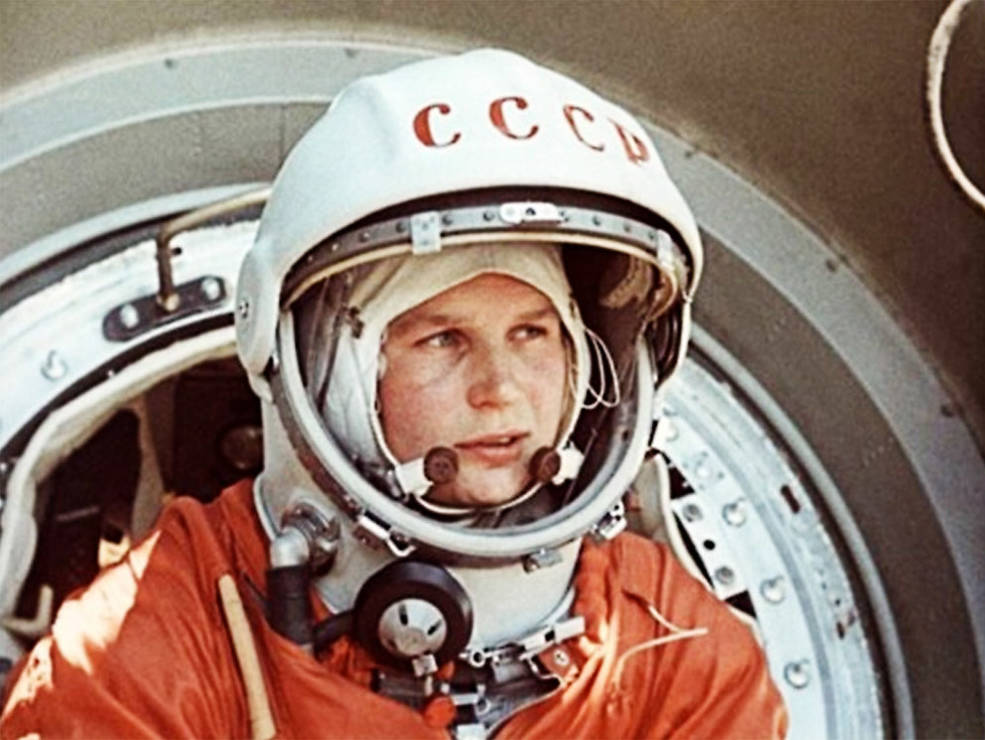
Valentina Tereshkova aboard Vostok 6 became the first woman in space on June 16, 1963.
*****
When would a second launch occur? Valery Bykovsky, in orbit aboard Vostok 5 on June 14, 1963, surely would be joined by a second Vostok most certainly carrying a woman. Likely the launch would occur the next day, as with the joint flight of Vostoks 3 & 4 in 1962. Surely the launch would be timed, as on the first group flight, so that the orbital tracks of the two spaceships traced each other in close proximity, the assumed first step toward a rendezvous.
On June 15, Bykovsky continued his flight program which included photography of the earth, its horizon and the sun. He assumed manual orientation of Vostok’s attitude for an orbit. On his 18th pass, he released his restraining straps and floated free in the tight cabin. Yet by day’s end, a Vostok 6 had not been launched. Bykovsky spends a second night in orbit, still alone.
As he approaches the end of his 31st orbit the next day, June 16, at 12:30 p.m. in Moscow, 5:30 a.m. in Washington, D.C., that changes. At that moment, 12:29:52 Moscow time to be precise, the first woman in space, Valentina Tereshkova, a 26-year-old sky-diving enthusiast, not a pilot but a textile worker in a clothing factory, lifts off aboard Vostok 6 and rides the thunder into orbit.
The two launches are out of sync for a rendezvous attempt. Their orbital inclination — think of it as their ground tracks — are 30 degrees apart, not matched as on Vostoks 3 & 4. That means they only cross paths twice every orbit, and they cannot rendezvous. However, shortly after Tereshkova achieves orbit, the two passed 3 mi. from each other, a record of sorts. The Soviets can claim the passed closer to each other than the previous group flight. Vostoks 3 & 4 only came about 4 mi. from each other.
Her call sign is “Seagull” — his is “Hawk.” They chat over the radio. He calls her his “space sister.” They send a joint statement to Soviet Premier Khrushchev: “We are a close distance from each other. All systems in the ships are working excellently. Feeling well.”
Tereshkova may not being feeling so well at first. Later reports indicate that she suffered from space motion sickness for the first few orbits. Not publicly known at the time, State Commission overseeing the flight considers ending it early, but she insisted she can continue the mission. And continued to perform her most important function: propaganda.
In TV transmissions, she says she is feeling fine, laughs. Khrushchev radios to her, “Now you see what women are capable of.”
The Soviet leader tells her, “I am very glad and feel a fatherly pride that it is our girl, a girl from the land of the Soviet, who is the first in space . . . It is a triumph of Leninist ideas. It is a triumph of the struggle of our people, and we are proud of you.”
Her flight more than achieves its propaganda objectives. The next day, a three-deck banner headline in The New York Times reads:
SOVIET ORBIT WOMAN ASTRONAUT
NEAR BYKOVSKY FOR DUAL FLIGHT;
THEY TALK BY RADIO, ARE PUT ON TV
Tereshkova will fly at least one day, maybe more if all goes well, the Soviets announce. After her 7th orbit, at 10 p.m. Moscow time, she begins her sleep period.
Western observers, still convinced there is more to the two flights than passively crossing each other’s orbit, still wonder if the flights will test rendezvous techniques. You might say they are obsessed with rendezvous. And the Russians are happy to let them deceive themselves.
 tlitiptree