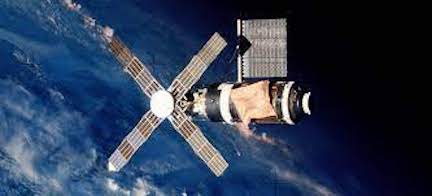
Skylab repairs complete: With its three-panel solar wing fully extended after a spacewalk by the first crew, a full scientific program could begin.
*****
It’s June 10, 1973, and full steam ahead for the three of us, the crew of Skylab II. Although steam perhaps isn’t the proper metaphor. With temperatures stabilizing at 73 degrees (F), the cavernous Orbital Workshop no longer feels like the engine room of a battleship. We no longer sleep in the cooler Multiple Docking Adapter. We’re able to push a full load of work. Yesterday, we conducted our longest runs with the Earth Resources Experiment Package, observing the ground with a suite eight cameras and radiation sensors on a 7,800-mi. sweep, gathering data for a wide range of applications such as monitoring as the status of agricultural crops. “We ought to be big in Nebraska this year, ” we joke.
We are Pete Conrad, Paul Weitz, and Dr. Joe Kerwin. And we’re humming along now on full power. Only 4-5 days ago, we weren’t certain we’d be able to undertake our full scientific program. With one of the big solar power wings ripped off on launch, we needed the power from the second wing pinned to the side of the Workshop. That meant a spacewalk.
*
This is not going to be an easy EVA. Skylab wasn’t designed for exterior repair work. The station was designed only to accommodate spacewalks up to the Apollo Telescope Mount to change film canisters. We’re going to an area, the side of the large cylindrical Workshop, not set up to be spacewalk-friendly with handrails. And we’re going to be working with a sharp cutter like pruning shears. Not to mention working close to the the sharp strip of metal holding the wing down. We’re going to have to be careful all the way.
The spacewalk could take up to four hours. We practice everything inside the big upper level of the Workshop on June 6, the day before the spacewalk, talked through it by backup Skylab commander Rusty Schweickart, who’d practiced the tasks in the neutral buoyancy water tank. After we practice, we tell him, “I guess we’ll know better when we see it, but our initial impression is that we’ve got a 50-50 chance of pulling it off. Even if we don’t, we’ll have a fine reconnaissance for you and some real good words on techniques and possibilities for another try later on.”
Schweickart replies, “That’s just the way we figured it, except we’ll give you a higher probability.”
June 7, the 14th day of the flight, marks our D-Day. Shortly after 7 a.m. EDT, we begin preparing. We’ve already gone over the improvised equipment we’ll need — the shears-like cable cutter, vice grips, pry bar, and five segments for a long pole. At the 11:17 a.m. EDT, two of us, Pete Conrad and Joe Kerwin, who will make the walk, are in the airlock and begin depressurizing it. Six minutes later, we exit its Gemini-style hatch nested below a skirt topping the Workshop. We’re on the nightside of orbit, and in floodlights at the skirt, we assemble the five rods into a 25-ft long pole and afix the cable cutter at one end.
Over Australia, during our brief communications passes, we report to Houston “OK, we have the five poles rigged swinging on the hook. And we’re intrepidly peering around out here deciding how far Joe can get in the dark.” We’ll be on our own, out of communications range, for most of the walk.
Our oxygen, cooling water and power are carried not in backpacks but through long, thick umbilical lines. Joe plays them out from a bag to their full lengths. As Pete will range the furthest, his is 55 ft. long. Joe’s is 35 ft.
Joe makes his way around the rim of the skirt and attaches the back end of long pole to a strut for the telescope mount. He swings its front, with the cutter, toward the stuck solar wing which fans slightly from the side of the Workshop. A rope lanyard runs the length of the pole, and he will pull it to close the jaws of the cutter. Unable to see in the darkness, we wait for daylight. Over Guam, it arrives.
We struggle with the damn long pole. With no foot restraints or other aids, it’s like those early Gemini spacewalks that were such a struggle. Joe can’t hold a firm position. He’s got one hand holding the pole to steady himself while the other holds the lanyard. He struggles a half hour, his heart rate souring. Yep, just like Gemini.
Finally he shortens up on umbilical by doubling a section to provide some support. And maneuvers the jaws onto that stubborn strip of metal holding the wing. Pete uses the pole as a handrail and pulls himself hand over hand to the stuck wing. He hooks a tether that will be needed later into a vent hole on the wing’s wide boom. And he makes sure the cutter’s blades are tight against the metal strap.
He moves back and holds the pole steady as Joe tugs the lanyard. And still the band of metal will not break. “Man, am I pulling it.”
Pete shimmies down the pole again to inspect the cutter blades. Just as he reaches it, the blades cut through, and the strap flies apart. The long boom begins to swing out, sending Pete cartwheeling away — secured by his umbilical, of course. He ropes himself back toward the station and pulls himself back to Joe. He can turns to look at the boom, with its three accordion-folded solar panels tucked inside. The boom had stopped 20 degrees out, which was anticipated, the deployment actuator frozen up. And that’s what the tether he hooked to the boom is to remedy. Attaching the tether to a strut on the station, we pull on it, trying to break free the boom. And it’s no go. As stubborn as can be
So Pete clambers back down to the booms hinge line. Bracing his feet there, he lifts the tether/rope over his shoulder. Then stands up against the station’s hull. That snaps the actuator bracket, allowing the boom to swing to its 90-degree position perpendicular to the body of the Workshop. . And sends ‘ol Pete away like an arrow shot from a bow. He later tells Houston, “I was facing away from it, heaving with all might might, and Joe was heaving with all his might, when it let go, and we both took off. By the time we got steeled down, those panels were out as far as they were going to go at this time.”
The hydraulics on the panels had frozen. Within hours the sun warmed them and the panels extended fully. In the meantime, we ended our EVA after 3 hr. 25 min.
The wing generates nearly 7 kW of power. The four Apollo Telescope Mount arrays we’d used as our main source of power until then produce 4.6 kW, but 3.6 kW had been needed just to maintain the station, leaving only 1 kW for experiments. We had saved power wherever we could, turning lights off behind us as we moved. This one wing is enough for us to ramp up the science load.
And the day after the spacewalk, June 8, we set a new U.S. endurance record, eclipsing the 13 days, 18 hr. and 35 min. of Gemini 7 in December 1965. Yet we have far further to go, a complete mission lasting 28 days.
 tlitiptree